

IEC | INDONESIA EXPORT CENTER
CONNECTING INDONESIAN PRODUCTS TO THE WORLD
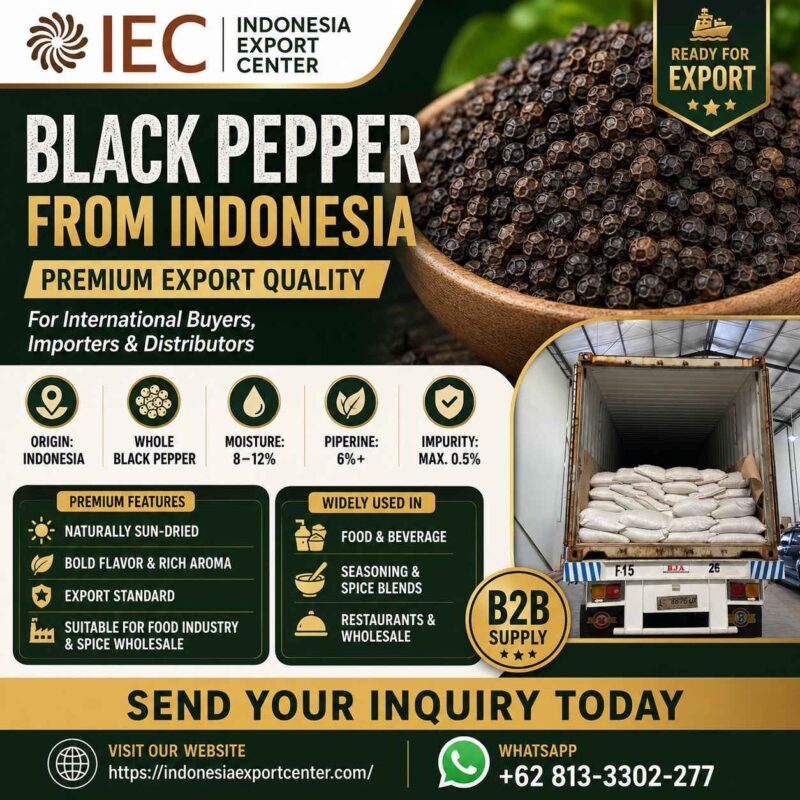
BLACK PEPPER FROM INDONESIA
PREMIUM EXPORT QUALITY
A PRACTICAL IMPORT GUIDE FOR FIRST-TIME BUYERS
RFQ | SUPPLIER VERIFICATION | PRODUCT SAMPLES | QUALITY INSPECTION | IMPORT DOCUMENTS | INCOTERMS | INTERNATIONAL SHIPPING
For International Importers, Spice Distributors, Food Manufacturers & Wholesale Buyers
Import Black Pepper from Indonesia with a Clear Sourcing Process
Are you planning to import black pepper from Indonesia for your spice distribution business, food manufacturing operation, or wholesale supply chain?
Indonesia is an established origin for black pepper, offering sourcing opportunities for international buyers seeking whole peppercorns for commercial applications.
However, importing agricultural products requires careful preparation.
First-time importers must understand product specifications, supplier verification, quotations, sample approval, inspection procedures, export documentation, import regulations, international shipping terms, and payment arrangements.
A successful import transaction is not simply about finding the lowest price per metric ton.
It requires purchasing the correct product, from a verified supplier, under clearly defined quality and commercial conditions.
IEC | Indonesia Export Center facilitates Indonesian product sourcing and export enquiries for international B2B buyers.
This guide explains the main steps involved in importing Indonesian black pepper, from preparing your first Request for Quotation (RFQ) to receiving and inspecting your shipment.
Start Your Indonesian Black Pepper Import Enquiry
Share your required quantity, specifications, destination country, destination port, and preferred Incoterm.
REQUEST A BLACK PEPPER QUOTE VIA WHATSAPP
WhatsApp: +62 813-3302-277
Website: https://indonesiaexportcenter.com/
Quick Overview: How to Import Black Pepper from Indonesia
The process generally involves the following stages:
| Step | Import Activity | Main Objective |
|---|---|---|
| 1 | Define Product Requirements | Identify the correct black pepper specification |
| 2 | Check Import Regulations | Confirm destination-market requirements |
| 3 | Identify Potential Suppliers | Find suitable Indonesian sourcing options |
| 4 | Verify Supplier Information | Reduce commercial and quality risks |
| 5 | Submit an RFQ | Obtain a detailed quotation |
| 6 | Request Samples | Evaluate product suitability |
| 7 | Review Laboratory Documentation | Assess quality and food safety |
| 8 | Agree on Inspection | Establish shipment acceptance procedures |
| 9 | Select Incoterms | Allocate transport costs and responsibilities |
| 10 | Confirm Payment Terms | Manage financial risk |
| 11 | Finalize the Contract | Document specifications and obligations |
| 12 | Arrange Export Shipment | Prepare goods and documentation |
| 13 | Complete Import Clearance | Meet destination-country requirements |
| 14 | Inspect the Received Goods | Confirm shipment condition and conformity |
The exact sequence may vary depending on the supplier, destination country, and transaction structure.
Step 1: Define Your Black Pepper Import Requirements
Before contacting suppliers, establish the type of black pepper your business needs.
A clear product specification makes quotations easier to compare and reduces misunderstandings.
Basic Product Information
| Specification | Reference Information |
|---|---|
| Product | Whole Black Pepper |
| Botanical Name | Piper nigrum L. |
| Origin | Indonesia |
| Reference Moisture | 8–12% |
| Reference Piperine | 6%+ |
| Reference Impurity | Maximum 0.5% |
| Product Form | Whole Dried Peppercorns |
| Bulk Density | Buyer-Specified |
| Peppercorn Size | Buyer-Specified |
| Foreign Matter | Buyer-Specified |
| Microbiological Requirements | Buyer and Market-Specific |
| Packaging | To Be Agreed |
| Order Quantity | Buyer-Specified |
Important: The moisture, piperine, and impurity values above are supplied reference specifications. They are not independently verified results for a particular available lot.
Buyers should establish contractual acceptance limits and testing methods before purchase.
Other Requirements to Consider
- Intended application
- Required grade
- Bulk density
- Cleanliness
- Aroma
- Pungency
- Packaging
- Food safety standards
- Laboratory testing
- Traceability
- Shipment quantity
- Delivery schedule
Step 2: Check Import Requirements in Your Country
Before purchasing black pepper, confirm the legal and regulatory requirements in your destination market.
Import requirements vary by country and may depend on product form, processing method, intended use, and applicable trade arrangements.
Key Import Checks
Importer Registration
Confirm whether your business requires registration, licensing, or an importer identification number.
Product Classification
Determine the correct customs classification for the actual product.
Food Safety Requirements
Review applicable microbiological criteria, contaminant limits, and food safety rules.
Plant Health Requirements
Check whether a phytosanitary certificate or other plant health documentation is required.
Pesticide Residues
Confirm the applicable maximum residue limits.
Mycotoxins and Heavy Metals
Review relevant limits and testing requirements.
Labeling
Determine whether bulk or retail packaging must carry specific information.
Tariffs and Taxes
Confirm applicable import duties, taxes, and any preferential tariff conditions.
Border Inspection
Determine whether the shipment may be subject to inspection, sampling, or testing.
Important
Do not assume that a document accepted in one destination country will automatically satisfy another country’s requirements.
Consult the relevant customs authority, food safety regulator, plant health authority, or qualified customs broker.
Step 3: Identify Potential Indonesian Black Pepper Suppliers
After defining your product and import requirements, identify suppliers capable of meeting them.
Potential sourcing channels may include producers, processors, exporters, trading companies, and sourcing facilitators.
Information to Request
- Legal company name
- Business registration information
- Business address
- Supplier role
- Product origin
- Processing or packing location
- Available product grades
- Quality specifications
- Food safety controls
- Available certifications
- Export experience
- Traceability information
- Commercial contact details
Understand the Supplier’s Role
The company supplying the quotation may not be the grower, processor, packing operator, or exporter of record.
Clarify which parties are responsible for each activity.
IEC facilitates sourcing and export enquiries and does not automatically act as the manufacturer, contractual seller, or exporter of record.
Step 4: Verify the Supplier Before Making a Payment
Supplier verification is an important part of international procurement.
Recommended Verification Checklist
- Confirm the supplier’s legal identity.
- Review business registration information.
- Verify the business address.
- Identify the actual processing or packing facility.
- Request product specifications.
- Review available laboratory documentation.
- Check relevant certifications.
- Request traceability information.
- Confirm the contractual seller.
- Verify the beneficiary’s bank account details through an independently confirmed communication channel.
- Clarify export responsibilities.
- Consider independent inspection where appropriate.
Warning Signs to Investigate
- Unverifiable company information
- Unclear product specifications
- Refusal to identify the contractual seller
- Inconsistent documents
- Unsupported certification claims
- Pressure to make immediate payment
- Unexpected changes to bank details
- Unclear inspection or complaint procedures
No single verification step eliminates all transaction risks.
Step 5: Prepare a Request for Quotation (RFQ)
A detailed RFQ helps suppliers understand your requirements and prepare comparable offers.
Information to Include
| RFQ Item | Buyer Information |
|---|---|
| Product | Whole Black Pepper |
| Origin | Indonesia |
| Grade | [Specify] |
| Moisture | [Specify Maximum] |
| Piperine | [Specify] |
| Impurity | [Specify] |
| Bulk Density | [Specify] |
| Quantity | [MT] |
| Packaging | [Specify] |
| Destination Country | [Specify] |
| Destination Port | [Specify] |
| Preferred Incoterm | [Specify] |
| Target Shipment Date | [Specify] |
| Required Documents | [Specify] |
| Inspection Requirements | [Specify] |
What to Request in the Quotation
- Product description
- Technical specifications
- Quantity
- Unit price
- Currency
- Incoterm and named place
- Packaging
- MOQ
- Production or preparation lead time
- Shipment schedule
- Payment terms
- Quality documentation
- Inspection arrangements
- Quotation validity
Important
Compare quotations on the same specification and Incoterm basis.
A lower product price does not necessarily mean a lower total import cost.
Step 6: Understand Indonesian Black Pepper Grades
Black pepper may be offered under different commercial grading systems.
Buyers should define grades through measurable specifications rather than relying only on marketing descriptions.
Common Specification Parameters
Bulk Density
Often expressed in grams per litre (g/L).
Moisture
An important parameter for dried spice handling and storage.
Impurity
Defines the permitted amount of specified unwanted material.
Piperine
A pungency-related analytical parameter.
Peppercorn Size
May be relevant to certain applications.
Microbiological Quality
Must be evaluated according to the intended use and destination-market requirements.
Example Buyer Grade Comparison
| Parameter | Grade A | Grade B |
|---|---|---|
| Bulk Density | [Specify] | [Specify] |
| Moisture | [Specify] | [Specify] |
| Impurity | [Specify] | [Specify] |
| Piperine | [Specify] | [Specify] |
| Peppercorn Size | [Specify] | [Specify] |
| Microbiological Criteria | [Specify] | [Specify] |
Grades should be supported by actual specifications and representative test results.
Step 7: Request and Evaluate Black Pepper Samples
Before committing to a commercial order, request representative samples where available.
Sample Evaluation Checklist
- Product appearance
- Aroma
- Moisture
- Cleanliness
- Foreign matter
- Bulk density
- Peppercorn size
- Piperine
- Microbiological quality
- Chemical contaminants, where relevant
Recommended Sample Approval Process
- Define the sample specification.
- Agree on sample quantity and shipping arrangements.
- Identify the sample source and lot.
- Conduct visual inspection.
- Perform relevant laboratory tests.
- Conduct application trials if necessary.
- Document the results.
- Establish the approved reference specification.
Important
A sample may not represent every characteristic of a later commercial shipment.
The contract should define how shipment lots will be evaluated against the approved specification.
Step 8: Review Quality and Laboratory Documentation
Black pepper is a food ingredient, and importers should assess relevant quality and food safety hazards.
Potential Laboratory Parameters
| Parameter | Purpose |
|---|---|
| Moisture | Quality and storage assessment |
| Piperine | Pungency-related specification |
| Impurity | Cleanliness |
| Bulk Density | Grade characterization |
| Foreign Matter | Physical quality |
| Salmonella spp. | Food safety |
| Other Microbiological Parameters | Risk-Based |
| Pesticide Residues | Regulatory compliance |
| Aflatoxins | Relevant contaminant assessment |
| Ochratoxin A | Where relevant |
| Heavy Metals | Applicable requirements |
Certificate of Analysis
A lot-specific Certificate of Analysis may contain:
- Supplier identification
- Product description
- Lot number
- Sample identification
- Test parameters
- Actual results
- Analytical methods
- Laboratory details
- Test date
Important
A COA is supporting documentation, not a guarantee that the entire lot is free from every hazard.
Step 9: Arrange Pre-Shipment Inspection
Pre-shipment inspection can help verify selected contractual requirements before the goods leave Indonesia.
Possible Inspection Activities
- Verify product identity.
- Confirm shipment quantity.
- Inspect packaging.
- Check markings and lot numbers.
- Review available documentation.
- Conduct representative sampling.
- Assess agreed quality parameters.
- Observe loading where contracted.
Define the Inspection Scope
The buyer and seller should agree on:
- Inspection company or responsible party.
- Inspection location.
- Inspection timing.
- Sampling procedures.
- Acceptance criteria.
- Laboratory methods.
- Responsibility for inspection costs.
- Procedures for failed inspection.
Important
An inspection report provides evidence within its defined scope. It does not guarantee that every unit in the shipment is defect-free.
Step 10: Understand Incoterms for Black Pepper Imports
Incoterms are internationally recognized trade rules that help define delivery responsibilities, costs, and risk transfer between buyer and seller.
They do not independently determine ownership, payment obligations, or product quality requirements.
The contract should specify the selected rule, named place or port, and applicable Incoterms edition.
Common Incoterms to Consider
| Incoterm | General Commercial Meaning |
|---|---|
| FCA | Seller delivers to the carrier or another nominated party at the named place |
| FOB | Seller delivers goods on board the vessel at the named port of shipment |
| CFR | Seller pays freight to the named destination port; risk transfers when goods are on board at shipment |
| CIF | Similar to CFR, with seller-provided cargo insurance meeting the rule’s requirements |
| CIP | Seller pays carriage and insurance to the named destination; risk transfers when goods are delivered to the carrier |
| DAP | Seller delivers to the named destination, ready for unloading, without import clearance |
Choosing the Right Incoterm
FCA
May be suitable for containerized cargo where delivery to a carrier or terminal is agreed.
FOB
Applies to sea or inland waterway transport. It may be less suitable for certain container shipments delivered to a terminal before loading.
CFR
May suit buyers who want the seller to arrange ocean freight while recognizing that risk transfers at the shipment port.
CIF
May suit certain sea freight transactions where seller-arranged insurance is required.
CIP
May suit multimodal transport where the seller arranges carriage and insurance.
Important
Always confirm the named place or port and the actual risk-transfer point.
For example, CIF does not mean the seller carries all transit risk until the goods arrive.
Step 11: Calculate the Total Landed Cost
The total landed cost is more than the product’s quoted price.
Potential Cost Components
- Product value
- Origin-side charges not included in the quotation
- Export inspection
- Laboratory testing
- Freight
- Cargo insurance
- Destination terminal charges
- Customs brokerage
- Import duties
- Import taxes
- Regulatory inspection
- Inland transportation
- Warehousing
- Other applicable charges
Basic Landed Cost Formula
Estimated Landed Cost = Product Cost + Applicable Freight + Insurance + Import Duties + Taxes + Clearance Charges + Other Relevant Costs
Avoid double-counting charges already included in the selected Incoterm quotation.
Illustrative Cost Worksheet
| Cost Component | Estimated Amount |
|---|---|
| Product Value | [Currency / Amount] |
| Origin Charges | [Amount] |
| Inspection and Testing | [Amount] |
| Freight | [Amount] |
| Insurance | [Amount] |
| Import Duty | [Amount] |
| Taxes | [Amount] |
| Customs Clearance | [Amount] |
| Destination Handling | [Amount] |
| Inland Transport | [Amount] |
| Other Costs | [Amount] |
| Estimated Total Landed Cost | [Calculate] |
Use actual quotations and destination-country tariff rules for the final calculation.
Step 12: Confirm Payment Terms
Payment arrangements should be agreed before production or shipment.
Common Commercial Options
Bank Transfer
May involve an advance payment, balance payment, or another agreed schedule.
Letter of Credit
May provide a documentary payment mechanism under agreed banking terms.
Documentary Collection
May be considered in some transactions, subject to the parties’ risk assessment.
Payment Risk Management
- Verify beneficiary details.
- Confirm the contractual seller.
- Document payment milestones.
- Agree on inspection conditions.
- Review documentary requirements.
- Clarify procedures for discrepancies.
- Consult a qualified trade finance professional when appropriate.
Important
No payment method completely eliminates commercial risk.
The appropriate structure depends on the transaction and the parties involved.
Step 13: Finalize the Purchase Contract
A written contract helps reduce misunderstandings.
Recommended Contract Terms
- Buyer and seller identities
- Product description
- Country of origin
- Grade
- Quality specifications
- Quantity and tolerance
- Packaging
- Price and currency
- Incoterm and named place
- Shipment schedule
- Payment terms
- Inspection procedures
- Sampling methods
- Acceptance criteria
- Required documents
- Claims procedures
- Dispute resolution provisions
Important
Product specifications should be attached to or incorporated into the contract.
Where necessary, obtain professional legal advice.
Step 14: Prepare Export and Shipping Documents
The actual document requirements depend on the destination country and transaction.
Common Documents to Discuss
| Document | Typical Purpose |
|---|---|
| Commercial Invoice | Commercial transaction details |
| Packing List | Packaging and shipment details |
| Bill of Lading or Transport Document | Transport record |
| Certificate of Origin | Origin documentation where required |
| Phytosanitary Certificate | Plant health documentation where required |
| Certificate of Analysis | Product testing information |
| Inspection Certificate | Inspection evidence where contracted |
| Insurance Document | Coverage evidence where applicable |
| Other Import Documents | Destination-specific requirements |
Important
Not every document is required for every shipment.
Confirm current requirements with the importer, customs broker, and relevant authorities.
Step 15: Arrange Packaging and Container Loading
Packaging should protect the product during transportation and storage.
Packaging Considerations
- Food-compatible materials
- Appropriate liners
- Moisture protection
- Packaging integrity
- Net weight
- Lot identification
- Product markings
- Palletization, where required
Container Loading Considerations
- Container cleanliness
- Container condition
- Moisture exposure
- Cargo securing
- Packaging protection
- Shipment identification
- Loading records
Important
Actual packaging options, bag weights, container loading quantities, and shipment arrangements must be confirmed with the supplier and logistics providers.
Step 16: Complete Import Customs Clearance
When the shipment arrives, the importer or appointed customs broker must complete the applicable import procedures.
Typical Activities
- Receive shipping documents.
- Submit customs declarations.
- Provide required permits or certificates.
- Complete relevant regulatory checks.
- Pay applicable duties and taxes.
- Respond to inspection or sampling requests.
- Obtain customs release.
- Arrange final delivery.
Important
The exact process depends on the importing country.
Some shipments may require additional food safety or plant health procedures.
Step 17: Inspect the Shipment After Arrival
Receiving inspection helps verify the shipment against the purchase contract.
Recommended Receiving Checklist
- Confirm shipment identity.
- Check quantity.
- Inspect packaging condition.
- Verify lot numbers.
- Review documents.
- Check for visible damage.
- Conduct agreed sampling.
- Perform required laboratory testing.
- Record discrepancies.
- Follow the agreed acceptance procedure.
If Problems Are Found
Document the issue promptly and follow the contract’s notification and claims requirements.
Do not assume that a pre-shipment inspection eliminates the need for receiving inspection.
Common Mistakes When Importing Black Pepper
Mistake 1: Buying Without a Technical Specification
A product description such as “premium black pepper” is not enough for industrial procurement.
Better approach: Define measurable quality criteria.
Mistake 2: Comparing Prices Without Comparing Incoterms
A quoted FOB price and a quoted CIF price include different obligations.
Better approach: Compare total landed costs.
Mistake 3: Skipping Supplier Verification
Unverified supplier information can increase commercial risk.
Better approach: Conduct appropriate due diligence.
Mistake 4: Approving Samples Without Shipment Acceptance Criteria
A good sample does not automatically guarantee an equivalent commercial lot.
Better approach: Agree on testing and acceptance procedures.
Mistake 5: Ignoring Import Regulations
Requirements vary by destination country.
Better approach: Confirm regulations before purchasing.
Mistake 6: Assuming Cleaning Means Sterilization
Cleaning and sorting do not reliably eliminate microbiological hazards.
Better approach: Establish appropriate food safety requirements.
Mistake 7: Leaving Inspection Responsibilities Unclear
Unclear inspection terms can lead to disputes.
Better approach: Define scope, timing, costs, and acceptance criteria.
Mistake 8: Making Payments Without Verifying Bank Details
Unexpected changes to payment instructions may create fraud risk.
Better approach: Verify bank details through an independently confirmed channel.
Black Pepper Import Checklist
Use this checklist before confirming your order.
-
Define the product form.
-
Establish technical specifications.
-
Confirm destination-market import requirements.
-
Verify supplier identity.
-
Identify the contractual seller.
-
Request a detailed RFQ response.
-
Compare quotations on the same basis.
-
Request representative samples.
-
Review laboratory documentation.
-
Confirm food safety requirements.
-
Agree on inspection procedures.
-
Select the Incoterm and named place.
-
Calculate estimated landed cost.
-
Verify payment details.
-
Finalize the purchase contract.
-
Confirm packaging.
-
Verify shipping documents.
-
Arrange customs clearance.
-
Plan receiving inspection.
Ready-to-Send RFQ – Import Black Pepper from Indonesia
Subject: RFQ – Import of Indonesian Whole Black Pepper
Dear IEC | Indonesia Export Center Team,
We are interested in importing Indonesian black pepper for our business.
Please advise whether suitable Indonesian suppliers are available and provide information regarding product specifications, quality documentation, pricing, packaging, and export arrangements.
BUYER INFORMATION
Company Name: [Company Name]
Country: [Country]
Business Type: [Importer / Distributor / Food Manufacturer / Wholesaler]
Contact Person: [Name]
Email: [Email]
WhatsApp: [Number]
PRODUCT REQUIREMENTS
Product: Whole Black Pepper
Origin: Indonesia
Required Grade: [Specify]
Required Quantity: [MT]
Intended Application: [Specify]
TECHNICAL SPECIFICATIONS
| Parameter | Requirement |
|---|---|
| Moisture | [Specify] |
| Piperine | [Specify] |
| Impurity | [Specify] |
| Bulk Density | [Specify] |
| Peppercorn Size | [Specify] |
| Foreign Matter | [Specify] |
| Salmonella | [Specify Criterion and Method] |
| Other Microbiological Parameters | [Specify] |
| Pesticide Residues | Applicable Market Requirements |
| Mycotoxins | Applicable Market Requirements |
| Heavy Metals | Applicable Market Requirements |
| Lot Identification | Required |
| COA | [Required / If Available] |
PACKAGING AND SHIPPING
Preferred Packaging: [Specify]
Destination Country: [Country]
Destination Port: [Port]
Preferred Incoterm: [FCA / FOB / CFR / CIF / CIP / Other]
Target Shipment Period: [Month / Year]
DOCUMENTATION REQUESTED
Please advise whether the following can be provided:
- Supplier company information.
- Product technical specification.
- Representative samples.
- Lot-specific COA.
- Relevant laboratory test reports.
- Traceability information.
- Available food safety certifications.
- Packaging specifications.
- Inspection arrangements.
- Relevant export documents.
COMMERCIAL INFORMATION REQUESTED
Please confirm:
- Product availability.
- Available grades.
- Minimum order quantity.
- Available quantity.
- Price per metric ton.
- Incoterm and named place.
- Sample arrangements.
- Payment terms.
- Inspection options.
- Shipment lead time.
- Packaging details.
- Quotation validity.
Thank you. We look forward to your response.
Kind regards,
[Your Name] [Company Name] [Country]SEND YOUR BLACK PEPPER IMPORT RFQ VIA WHATSAPP
Frequently Asked Questions About Importing Black Pepper from Indonesia
1. How do I import black pepper from Indonesia?
Start by defining your product requirements, checking import regulations, verifying suppliers, requesting quotations and samples, agreeing on quality and shipping terms, and arranging customs clearance.
2. Can first-time importers contact IEC?
Yes. IEC welcomes sourcing and export enquiries from first-time international buyers.
3. What type of black pepper is included in the reference specification?
Whole dried black pepper from Indonesia.
4. What is the minimum order quantity?
No fixed MOQ has been independently verified. It must be confirmed with the proposed supplier.
5. Can I request black pepper samples?
Samples may be requested, subject to supplier availability and agreed arrangements.
6. What is the reference moisture specification?
8–12%. The contractual maximum and actual lot result must be confirmed.
7. What is the reference piperine specification?
6%+, subject to laboratory verification.
8. Can I request a Certificate of Analysis?
A lot-specific COA may be requested, subject to supplier and laboratory availability.
9. Is a phytosanitary certificate always required?
No. Requirements depend on the destination country and product classification.
10. Which Incoterm should I use?
The appropriate Incoterm depends on your transport arrangement, logistics capabilities, and agreed responsibilities.
11. Does CIF mean the seller carries all risk until arrival?
No. Under CIF, risk generally transfers when the goods are on board the vessel at the shipment port, even though the seller pays freight and provides the required insurance.
12. Should I arrange pre-shipment inspection?
Independent inspection may be useful, depending on the transaction value, supplier relationship, and risk assessment.
13. Can I import black pepper for food manufacturing?
Yes, subject to the product meeting the relevant technical, food safety, and import requirements.
14. Does cleaning eliminate Salmonella?
No. Cleaning is not equivalent to a validated microbial reduction process.
15. How do I calculate landed cost?
Include the applicable product cost, freight, insurance, duties, taxes, clearance, and other relevant charges without double-counting costs included in the quotation.
16. What payment method should I use?
Choose payment terms based on your risk assessment and obtain appropriate trade finance advice when needed.
17. Can IEC guarantee import clearance?
No. Import clearance depends on the actual shipment, documentation, and destination-country requirements.
18. Can I request recurring black pepper supply?
Yes. Recurring supply enquiries may be submitted, subject to supplier capacity and commercial agreement.
Start Importing Indonesian Black Pepper
Importing black pepper from Indonesia requires careful coordination between the buyer, supplier, logistics providers, and relevant authorities.
A clear purchasing process can help reduce avoidable misunderstandings and support better quality and commercial decisions.
IEC | Indonesia Export Center welcomes enquiries from international importers, spice distributors, wholesalers, and food manufacturers interested in Indonesian black pepper.
Black Pepper Import Enquiry Summary
| Parameter | Details |
|---|---|
| Product | Whole Black Pepper |
| Origin | Indonesia |
| Reference Moisture | 8–12% |
| Reference Piperine | 6%+ |
| Reference Impurity | Maximum 0.5% |
| Product Grade | Buyer-Specified |
| Bulk Density | Buyer-Specified |
| Quantity | Buyer-Specified |
| Quality Documentation | To Be Requested |
| Inspection | Subject to Agreement |
| Packaging | To Be Confirmed |
| Incoterm | To Be Agreed |
| Import Requirements | Destination-Specific |
| MOQ | To Be Confirmed |
| Export Price | Request Quotation |
| Destination | Global |
IEC | INDONESIA EXPORT CENTER
CONNECTING INDONESIAN PRODUCTS TO THE WORLD
INDONESIAN BLACK PEPPER FOR INTERNATIONAL IMPORTERS
WHOLE BLACK PEPPERCORNS | BULK SOURCING | EXPORT ENQUIRIES
SEND YOUR BLACK PEPPER IMPORT INQUIRY TODAY
WhatsApp: +62 813-3302-277
Website: https://indonesiaexportcenter.com/
Contact us for specifications, supplier enquiries, samples, bulk quotations, inspection requirements, shipping terms, and export inquiries.
Important Disclaimer: This guide provides general information about importing black pepper from Indonesia. It is not legal, customs, regulatory, or trade finance advice. Actual product availability, supplier capabilities, laboratory results, certifications, prices, MOQ, and shipment arrangements must be verified for each transaction. Import requirements and documentation vary by destination market and may change. IEC facilitates sourcing and export enquiries; the contractual seller, exporter of record, and importer must be identified before shipment.
