

IEC | INDONESIA EXPORT CENTER
CONNECTING INDONESIAN PRODUCTS TO THE WORLD
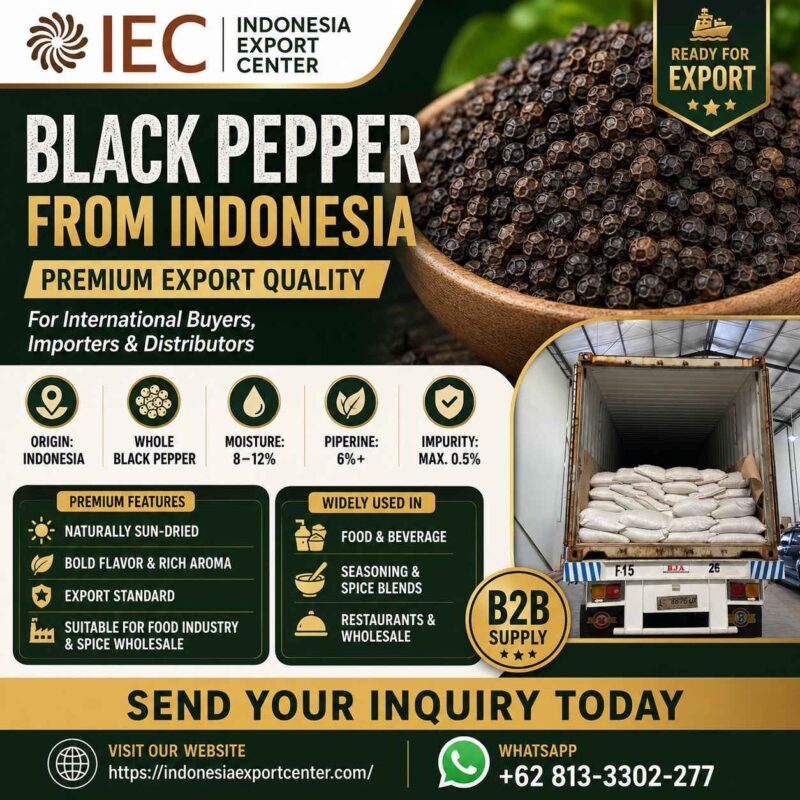
BLACK PEPPER FROM INDONESIA
PREMIUM EXPORT QUALITY
WHOLE BLACK PEPPER | GROUND PEPPER ENQUIRIES | SAUCE FORMULATION | RECIPE CONSISTENCY | SHELF-LIFE EVALUATION
FOR SAUCE MANUFACTURERS, CONDIMENT PRODUCERS, MARINADE FACTORIES, FOOD PROCESSORS & INDUSTRIAL INGREDIENT BUYERS
Indonesian Black Pepper for Sauce and Condiment Manufacturers
Looking for black pepper for sauce manufacturers to support your industrial food production requirements?
Black pepper is used in a wide range of sauces, condiments, marinades, dressings, and savoury food preparations. Its characteristic pungency and aroma can help manufacturers develop distinctive flavour profiles for commercial food products.
For sauce and condiment producers, choosing the right black pepper ingredient involves more than evaluating origin and price.
Manufacturers must consider the required product form, particle size, flavour consistency, dispersion, visual appearance, microbiological safety, and finished-product shelf-life performance.
A pepper ingredient that performs well in a dry seasoning blend may behave differently when incorporated into a liquid, semi-liquid, emulsified, or particulate sauce.
IEC | Indonesia Export Center facilitates sourcing and export enquiries for Indonesian black pepper intended for international food manufacturers and ingredient distributors.
IEC can receive your technical specifications and seek confirmation of suitable Indonesian suppliers, representative samples, quality documentation, available processing options, packaging, and bulk export quotations.
Our supplied reference product is whole dried black pepper. Ground, cracked, or specially processed forms may be requested, but their availability and technical characteristics must be confirmed separately.
Product availability, processing capability, laboratory results, food safety documentation, and shipment arrangements must be verified before purchase.
Request Black Pepper for Sauce Manufacturing
Share your sauce application, required pepper form, target particle size, product specifications, quantity, and destination.
REQUEST A BLACK PEPPER QUOTE VIA WHATSAPP
WhatsApp: +62 813-3302-277
Website: https://indonesiaexportcenter.com/
Indonesian Black Pepper – Reference Product Specifications
| Product Information | Details |
|---|---|
| Product | Whole Black Pepper |
| Botanical Name | Piper nigrum L. |
| Country of Origin | Indonesia |
| Reference Moisture | 8–12% |
| Reference Piperine | 6%+ |
| Reference Impurity | Maximum 0.5% |
| Reference Product Form | Whole Dried Peppercorns |
| Ground or Cracked Forms | Subject to Supplier Confirmation |
| Particle Size | Buyer-Specified for Processed Forms |
| Bulk Density | Buyer-Specified |
| Aroma Profile | Buyer-Specified |
| Foreign Matter | Buyer-Specified |
| Microbiological Criteria | Application and Market-Specific |
| Pesticide Residues | Applicable Market Requirements |
| Mycotoxins | Applicable Market Requirements |
| Lot-Specific COA | To Be Requested |
| Traceability | To Be Verified |
| Packaging | To Be Confirmed |
| Minimum Order Quantity | To Be Confirmed |
| Export Price | Request Quotation |
| Destination | Global B2B Markets |
Specification note: Moisture 8–12%, piperine 6%+, and impurity maximum 0.5% are supplied reference values for whole black pepper, not independently verified laboratory results for an available commercial lot. Finished ground pepper requires its own specifications and verification.
Why Black Pepper Is Used in Sauces and Condiments
Black pepper contributes pungency, aroma, and characteristic spice flavour to many commercial sauce formulations.
Its functional and sensory contribution depends on the type of sauce, processing conditions, and ingredient preparation.
Key Formulation Considerations
Pungency
Piperine contributes to black pepper’s characteristic pungency.
Aroma
Black pepper contains volatile aromatic compounds that contribute to its sensory profile.
Visual Appearance
Visible pepper particles may be desirable in certain sauces and dressings.
Texture
Particle size can influence mouthfeel and perceived texture.
Dispersion
Ground pepper must be evaluated for its behaviour within the finished sauce.
Recipe Consistency
Controlled raw material specifications can help manufacturers maintain predictable finished-product characteristics.
Important
Black pepper should be evaluated as part of the complete sauce formulation rather than as an isolated ingredient.
Black Pepper Applications in Sauce and Condiment Manufacturing
1. Black Pepper Sauce
Black pepper is a defining flavour ingredient in many black pepper sauce formulations.
Manufacturers may evaluate:
- Pungency
- Aroma
- Particle size
- Visible pepper content
- Flavour consistency
- Processing compatibility
2. Marinades
Black pepper may be incorporated into liquid or dry marinade systems.
Relevant considerations include ingredient distribution, flavour release, and processing conditions.
3. Barbecue Sauces
Black pepper may contribute pungency and savoury flavour to barbecue sauce formulations.
Manufacturers may evaluate its compatibility with sweet, acidic, smoky, and other flavour components.
4. Salad Dressings
Black pepper may be used in dressings where fine or visible particles are desirable.
Relevant considerations include particle distribution, sedimentation, and sensory characteristics.
5. Table Sauces and Condiments
Black pepper may be incorporated into various commercial condiments and savoury sauces.
The appropriate form depends on the intended product characteristics.
6. Cooking Sauces
Black pepper may be used in cooking sauces and prepared food formulations.
Manufacturers should evaluate how processing affects flavour, aroma, and ingredient distribution.
7. Dipping Sauces
Black pepper may contribute characteristic flavour to dipping sauces.
Particle size and texture may influence consumer perception.
8. Industrial Sauce Bases
Black pepper may be included in concentrated sauce bases and other intermediate food preparations.
Manufacturers should evaluate ingredient compatibility under their specific processing conditions.
Whole vs. Ground Black Pepper for Sauce Manufacturing
The appropriate black pepper form depends on the manufacturing process and desired finished-product characteristics.
| Product Form | Potential Application | Main Considerations |
|---|---|---|
| Whole Black Pepper | In-House Grinding or Processing | Raw material quality |
| Cracked Black Pepper | Sauces with Visible Pepper Particles | Appearance and texture |
| Coarse Ground Black Pepper | Black Pepper Sauces and Marinades | Particle distribution |
| Fine Ground Black Pepper | Smooth Sauces and Seasoning Bases | Dispersion and mouthfeel |
| Custom Particle Size | Application-Specific Formulations | Processing capability |
Availability note: IEC’s supplied reference product is whole black pepper. Cracked, ground, and custom-processed forms are sourcing enquiries and must be confirmed with the proposed supplier.
Choosing the Right Black Pepper Particle Size
Particle size is an important parameter for sauce and condiment manufacturers.
Why Particle Size Matters
Visual Appearance
Coarser particles may create a visible pepper effect.
Mouthfeel
Particle size can influence texture and sensory perception.
Dispersion
Fine particles may behave differently from coarse particles in liquid or semi-liquid systems.
Sedimentation
Particle characteristics can influence settling behaviour during storage.
Processing Compatibility
Particle size may affect pumping, filling, mixing, and other manufacturing operations.
Recommended Specification Elements
| Parameter | Buyer Requirement |
|---|---|
| Product Form | Ground / Cracked |
| Target Particle Size | [Specify] |
| Sieve Size | [Specify] |
| Percentage Passing | [Specify] |
| Percentage Retained | [Specify] |
| Oversized Particle Limit | [Specify] |
| Fines Limit | [Specify] |
| Test Method | [Specify] |
| Sampling Procedure | [Specify] |
Important
A single mesh number may not fully describe the particle-size distribution.
Manufacturers should establish measurable acceptance criteria.
Black Pepper Dispersion in Sauce Formulations
Black pepper does not necessarily disperse uniformly in every sauce system.
Its behaviour depends on particle size, formulation viscosity, processing conditions, and other ingredients.
Factors to Evaluate
- Particle size
- Sauce viscosity
- Mixing intensity
- Processing temperature
- Holding time
- Packaging format
- Storage conditions
Potential Formulation Issues
Uneven Distribution
Pepper particles may not remain uniformly distributed during processing or storage.
Sedimentation
Some formulations may experience particle settling.
Texture Variation
Particle size may affect mouthfeel.
Appearance Changes
Visible particles may influence finished-product presentation.
Recommended Approach
Manufacturers should evaluate black pepper dispersion under realistic processing and storage conditions.
Recipe Consistency in Sauce Manufacturing
Recipe consistency is important for commercial sauce and condiment producers.
Variations in raw material characteristics can affect finished-product flavour, aroma, and appearance.
Potential Sources of Variation
- Growing conditions
- Harvest maturity
- Drying methods
- Storage conditions
- Grinding methods
- Particle-size distribution
- Supplier aggregation
- Lot-to-lot variation
Parameters to Monitor
| Parameter | Why It Matters |
|---|---|
| Piperine | Pungency-related specification |
| Aroma | Sensory consistency |
| Moisture | Raw material quality |
| Particle Size | Texture and dispersion |
| Appearance | Finished-product presentation |
| Microbiological Quality | Food safety |
| Lot Identification | Traceability |
| Packaging | Ingredient protection |
Important
No supplier is claimed to guarantee identical flavour or aroma across every batch.
Consistency should be evaluated through agreed specifications, representative sampling, and documented quality controls.
Aroma and Flavour Stability During Sauce Processing
Black pepper aroma and flavour may change during food processing.
Processing Factors
- Heating
- Mixing
- Holding time
- Exposure to oxygen
- Product pH
- Packaging
- Storage temperature
- Storage duration
Why Processing Trials Matter
A black pepper sample may have a desirable aroma before processing but behave differently in the finished sauce.
Manufacturers should evaluate the ingredient under their actual processing conditions.
Recommended Sensory Evaluation
- Establish an approved reference formulation.
- Prepare a controlled trial batch.
- Evaluate aroma and pungency.
- Assess particle distribution.
- Compare against the approved product standard.
- Evaluate changes during storage.
- Document the results.
Shelf-Life Testing for Black Pepper Sauces and Condiments
Shelf-life testing is an important part of commercial sauce development.
The shelf life of a finished sauce depends on the complete formulation, processing method, packaging, storage conditions, and relevant microbiological hazards.
Important
The moisture content of dried black pepper does not determine the shelf life of a finished sauce.
A sauce containing black pepper may require a separate shelf-life validation program.
Key Shelf-Life Evaluation Areas
| Parameter | Evaluation |
|---|---|
| Microbiological Stability | Risk-Based Testing |
| pH | Formulation-Specific |
| Water Activity | Where Relevant |
| Aroma | Sensory Monitoring |
| Pungency | Sensory or Analytical Monitoring |
| Colour | Visual Evaluation |
| Particle Distribution | Physical Stability |
| Sedimentation | Physical Stability |
| Texture | Sensory and Physical Evaluation |
| Packaging Integrity | Packaging Assessment |
| Storage Conditions | Defined Test Conditions |
Recommended Shelf-Life Study
Step 1: Define the Finished Product
Identify the sauce formulation, processing method, and packaging.
Step 2: Establish Storage Conditions
Determine intended storage and distribution conditions.
Step 3: Identify Relevant Hazards
Conduct a product-specific food safety assessment.
Step 4: Define Test Parameters
Select appropriate microbiological, chemical, physical, and sensory measurements.
Step 5: Establish Sampling Intervals
Determine when samples will be evaluated.
Step 6: Conduct Testing
Use suitable analytical methods and controlled conditions.
Step 7: Review Results
Assess changes in product safety and quality.
Step 8: Establish Shelf Life
Determine a justified shelf-life period based on the complete study and applicable requirements.
Important
No fixed shelf life is claimed for any sauce containing IEC-sourced black pepper.
Black Pepper and Sauce Microbiological Safety
Dried spices may present microbiological hazards.
Low moisture does not automatically eliminate pathogens.
Potential Microbiological Concerns
- Salmonella spp.
- Other relevant pathogenic microorganisms
- Indicator microorganisms
- Spoilage microorganisms
Why This Matters
Black pepper may be added before or after a sauce’s thermal processing stage.
The timing of addition can influence the appropriate food safety control strategy.
Recommended Risk-Based Approach
- Identify the intended sauce application.
- Determine the stage of pepper addition.
- Evaluate subsequent processing.
- Assess relevant microbiological hazards.
- Establish ingredient acceptance criteria.
- Evaluate supplier controls.
- Determine whether microbial reduction treatment is required.
- Verify relevant documentation.
Important
Black pepper should not be assumed to be pathogen-free based solely on its low moisture content.
Microbiological Specifications for Sauce Ingredients
| Parameter | Buyer Consideration |
|---|---|
| Salmonella spp. | Relevant Food Safety Hazard |
| Total Aerobic Count | Buyer-Specified |
| Yeasts and Moulds | Buyer-Specified |
| Enterobacteriaceae | Buyer-Specified |
| E. coli | Buyer-Specified |
| Other Relevant Microorganisms | Risk-Based |
| Sampling Plan | Agreed |
| Test Method | Documented |
| Lot Identification | Required |
Microbial Reduction Treatments
Some sauce manufacturers may require spices that have undergone a validated microbial reduction process.
Treatment availability, validation, and supporting documentation must be confirmed with the actual supplier.
Cleaning, sorting, and grinding are not equivalent to sterilization.
Piperine and Flavour Control
Piperine is an important compound associated with black pepper pungency.
Supplied Reference
Piperine: 6%+
This is a reference specification, not a verified laboratory result for a particular lot.
Why Sauce Manufacturers May Test Piperine
- Raw material comparison
- Purchasing specifications
- Flavour consistency monitoring
- Supplier evaluation
Important
Piperine content alone does not fully determine aroma or finished-sauce flavour performance.
Moisture Control for Black Pepper Ingredients
Moisture is an important parameter for dried spice ingredients.
Supplied Reference
Moisture: 8–12%
For commercial purchasing, manufacturers should establish a specific maximum moisture limit and agreed test method.
Why Moisture Matters
- Ingredient storage
- Grinding behaviour
- Handling
- Packaging selection
- Raw material stability
Important
Moisture content alone does not establish microbiological safety or finished-sauce shelf life.
Foreign Matter and Product Cleanliness
Sauce manufacturers should evaluate physical contamination risks associated with incoming spices.
Potential Concerns
- Stones
- Soil
- Plant debris
- Other unintended materials
Supplied Reference
Impurity: Maximum 0.5%
The definition of impurity, test method, and actual lot result must be agreed.
Potential Supplier Controls
Buyers may request information about:
- Screening
- Sorting
- Foreign matter removal
- Metal detection, where applicable
- Final inspection
Actual supplier equipment and capabilities must be verified.
Pesticide Residues, Mycotoxins, and Heavy Metals
Sauce and condiment producers may require testing for relevant chemical contaminants.
Potential Testing Areas
- Pesticide residues
- Aflatoxins
- Ochratoxin A, where relevant
- Heavy metals
- Other substances identified through hazard assessment
Recommended Verification
- Identify applicable destination-market requirements.
- Establish acceptance criteria.
- Determine the analytical testing panel.
- Agree on sampling procedures.
- Request laboratory reports.
- Confirm lot identification.
- Review results before commercial acceptance.
No particular black pepper lot is claimed to meet every applicable contaminant limit without verification.
Quality Control Specifications for Sauce Manufacturers
| Quality Parameter | Reference or Buyer Requirement |
|---|---|
| Product | Whole Black Pepper |
| Origin | Indonesia |
| Moisture | 8–12% Reference; Agree Maximum |
| Piperine | 6%+ Reference; Verify by Testing |
| Impurity | Maximum 0.5% Reference |
| Product Form | Whole; Other Forms Subject to Confirmation |
| Particle Size | Buyer-Specified for Processed Forms |
| Sieve Distribution | Buyer-Specified |
| Bulk Density | Buyer-Specified |
| Foreign Matter | Buyer-Specified |
| Aroma | Buyer-Specified |
| Appearance | Buyer-Specified |
| Salmonella | Applicable Acceptance Criterion |
| Other Microbiological Parameters | Risk-Based |
| Pesticide Residues | Applicable Market Requirements |
| Mycotoxins | Applicable Market Requirements |
| Heavy Metals | Applicable Market Requirements |
| Lot Identification | Required |
| COA | To Be Requested |
| Packaging | Buyer-Specified |
Certificate of Analysis for Sauce Manufacturing Ingredients
A lot-specific Certificate of Analysis can help manufacturers evaluate ingredient quality.
Recommended COA Information
| COA Field | Requested Information |
|---|---|
| Product | Whole Black Pepper or Confirmed Processed Form |
| Origin | Indonesia |
| Supplier | Identified Supplier |
| Lot Number | Required |
| Sample Identification | Required |
| Moisture | Actual Result |
| Piperine | Actual Result |
| Impurity | Actual Result |
| Particle Size | If Applicable |
| Sieve Distribution | If Applicable |
| Microbiological Results | If Required |
| Pesticide Residues | If Required |
| Mycotoxins | If Required |
| Heavy Metals | If Required |
| Laboratory | Identified |
| Analytical Methods | Documented |
| Test Date | Recorded |
Important
A COA supports quality assessment but does not independently establish complete food safety compliance.
Supplier Qualification for Sauce and Condiment Producers
Sauce manufacturers may require a structured supplier approval process.
Recommended Supplier Evaluation
- Legal supplier identity
- Processing facility information
- Product specifications
- Food safety procedures
- Cleaning and sorting controls
- Grinding controls, if applicable
- Microbiological controls
- Contaminant testing
- Traceability
- Packaging procedures
- Available certifications
- Audit reports, where available
- Corrective action procedures
- Recall procedures
Food Safety Certifications
Some buyers may request information regarding:
- HACCP-based food safety controls
- GMP
- ISO 22000
- FSSC 22000
- Other relevant food safety schemes
Actual certification status, scope, and validity must be verified.
Traceability and Batch Identification
Traceability helps sauce manufacturers connect incoming black pepper with relevant suppliers, processing activities, and commercial shipments.
Potential Supply Chain
Indonesian Producer → Collection → Drying → Cleaning → Packing → Export → Sauce Manufacturer
If grinding or other processing is involved, the relevant processing stage should be included in traceability records.
Recommended Traceability Information
- Supplier identity
- Product description
- Country of origin
- Lot number
- Processing records
- Packing records
- Laboratory reports
- Shipment records
- Receiving records
Packaging for Industrial Sauce Ingredients
Packaging should help protect black pepper during transportation and storage.
Potential Packaging Options
- Food-compatible woven bags with suitable liners
- Multiwall paper bags with suitable liners
- Other supplier-approved bulk packaging
Actual packaging materials and bag weights must be confirmed.
Packaging Checklist
| Packaging Requirement | Buyer Specification |
|---|---|
| Packaging Material | [Specify] |
| Net Weight per Bag | [Specify] |
| Inner Liner | [Required / Not Required] |
| Palletization | [Required / Not Required] |
| Lot Marking | Required |
| Product Identification | Required |
| Moisture Protection | [Specify] |
| Food-Contact Suitability | Verify |
| Destination-Market Requirements | Verify |
Bulk Black Pepper Supply for Sauce Manufacturers
Sauce and condiment producers may request quotations for trial orders, production orders, or recurring procurement.
Commercial Requirements
- Required product form
- Quantity
- Order frequency
- Technical specifications
- Particle size requirements
- Quality documentation
- Sampling
- Packaging
- Destination
- Incoterm
- Payment terms
- Delivery schedule
Recurring Supply Enquiries
Buyers may request information about potential ongoing supply arrangements.
However, actual supplier capacity, production schedules, inventory, and consistent availability must be verified.
Export Pricing for Sauce Manufacturing Black Pepper
Export pricing depends on product specifications and commercial arrangements.
Main Price Drivers
- Product form
- Grade
- Moisture
- Piperine
- Impurity limit
- Bulk density
- Particle size requirements
- Cleaning and sorting
- Grinding or processing requirements, if available
- Microbiological testing
- Contaminant testing
- Packaging
- Order quantity
- Supplier availability
- Inspection arrangements
- Freight
- Incoterm
- Payment terms
Potential Quotation Terms
Buyers may request quotations under suitable Incoterms, including:
- FCA
- FOB
- CFR
- CIF
- CIP
The appropriate term depends on the actual transport arrangement.
No current price, MOQ, supplier capacity, or available shipment quantity has been independently verified.
How Sauce Manufacturers Can Source Indonesian Black Pepper
Step 1: Define Your Sauce Application
Identify the finished product and manufacturing process.
Step 2: Select the Required Product Form
Specify whole, cracked, ground, or another required form.
Step 3: Define Particle Size
For processed forms, establish measurable particle-size acceptance criteria.
Step 4: Establish Recipe Requirements
Define flavour, aroma, appearance, and dispersion requirements.
Step 5: Establish Quality Specifications
Define moisture, piperine, cleanliness, microbiology, and contaminant requirements.
Step 6: Submit Your RFQ
Provide quantity, destination, packaging, and commercial requirements.
Step 7: Request Supplier Information
Ask for supplier identity, processing capabilities, and relevant food safety controls.
Step 8: Confirm Product Availability
Request confirmation of the proposed form, grade, quantity, and lead time.
Step 9: Request Samples
Where available, obtain samples for laboratory and formulation testing.
Step 10: Conduct Sauce Application Trials
Evaluate the ingredient under relevant production conditions.
Step 11: Conduct Shelf-Life Evaluation
Assess the finished sauce using an appropriate product-specific study.
Step 12: Finalize Inspection and Commercial Terms
Define sampling, acceptance criteria, responsible parties, and shipment arrangements.
Ready-to-Send RFQ – Black Pepper for Sauce and Condiment Manufacturers
Subject: RFQ – Indonesian Black Pepper for Industrial Sauce Manufacturing
Dear IEC | Indonesia Export Center Team,
We are interested in sourcing Indonesian black pepper for industrial sauce and condiment manufacturing.
Our purchasing requirements include product quality, particle size, recipe consistency, formulation suitability, food safety documentation, and commercial export terms.
Please advise whether suitable Indonesian supply options are available.
BUYER INFORMATION
Company Name: [Company Name]
Country: [Country]
Business Type: [Sauce Manufacturer / Condiment Producer / Marinade Manufacturer / Food Ingredient Distributor]
Contact Person: [Name]
Email: [Email]
WhatsApp: [Number]
Destination Port: [Port]
PRODUCT REQUIREMENTS
Product: Black Pepper
Origin: Indonesia
Required Form: [Whole / Cracked / Ground / Other]
Intended Application: [Specify]
Required Quantity: [MT]
Order Frequency: [Trial / One-Time / Monthly / Quarterly]
TECHNICAL REQUIREMENTS
| Parameter | Requirement |
|---|---|
| Product | Black Pepper |
| Origin | Indonesia |
| Required Form | [Specify] |
| Moisture | [Specify] |
| Piperine | [Specify] |
| Impurity | [Specify] |
| Bulk Density | [Specify] |
| Foreign Matter | [Specify] |
| Particle Size | [Specify if Applicable] |
| Sieve Distribution | [Specify if Applicable] |
| Aroma | [Specify] |
| Appearance | [Specify] |
| Salmonella | [Specify Acceptance Criterion and Method] |
| Other Microbiological Requirements | [Specify] |
| Pesticide Residues | Applicable Market Requirements |
| Mycotoxins | Applicable Market Requirements |
| Heavy Metals | Applicable Market Requirements |
APPLICATION INFORMATION
Finished Product: [Specify]
Sauce Type: [Specify]
Manufacturing Process: [Specify]
Target Sensory Profile: [Specify]
Particle Size Requirements: [Specify]
Dispersion Requirements: [Specify]
Shelf-Life Evaluation Requirements: [Specify]
Special Processing Requirements: [Specify]
SUPPLIER AND QUALITY DOCUMENTATION REQUESTED
Please advise whether the following can be provided:
- Legal supplier identity.
- Processing facility information.
- Product technical specification.
- Lot-specific COA.
- Particle-size report, if applicable.
- Microbiological test report.
- Pesticide residue test report, if required.
- Mycotoxin test report, if required.
- Heavy metal test report, if required.
- Traceability information.
- Available food safety certifications.
- Packaging specifications.
- Representative samples.
- Relevant export documentation.
COMMERCIAL REQUIREMENTS
Required Quantity: [MT]
Preferred Packaging: [Specify]
Destination Country: [Country]
Destination Port: [Port]
Requested Incoterm: [FCA / FOB / CFR / CIF / CIP / Other]
Target Shipment Period: [Month / Year]
Please confirm:
- Product availability.
- Available forms and grades.
- Particle-size capability, if applicable.
- Minimum order quantity.
- Available quantity.
- Sample availability.
- Price per metric ton.
- Available laboratory documentation.
- Inspection arrangements.
- Packaging options.
- Payment terms.
- Shipment lead time.
- Relevant export documentation.
- Quotation validity.
We will review the supplier information, product specifications, recipe consistency requirements, formulation suitability, food safety documentation, and commercial terms before proceeding.
Thank you. We look forward to your response.
Kind regards,
[Your Name] [Company Name] [Country]SEND YOUR SAUCE MANUFACTURING BLACK PEPPER RFQ VIA WHATSAPP
Frequently Asked Questions – Black Pepper for Sauce Manufacturers
1. Can sauce manufacturers source Indonesian black pepper through IEC?
IEC can receive enquiries and seek confirmation of suitable Indonesian suppliers and export quotations.
2. Is black pepper commonly used in sauces and condiments?
Yes. Black pepper is used in many sauces, marinades, dressings, and savoury condiments.
3. Is whole black pepper suitable for sauce manufacturing?
Yes. Whole black pepper may be used as a raw material for further grinding and processing.
4. Can buyers request ground black pepper?
Buyers may request ground black pepper sourcing. Actual availability and processing specifications must be confirmed.
5. Can sauce manufacturers specify particle size?
Yes. Buyers may define measurable particle-size requirements, subject to supplier capability and verification.
6. Why is particle size important in sauces?
Particle size can influence appearance, texture, dispersion, and sedimentation.
7. Does black pepper affect sauce shelf life?
Black pepper can influence sensory characteristics, but the shelf life of a finished sauce depends on the complete formulation, processing, packaging, and storage conditions.
8. Can IEC guarantee a specific sauce shelf life?
No. Finished-product shelf life must be established through appropriate testing and validation by the manufacturer.
9. Is Salmonella a concern in black pepper?
Yes. Salmonella is an important hazard to consider in dried spice procurement.
10. Can buyers request microbially treated black pepper?
Buyers may request information about treated products, but availability and validation must be confirmed.
11. Can buyers request a COA?
A lot-specific COA may be requested, subject to supplier and laboratory availability.
12. What is the supplied moisture specification?
8–12% as a reference range. The contractual maximum and actual lot result must be confirmed.
13. What is the supplied piperine specification?
6%+ as a reference value, subject to laboratory verification.
14. Can buyers request representative samples?
Samples may be requested, subject to supplier availability and agreed arrangements.
15. What is the minimum order quantity?
No fixed MOQ has been independently verified.
16. Can buyers request recurring supply?
Recurring supply enquiries may be submitted, subject to supplier capacity and commercial agreement.
17. Can IEC guarantee identical flavour across every batch?
No. Flavour consistency must be evaluated through agreed specifications and quality controls.
18. Does IEC guarantee food safety compliance?
No. Compliance must be verified for the actual product, supplier, intended application, and destination market.
Request Indonesian Black Pepper for Your Sauce Manufacturing Business
For companies searching for black pepper for sauce manufacturers, successful procurement requires careful evaluation of product form, particle size, recipe consistency, microbiological safety, and finished-product shelf-life performance.
IEC | Indonesia Export Center welcomes enquiries from sauce factories, condiment producers, marinade manufacturers, food processors, and industrial ingredient distributors seeking Indonesian black pepper.
Sauce Manufacturing Black Pepper Enquiry Summary
| Parameter | Details |
|---|---|
| Product | Black Pepper |
| Origin | Indonesia |
| Reference Form | Whole Black Pepper |
| Other Forms | Subject to Confirmation |
| Reference Moisture | 8–12% |
| Reference Piperine | 6%+ |
| Reference Impurity | Maximum 0.5% |
| Particle Size | Buyer-Specified |
| Application | Sauce and Condiment Manufacturing |
| Recipe Consistency | Subject to Verification |
| Shelf-Life Testing | Finished-Product Responsibility |
| Microbiological Requirements | Application-Specific |
| Contaminant Requirements | Applicable Criteria |
| Traceability | To Be Verified |
| Lot-Specific COA | To Be Requested |
| Packaging | To Be Confirmed |
| MOQ | To Be Confirmed |
| Destination | Global |
| Export Price | Request Quotation |
IEC | INDONESIA EXPORT CENTER
CONNECTING INDONESIAN PRODUCTS TO THE WORLD
INDONESIAN BLACK PEPPER FOR INDUSTRIAL SAUCE AND CONDIMENT MANUFACTURING
FOR SAUCE FACTORIES, CONDIMENT PRODUCERS, MARINADE MANUFACTURERS & FOOD INGREDIENT BUYERS
SEND YOUR SAUCE MANUFACTURING BLACK PEPPER ENQUIRY TODAY
WhatsApp: +62 813-3302-277
Website: https://indonesiaexportcenter.com/
Contact us for product specifications, particle-size enquiries, sauce formulation requirements, sample requests, bulk quotations, and export inquiries.
Technical and Commercial Disclaimer: This page provides general sourcing information for sauce and condiment manufacturers. Actual product forms, grinding capabilities, laboratory results, certifications, supplier capacity, product availability, and shipment arrangements must be verified for each proposed transaction. Moisture, piperine, and impurity values are reference specifications for whole black pepper, not tested results for an available lot or finished ground product. Finished-sauce shelf life must be established through product-specific testing and validation. Food safety requirements depend on the intended application and destination market. IEC facilitates sourcing and export enquiries; the contractual seller, exporter of record, and importer must be identified before shipment.
