

IEC | INDONESIA EXPORT CENTER
CONNECTING INDONESIAN PRODUCTS TO THE WORLD
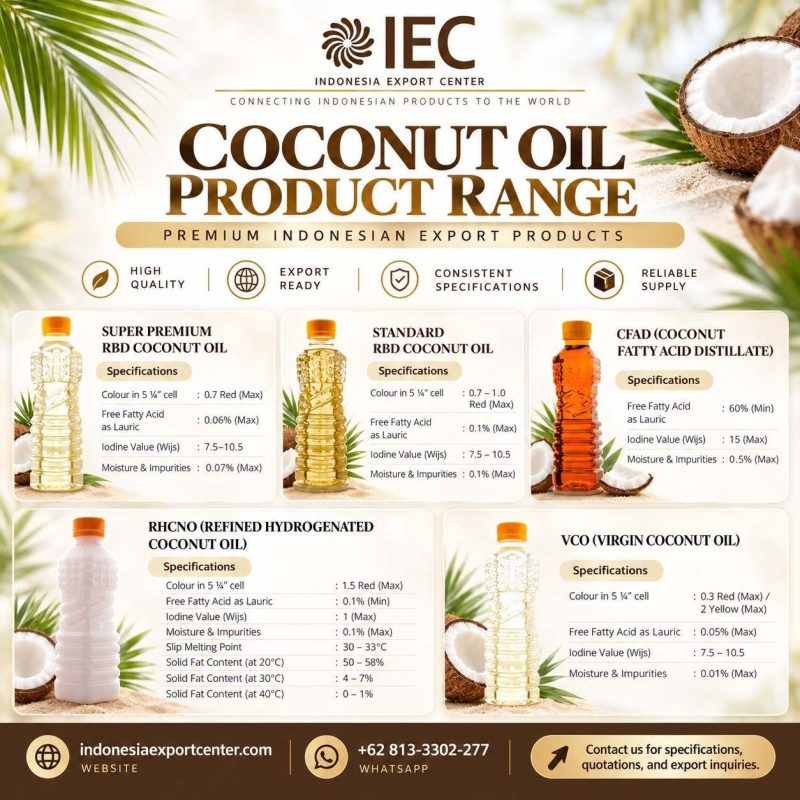
COCONUT OIL PRODUCT RANGE | PREMIUM INDONESIAN EXPORT PRODUCTS
Understanding Refined Hydrogenated Coconut Oil Melting Characteristics
The RHCNO melting point specification is an important technical consideration for manufacturers, formulation specialists, R&D teams, and international procurement professionals evaluating Refined Hydrogenated Coconut Oil.
RHCNO is a coconut-derived fat processed through refining and hydrogenation to modify its degree of unsaturation and physical characteristics.
Its melting behaviour can influence processing, storage, product texture, crystallization, and application suitability.
For industrial buyers, understanding the difference between slip melting point, solid fat content, and actual melting behaviour is essential.
The supplied RHCNO reference specification indicates a slip melting point of 30–33°C, together with a defined solid fat content profile at 20°C, 30°C, and 40°C.
IEC | Indonesia Export Center facilitates sourcing and export enquiries for Indonesian coconut-derived products, including potential Refined Hydrogenated Coconut Oil supply.
International buyers can enquire about technical specifications, analytical documentation, manufacturer availability, and bulk quotations.
Request RHCNO melting point specifications and a bulk sourcing quotation.
WhatsApp: +62 813-3302-277
Website: https://indonesiaexportcenter.com/
Actual manufacturer, lot-specific COA, stock availability, MOQ, packaging, certifications, and export arrangements require verification.
RHCNO Melting Point Specification at a Glance
| Technical Parameter | Reference Specification |
|---|---|
| Product | Refined Hydrogenated Coconut Oil (RHCNO) |
| Slip Melting Point | 30–33°C |
| Solid Fat Content at 20°C | 50–58% |
| Solid Fat Content at 30°C | 4–7% |
| Solid Fat Content at 40°C | 0–1% |
| Iodine Value (Wijs) | 1 (Max) |
| Moisture & Impurities | 0.1% (Max) |
| Colour in 5¼” Cell | 1.5 Red (Max) |
| Free Fatty Acid as Lauric | 0.1% (Min) – Requires Verification |
These are supplied reference specifications, not actual analytical results for a particular production lot.
Important: The supplied FFA specification states 0.1% minimum. Because this is an unusual acceptance direction for refined oil, the manufacturer must confirm the correct limit before contractual use.
What Is the Melting Point of RHCNO?
The supplied reference RHCNO slip melting point is 30–33°C.
This range describes the slip melting point under the applicable analytical test conditions.
It should not be interpreted as a single universal temperature at which every part of the fat becomes completely liquid.
Fats are mixtures of different triacylglycerols and can melt over a temperature interval.
Therefore, melting behaviour is more complex than a single melting point value.
Why the Melting Range Matters
The melting characteristics of RHCNO may influence:
- Product handling
- Processing temperature selection
- Texture
- Firmness
- Crystallization behaviour
- Storage conditions
- Application compatibility
However, the appropriate melting range depends on the intended use.
What Is Slip Melting Point?
Slip melting point is a standardized measurement used to characterize the melting behaviour of fats.
In a typical capillary-based slip melting point determination, a prepared fat sample is subjected to controlled heating.
The temperature at which the fat column begins to move under the specified test conditions is recorded.
The exact procedure depends on the selected analytical method.
Why Slip Melting Point Is Used
Slip melting point can provide a useful reference for:
- Raw material identification
- Quality control
- Supplier comparison
- Batch consistency assessment
- Preliminary formulation screening
However, slip melting point does not describe the entire melting profile.
It should be evaluated alongside solid fat content and other relevant physical properties.
Slip Melting Point vs Complete Melting Behaviour
The terms slip melting point and complete melting temperature should not be treated as interchangeable.
| Parameter | Meaning | Main Use |
|---|---|---|
| Slip Melting Point | Temperature at which a prepared fat column begins to move under specified conditions | Quality control and raw material comparison |
| Solid Fat Content | Proportion of fat remaining solid at a specified temperature | Melting profile and formulation assessment |
| Melting Curve | Changes in melting behaviour over a temperature range | Detailed thermal characterization |
| Crystallization Behaviour | Formation and transformation of fat crystals | Texture and processing evaluation |
A fat may contain both solid and liquid fractions over a range of temperatures.
This is why SFC measurements are particularly useful for R&D and procurement teams.
RHCNO Solid Fat Content and Melting Profile
The supplied RHCNO reference SFC profile is:
| Temperature | Solid Fat Content |
|---|---|
| 20°C | 50–58% |
| 30°C | 4–7% |
| 40°C | 0–1% |
These are reference ranges, not actual lot-specific results.
At 20°C: Significant Solid Fraction
The supplied profile indicates that approximately 50–58% of the fat remains solid under the specified measurement conditions.
This may be relevant to firmness and structure in suitable formulations.
At 30°C: Substantial Reduction in Solid Fraction
The supplied SFC decreases to 4–7%.
This indicates significant melting between the measured temperature points.
At 40°C: Very Low Solid Fraction
The supplied profile indicates 0–1% remaining solid fat.
This suggests that very little solid material remains under the specified measurement conditions.
Important Interpretation
The SFC profile does not provide a complete continuous melting curve.
Additional measurements may be necessary to characterize the material at other temperatures.
Why Solid Fat Content Matters More Than a Single Melting Point
For many industrial applications, the solid fat content profile provides more useful information than a single melting point.
Two fats may have similar slip melting points but different SFC curves.
These differences may influence:
- Firmness
- Texture
- Processing behaviour
- Crystallization
- Storage stability
- Finished product performance
Recommended R&D Approach
- Review slip melting point.
- Review SFC at relevant temperatures.
- Confirm analytical methods.
- Evaluate fatty acid composition.
- Conduct formulation trials.
- Test crystallization behaviour.
- Assess finished product performance.
The most appropriate melting profile depends on the intended application.
RHCNO Iodine Value and Melting Characteristics
The supplied RHCNO iodine value is:
Iodine Value (Wijs): 1 Maximum
Iodine value is an analytical indicator of the degree of unsaturation.
Hydrogenation reduces carbon-carbon double bonds in unsaturated fatty acid components.
A low iodine value generally indicates a low degree of unsaturation.
How Hydrogenation May Affect Melting Behaviour
Hydrogenation can modify:
- Fatty acid saturation
- Physical characteristics
- Melting behaviour
- Crystallization properties
- Solid fat content
However, iodine value alone does not determine the slip melting point or complete SFC profile.
RHCNO Melting Point and Fatty Acid Composition
The melting characteristics of a fat depend partly on its fatty acid and triacylglycerol composition.
Relevant factors include:
- Fatty acid chain length
- Degree of unsaturation
- Triacylglycerol composition
- Crystallization behaviour
- Processing history
Why Composition Matters
Different fatty acid and triacylglycerol profiles may produce different melting characteristics.
For technical qualification, buyers may request:
- Fatty acid composition
- Triacylglycerol composition where relevant
- Iodine value
- Slip melting point
- SFC profile
- Crystallization information
The supplied reference data does not include a complete fatty acid or triacylglycerol analysis.
Factors That May Influence RHCNO Melting Point Results
Melting point measurements can be affected by the analytical method and sample conditions.
1. Sample Preparation
The sample preparation procedure can influence crystal formation.
2. Cooling Conditions
Cooling history may affect crystallization behaviour.
3. Tempering
Tempering conditions can influence the physical state of the fat.
4. Heating Rate
The heating procedure may affect the observed result.
5. Analytical Method
Different methods may produce results that are not directly comparable.
6. Product Composition
Variations in fatty acid and triacylglycerol composition may influence melting behaviour.
7. Production Consistency
Differences between production lots may affect analytical results.
Recommended Buyer Action
Request the analytical method and confirm that supplier and buyer laboratories use comparable procedures.
RHCNO Melting Point Testing Methods
The appropriate method should be selected according to the intended application and contractual specification.
Slip Melting Point Testing
Used to characterize melting behaviour under standardized conditions.
Solid Fat Content Testing
Often performed using suitable analytical methods such as nuclear magnetic resonance (NMR), depending on the laboratory procedure.
Differential Scanning Calorimetry
Differential scanning calorimetry (DSC) may be used to investigate thermal transitions and melting behaviour.
Crystallization Analysis
Additional methods may be used to evaluate crystal structure and polymorphism.
Important
No specific analytical method has been verified for the supplied RHCNO reference values.
The manufacturer should confirm the actual test methods used.
RHCNO Melting Point for Different Applications
The required melting characteristics depend on the intended use.
Confectionery Formulations
Confectionery manufacturers may evaluate melting behaviour in relation to texture, firmness, and sensory performance.
However, food-grade status and fat compatibility must be verified.
Chocolate-Type Coatings
Coating manufacturers may assess slip melting point and SFC alongside crystallization behaviour and cocoa butter compatibility.
RHCNO should not automatically be considered a cocoa butter substitute.
Bakery Fat Blends
Bakery fat manufacturers may evaluate melting behaviour, plasticity, and processing characteristics.
RHCNO should not automatically be considered a ready-to-use bakery shortening.
Specialty Fat Blends
Specialty fat blenders may use melting point and SFC data to screen potential blending components.
Actual blend performance must be tested.
Cosmetic Formulations
Cosmetic formulators may evaluate melting characteristics in relation to texture, consistency, and processing.
Cosmetic-grade status and INCI identity must be verified.
Application-Specific Qualification
The supplied melting point range of 30–33°C does not establish suitability for any particular application.
RHCNO Melting Point vs Standard RBD Coconut Oil
RHCNO and standard RBD coconut oil differ in processing and supplied reference properties.
| Parameter | RHCNO | Standard RBD Coconut Oil |
|---|---|---|
| Processing | Refined and Hydrogenated | Refined, Bleached and Deodorized |
| Hydrogenation | Yes | Not Inherent |
| Iodine Value | 1 (Max) | 7.5–10.5 |
| Slip Melting Point | 30–33°C | Not Supplied |
| SFC at 20°C | 50–58% | Not Supplied |
| SFC at 30°C | 4–7% | Not Supplied |
| SFC at 40°C | 0–1% | Not Supplied |
| Melting Behaviour | Requires Lot-Specific Verification | Requires Lot-Specific Verification |
The table uses supplied reference specifications and does not represent actual analytical results from specific production lots.
How to Select the Required Melting Range
For R&D procurement teams, selecting a melting range should begin with the application requirements.
Step 1: Define the Intended Application
Identify the product and processing requirements.
Step 2: Establish the Working Temperature
Determine the relevant processing and storage temperatures.
Step 3: Define the Required Physical Properties
Consider:
- Firmness
- Texture
- Plasticity
- Melting behaviour
- Crystallization
- Stability
Step 4: Review the RHCNO Reference Profile
Compare the supplied melting point and SFC values with the target requirements.
Step 5: Request Lot-Specific Data
Obtain actual COA results and analytical methods.
Step 6: Conduct Laboratory Trials
Evaluate the material in the intended formulation.
Step 7: Confirm Commercial Suitability
Approve the material only after technical and quality requirements have been satisfied.
RHCNO Melting Point Specification for Procurement
When requesting RHCNO quotations, buyers should specify more than the product name.
Recommended Technical Information
- Product identity
- Required slip melting point range
- Required SFC profile
- Iodine value
- Moisture and impurities
- FFA specification
- Colour
- Fatty acid composition
- Analytical methods
- Intended application
- Additional buyer-defined parameters
Recommended Commercial Information
- Required quantity
- Packaging
- Destination country
- Destination port
- Incoterm
- Shipment schedule
- Documentation requirements
RHCNO Certificate of Analysis and Melting Point Verification
A lot-specific COA should be reviewed before commercial approval.
| Parameter | Reference Specification | Actual Lot Result |
|---|---|---|
| Slip Melting Point | 30–33°C | To Be Verified |
| SFC at 20°C | 50–58% | To Be Verified |
| SFC at 30°C | 4–7% | To Be Verified |
| SFC at 40°C | 0–1% | To Be Verified |
| Iodine Value (Wijs) | 1 (Max) | To Be Verified |
| Moisture & Impurities | 0.1% (Max) | To Be Verified |
| Colour in 5¼” Cell | 1.5 Red (Max) | To Be Verified |
| FFA as Lauric | 0.1% (Min) – Requires Clarification | To Be Verified |
| Fatty Acid Composition | Buyer-Defined | To Be Verified |
| Additional Parameters | Buyer-Defined | To Be Verified |
COA Verification Checklist
-
Manufacturer or laboratory identity
-
Product name and grade
-
Lot or batch number
-
Test date
-
Analytical methods
-
Actual numerical results
-
Units of measurement
-
Specification limits
-
Authorized approval
-
Shipment traceability
A generic specification sheet is not a substitute for a lot-specific COA.
RHCNO Storage and Handling Considerations
Because RHCNO has temperature-dependent solid fat characteristics, storage and handling requirements should be evaluated carefully.
Important Considerations
- Storage temperature
- Product condition during transport
- Melting requirements
- Heating procedures, if any
- Packaging compatibility
- Unloading equipment
- Contamination prevention
- Lot traceability
No specific storage temperature, heating temperature, or shelf life has been verified.
RHCNO Bulk Packaging and Export Shipping
Potential packaging arrangements may include:
- Suitable industrial drums
- Compatible bulk containers
- Other supplier-approved packaging formats
Actual packaging options depend on the manufacturer and shipment requirements.
Shipping Information to Confirm
- Packaging type
- Net weight
- Gross weight
- Origin port
- Destination port
- Transport conditions
- Handling requirements
- Freight cost
- Insurance requirements
- Estimated transit time
No specific packaging configuration or shipment schedule has been independently verified.
RHCNO MOQ, Pricing and Export Terms
International buyers may request quotations based on their technical and commercial requirements.
Commercial Details to Confirm
- Product grade
- Required quantity
- Minimum order quantity
- Available quantity
- Packaging
- Price per MT
- Currency
- Origin port
- Destination port
- Incoterm
- Payment terms
- Production lead time
- Shipment lead time
- Quotation validity
Possible Incoterms
Depending on the shipment arrangement, quotations may be requested using FCA, FOB, CFR, CIF, or CIP.
For containerized cargo handed to a carrier before vessel loading, FCA is often more appropriate than FOB.
All prices and commercial terms require supplier confirmation.
RHCNO Technical Procurement Checklist
Before placing an order, verify:
-
Manufacturer identity
-
Product identity as RHCNO
-
Intended application
-
Slip melting point range
-
SFC at 20°C
-
SFC at 30°C
-
SFC at 40°C
-
Iodine value
-
FFA specification direction
-
Moisture and impurities
-
Colour
-
Fatty acid composition
-
Analytical methods
-
Crystallization behaviour where relevant
-
Application trial results
-
Lot-specific COA
-
Safety Data Sheet
-
Grade-specific regulatory documentation
-
Packaging suitability
-
MOQ
-
Available quantity
-
Price per MT
-
Export terms
-
Destination-country requirements
Request for Quotation – RHCNO Melting Point Specification
Subject: RFQ – Refined Hydrogenated Coconut Oil with Slip Melting Point 30–33°C
Dear IEC | Indonesia Export Center Team,
We are evaluating Refined Hydrogenated Coconut Oil for an industrial formulation requiring a defined melting profile.
Please advise whether a suitable Indonesian manufacturer can provide RHCNO meeting our technical and commercial requirements.
BUYER INFORMATION
Company Name: [Company Name] Country: [Country] Business Type: [R&D Procurement / Specialty Fat Manufacturer / Industrial Processor / Ingredient Importer / Distributor] Contact Person: [Name] Email: [Email] WhatsApp: [Number]
PRODUCT REQUIREMENTS
Product: Refined Hydrogenated Coconut Oil (RHCNO)
Intended Application: [Specify]
Required Quantity: [MT]
Order Frequency: [Trial / One-Time / Monthly / Other]
REFERENCE SPECIFICATIONS
| Parameter | Required Value |
|---|---|
| Slip Melting Point | 30–33°C |
| SFC at 20°C | 50–58% |
| SFC at 30°C | 4–7% |
| SFC at 40°C | 0–1% |
| Iodine Value (Wijs) | 1 (Max) |
| Moisture & Impurities | 0.1% (Max) |
| Colour in 5¼” Cell | 1.5 Red (Max) |
| FFA as Lauric | Please Confirm Correct Limit and Direction |
| Fatty Acid Composition | Request Analysis |
| Analytical Methods | Please Specify |
| Additional Requirements | [Specify] |
DOCUMENTATION REQUESTED
Please provide, where available:
- Manufacturer legal name and facility location
- Current RHCNO technical specification
- Lot-specific COA
- Safety Data Sheet
- Slip melting point analytical method
- Solid fat content analytical method
- Actual slip melting point result
- Actual SFC profile
- Iodine value result
- Confirmation of FFA specification
- Fatty acid composition
- Packaging specifications
- Storage and handling recommendations
- Relevant certification documents, if claimed
- Sample availability
COMMERCIAL REQUIREMENTS
Preferred Packaging: [Specify] Required Quantity: [MT] Destination Country: [Country] Destination Port: [Port] Requested Incoterm: [FCA / FOB / CFR / CIF / CIP / Other] Target Shipment Period: [Month / Year]
Please advise:
- Minimum order quantity
- Available quantity
- Price per MT
- Currency
- Packaging options
- Indonesian origin port
- Production lead time
- Estimated shipment lead time
- Payment terms
- Quotation validity
- Recurring supply capability
We will review the melting point specification, SFC profile, analytical methods, and application suitability before commercial approval.
Thank you. We look forward to your response.
Kind regards,
[Your Name] [Company Name] [Country]SEND YOUR RHCNO MELTING POINT ENQUIRY VIA WHATSAPP
Frequently Asked Questions – RHCNO Melting Point Specification
1. What is the melting point of RHCNO?
The supplied reference slip melting point is 30–33°C.
2. Is slip melting point the same as complete melting temperature?
No. Slip melting point is a standardized measurement and does not describe the entire melting process.
3. What is the supplied RHCNO SFC at 20°C?
50–58%.
4. What is the supplied RHCNO SFC at 30°C?
4–7%.
5. What is the supplied RHCNO SFC at 40°C?
0–1%.
6. Why is SFC important?
SFC helps characterize the proportion of fat remaining solid at different temperatures.
7. Does iodine value determine melting point?
No. Iodine value indicates the degree of unsaturation but does not independently determine melting behaviour.
8. What is the supplied RHCNO iodine value?
1 maximum, using the Wijs method.
9. Can melting point vary between production lots?
Actual results may vary within agreed specification limits, depending on product consistency and testing conditions.
10. Can RHCNO melting point be measured using DSC?
DSC may be used to investigate thermal behaviour, but it measures different thermal characteristics from a slip melting point test.
11. Is a slip melting point of 30–33°C suitable for confectionery?
Suitability depends on the formulation, fat compatibility, and application requirements.
12. Is RHCNO suitable for bakery shortening?
Not automatically. Plasticity, crystallization, and bakery performance must be tested.
13. Can buyers request a lot-specific COA?
Yes. Actual availability must be confirmed.
14. What is the minimum order quantity?
No fixed MOQ has been verified.
15. Does IEC have verified RHCNO stock meeting this melting point specification?
No specific RHCNO stock or current supply availability has been independently verified for this page.
Request RHCNO Melting Point Specifications and Bulk Quotation
Understanding the RHCNO melting point specification is essential for evaluating Refined Hydrogenated Coconut Oil in industrial formulations.
The supplied reference slip melting point of 30–33°C, together with the solid fat content profile at 20°C, 30°C, and 40°C, provides a starting point for technical screening.
However, final material selection should be based on lot-specific analytical results, test methods, application trials, and commercial requirements.
IEC | Indonesia Export Center welcomes international enquiries for potential Indonesian Refined Hydrogenated Coconut Oil sourcing and export quotations.
IEC | INDONESIA EXPORT CENTER
CONNECTING INDONESIAN PRODUCTS TO THE WORLD
Product: Refined Hydrogenated Coconut Oil (RHCNO)
Product Category: Coconut-Derived Specialty Fat
Proposed Sourcing Country: Indonesia
Target Market: Global
Target Buyers: R&D Procurement Teams, Specialty Fat Manufacturers, Industrial Formulators, and Ingredient Importers
Reference Slip Melting Point: 30–33°C
Reference SFC at 20°C: 50–58%
Reference SFC at 30°C: 4–7%
Reference SFC at 40°C: 0–1%
Reference Iodine Value: 1 (Max)
Reference Moisture & Impurities: 0.1% (Max)
Reference Colour: 1.5 Red (Max), 5¼” Cell
Reference FFA as Lauric: 0.1% (Min) – Requires Verification
Analytical Methods: To Be Confirmed
Fatty Acid Composition: To Be Verified
Manufacturer: To Be Verified
Lot-Specific COA: To Be Requested and Verified
Safety Data Sheet: To Be Requested and Verified
Certifications: To Be Verified
MOQ: To Be Confirmed
Available Quantity: To Be Confirmed
Packaging: To Be Confirmed
Price per MT: Request Quotation
Shipment Lead Time: To Be Confirmed
Request RHCNO Technical Specifications and Bulk Quotation
Website: https://indonesiaexportcenter.com/
WhatsApp: +62 813-3302-277
REQUEST RHCNO MELTING POINT SPECIFICATION AND QUOTATION
Contact us for specifications, quotations, and export inquiries.
Technical and Commercial Disclaimer: This page provides general technical and sourcing information about Refined Hydrogenated Coconut Oil melting characteristics. The numerical values shown are supplied reference specifications, not actual lot-specific COA results. The FFA value is reproduced as provided and requires manufacturer verification because its minimum-limit direction is unusual for refined oil. No specific manufacturer, analytical method, certification, COA, SDS, stock, MOQ, packaging configuration, price, production capacity, or shipment lead time has been independently verified. Melting behaviour, solid fat content, crystallization, application suitability, and destination-country requirements must be assessed for the actual product and intended use. IEC facilitates sourcing and export enquiries; the actual manufacturer, contractual seller, and exporter of record must be confirmed for each order.
