

IEC | INDONESIA EXPORT CENTER
CONNECTING INDONESIAN PRODUCTS TO THE WORLD
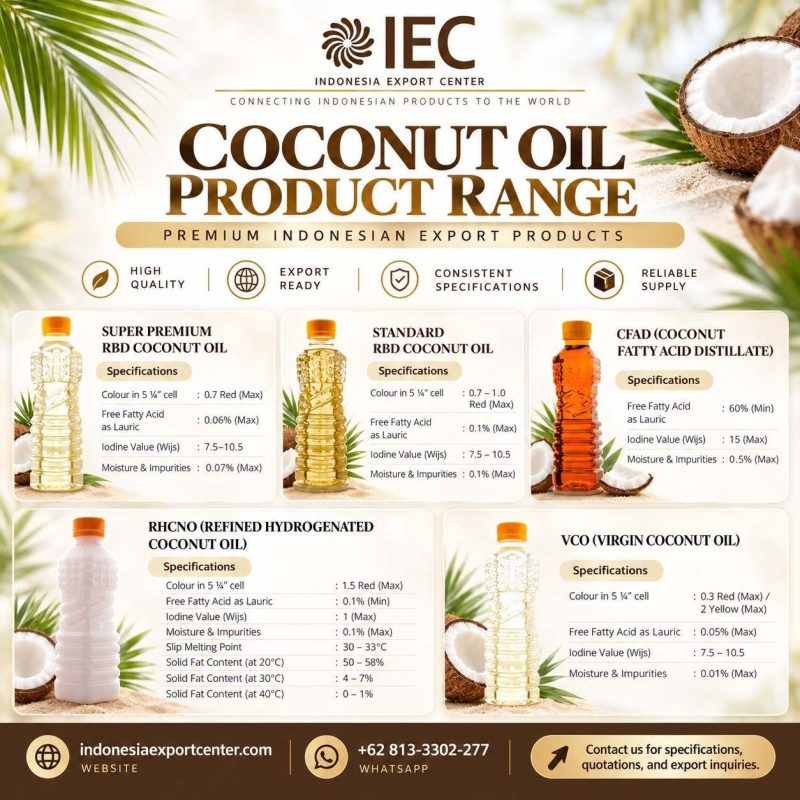
COCONUT OIL PRODUCT RANGE | PREMIUM INDONESIAN EXPORT PRODUCTS
Source Hydrogenated Coconut Oil for Cosmetic Formulation Development
Looking for a hydrogenated coconut oil cosmetic ingredient for skincare, personal care, or specialty cosmetic formulation development?
Hydrogenated Coconut Oil is a coconut-derived material processed through hydrogenation to modify its degree of unsaturation and physical properties.
Refined Hydrogenated Coconut Oil (RHCNO) may be evaluated by cosmetic formulators seeking a fat-based ingredient with specific melting characteristics, solid fat content, and formulation behaviour.
Depending on the verified grade and complete formulation, hydrogenated coconut oil may be investigated for functions such as emolliency, consistency modification, and structuring in selected cosmetic products.
However, the material’s actual suitability depends on its verified identity, purity, cosmetic-grade documentation, stability, compatibility, and intended use.
IEC | Indonesia Export Center facilitates sourcing and export enquiries for Indonesian coconut-derived products, including potential Refined Hydrogenated Coconut Oil supply.
IEC welcomes enquiries from cosmetic formulators, personal care manufacturers, skincare brands, ingredient distributors, and international procurement teams.
Request hydrogenated coconut oil specifications and a bulk cosmetic ingredient quotation.
WhatsApp: +62 813-3302-277
Website: https://indonesiaexportcenter.com/
Cosmetic-grade status, INCI identity, purity, certifications, COA, stock availability, MOQ, packaging, and export arrangements must be verified before commercial use.
Hydrogenated Coconut Oil Cosmetic Ingredient Overview
| Item | Information |
|---|---|
| Product | Refined Hydrogenated Coconut Oil |
| Abbreviation | RHCNO |
| Ingredient Category | Hydrogenated Coconut-Derived Fat |
| Potential INCI Name | Hydrogenated Coconut Oil – Subject to Identity Verification |
| Proposed Sourcing Country | Indonesia |
| Target Market | Global |
| Primary Buyers | Cosmetic Formulators |
| Other Buyers | Personal Care Manufacturers, Skincare Brands, Cosmetic Ingredient Distributors |
| Potential Functions | Emollient and Consistency-Related Functions, Subject to Formulation Testing |
| Cosmetic-Grade Status | To Be Verified |
| Purity | To Be Verified |
| Lot-Specific COA | To Be Requested and Verified |
| Safety Data Sheet | To Be Requested and Verified |
| Regulatory Documentation | To Be Verified |
| Manufacturer | To Be Verified |
| Certifications | To Be Verified |
| Packaging | To Be Confirmed |
| MOQ | To Be Confirmed |
| Available Quantity | To Be Confirmed |
| Price per MT | Request Quotation |
| Shipment Lead Time | To Be Confirmed |
RHCNO Reference Technical Specifications
The following are supplied reference specifications for Refined Hydrogenated Coconut Oil.
| Technical Parameter | Reference Specification |
|---|---|
| Colour in 5¼” Cell | 1.5 Red (Max) |
| Free Fatty Acid as Lauric | 0.1% (Min) – Requires Verification |
| Iodine Value (Wijs) | 1 (Max) |
| Moisture & Impurities | 0.1% (Max) |
| Slip Melting Point | 30–33°C |
| Solid Fat Content at 20°C | 50–58% |
| Solid Fat Content at 30°C | 4–7% |
| Solid Fat Content at 40°C | 0–1% |
Important: These figures are reference specification limits and ranges, not actual lot-specific Certificate of Analysis results.
The supplied FFA specification states 0.1% minimum. Because this is an unusual acceptance direction for refined oil, the correct limit must be confirmed with the manufacturer.
The supplied specifications do not independently establish cosmetic-grade purity, ingredient identity, or regulatory suitability.
What Is Hydrogenated Coconut Oil in Cosmetics?
Hydrogenated coconut oil is derived from coconut oil that has undergone hydrogenation.
Hydrogenation reduces carbon-carbon double bonds in unsaturated fatty acid components.
This process may influence:
- Degree of unsaturation
- Melting behaviour
- Solid fat content
- Consistency
- Crystallization characteristics
- Oxidative behaviour
- Formulation texture
In cosmetic formulations, hydrogenated fats may be evaluated for their contribution to product structure and sensory characteristics.
However, their actual functionality depends on the ingredient grade and complete formulation.
Hydrogenated Coconut Oil INCI Name
For cosmetic ingredient procurement, INCI identity is an important consideration.
Potential INCI Name: Hydrogenated Coconut Oil
This designation must be verified against the actual manufacturer’s product identity and applicable cosmetic ingredient nomenclature.
Why INCI Verification Matters
INCI names support consistent identification of cosmetic ingredients.
Correct ingredient identity is important for:
- Formulation documentation
- Ingredient labeling
- Regulatory review
- Product information files
- Supplier qualification
- Traceability
Documents to Request
- Manufacturer product specification
- Confirmed INCI name
- Ingredient composition statement
- CAS identification where applicable
- Safety Data Sheet
- Lot-specific COA
- Regulatory documentation
The INCI name should not be treated as confirmed solely because a product is marketed as RHCNO.
Potential Cosmetic Functions of Hydrogenated Coconut Oil
Depending on the verified grade and formulation, hydrogenated coconut oil may be evaluated for several cosmetic functions.
1. Emollient Function
Fat-based ingredients may contribute to the sensory characteristics of cosmetic products.
Hydrogenated coconut oil may be evaluated for its potential emollient contribution in suitable formulations.
2. Consistency Modification
Hydrogenated fats may influence product firmness and consistency.
RHCNO may be investigated as a component in formulations requiring particular physical characteristics.
3. Structuring
RHCNO may be evaluated as a structuring component in selected anhydrous or emulsion-based formulations.
4. Texture Modification
The ingredient may influence the texture and sensory properties of a cosmetic product.
5. Formulation Stability
The physical characteristics of hydrogenated coconut oil may influence formulation behaviour.
However, no stability improvement is guaranteed without testing.
These are potential formulation functions, not verified performance claims for the referenced material.
Potential Applications in Skincare and Personal Care
Hydrogenated coconut oil may be evaluated in selected cosmetic product categories.
Skincare Creams
Formulators may investigate RHCNO as part of the oil phase or structuring system.
Evaluation Parameters
- Emulsion compatibility
- Texture
- Viscosity
- Stability
- Sensory performance
- Processing temperature
Body Balms
Anhydrous balm formulations may require fats with specific melting and consistency characteristics.
RHCNO may be evaluated as one component in such systems.
Lip Care Products
Lip care formulations often require careful control of firmness, melting behaviour, and sensory properties.
RHCNO may be considered for technical evaluation, subject to cosmetic-grade and regulatory verification.
Personal Care Sticks
Stick products require a suitable balance of hardness, application characteristics, and stability.
RHCNO may be investigated as a component in selected formulations.
Hair Care Products
Certain hair care formulations contain fatty materials selected for texture and conditioning-related properties.
RHCNO may be evaluated where appropriate.
Specialty Cosmetic Fat Blends
Cosmetic ingredient manufacturers may evaluate RHCNO in blends developed for specific formulation requirements.
No particular cosmetic application has been independently verified as approved for the referenced RHCNO.
RHCNO Solid Fat Content for Cosmetic Formulations
Solid fat content (SFC) describes the proportion of fat that remains solid under specified test conditions.
For cosmetic formulation, SFC may be relevant to consistency and melting behaviour.
Reference Solid Fat Content Profile
| Temperature | Solid Fat Content |
|---|---|
| 20°C | 50–58% |
| 30°C | 4–7% |
| 40°C | 0–1% |
These are reference specification ranges, not actual lot-specific measurements.
At 20°C
The supplied profile indicates a substantial solid fraction.
This may be relevant to firmness and structure in suitable formulations.
At 30°C
The reference SFC decreases to 4–7%.
This indicates a substantial reduction in the solid fraction over the measured temperature interval.
At 40°C
The supplied reference indicates 0–1% remaining solid fat.
This may be useful when evaluating melting characteristics.
Important Formulation Consideration
The SFC profile of the raw material does not independently determine the behaviour of the finished cosmetic product.
The complete formulation must be tested.
Slip Melting Point and Cosmetic Texture
The supplied RHCNO slip melting point is:
30–33°C
Slip melting point provides an indication of melting behaviour under standardized test conditions.
For cosmetic formulators, this may support initial ingredient screening.
Why It Matters
Slip melting point may influence:
- Processing temperature
- Ingredient handling
- Product consistency
- Melting characteristics
- Sensory evaluation
However, slip melting point alone does not establish skin feel, spreadability, or finished product stability.
These characteristics require formulation testing.
RHCNO Iodine Value and Oxidative Behaviour
The supplied iodine value specification is:
Iodine Value (Wijs): 1 Maximum
A low iodine value generally indicates a low degree of unsaturation.
Hydrogenation can influence the oxidative behaviour of a fat.
However, iodine value alone does not establish oxidative stability or shelf life.
Recommended Stability Evaluation
- Oxidative stability testing where appropriate
- Storage studies
- Appearance monitoring
- Odour evaluation
- Colour stability
- Formulation compatibility
- Packaging compatibility
No specific shelf life or oxidation-resistance claim has been verified.
Cosmetic Ingredient Purity Requirements
Purity is an important consideration when selecting cosmetic raw materials.
The supplied RHCNO reference specifications do not provide a complete cosmetic purity profile.
Recommended Purity Assessment
- Product identity
- Free fatty acid content
- Moisture and impurities
- Colour
- Iodine value
- Fatty acid composition
- Relevant residual processing materials
- Relevant contaminants
- Odour and appearance
- Other buyer-defined purity parameters
Why Purity Matters
Impurities and compositional variation may influence:
- Product appearance
- Odour
- Formulation stability
- Processing behaviour
- Quality consistency
- Regulatory suitability
The required acceptance limits depend on the intended cosmetic application and applicable regulations.
RHCNO Free Fatty Acid Specification
The supplied reference states:
Free Fatty Acid as Lauric: 0.1% Minimum
This value requires clarification.
For refined oils, FFA specifications commonly define an upper limit rather than a minimum.
Recommended Buyer Action
Request written confirmation of:
- The correct FFA limit.
- Whether the value is minimum or maximum.
- The analytical method.
- The reporting basis.
- The actual lot-specific result.
The value should not be changed to maximum without manufacturer confirmation.
RHCNO Moisture and Impurities
The supplied reference specification is:
Moisture & Impurities: 0.1% Maximum
Moisture and impurities may affect raw material quality and formulation processing.
Why It Matters
Potential considerations include:
- Storage behaviour
- Product handling
- Processing consistency
- Contamination control
- Finished product quality
Buyers should request actual analytical results and confirm the test method.
RHCNO vs Virgin Coconut Oil in Cosmetic Formulations
RHCNO and Virgin Coconut Oil (VCO) are different coconut-derived materials.
| Comparison Factor | RHCNO | Virgin Coconut Oil |
|---|---|---|
| Product Type | Refined Hydrogenated Coconut Oil | Virgin Coconut Oil |
| Hydrogenation | Yes | Not Inherent |
| Reference Iodine Value | 1 (Max) | 7.5–10.5 |
| Reference Slip Melting Point | 30–33°C | Not Supplied |
| Reference SFC at 20°C | 50–58% | Not Supplied |
| Reference SFC at 30°C | 4–7% | Not Supplied |
| Reference SFC at 40°C | 0–1% | Not Supplied |
| Cosmetic Functionality | Grade-Specific | Grade-Specific |
| INCI Identity | Requires Verification | Requires Verification |
| Application Suitability | Requires Testing | Requires Testing |
These are supplied reference values and general product distinctions, not verified results for specific production lots.
RHCNO vs Standard RBD Coconut Oil
| Comparison Factor | RHCNO | Standard RBD Coconut Oil |
|---|---|---|
| Processing | Refined and Hydrogenated | Refined, Bleached and Deodorized |
| Hydrogenation | Yes | Not Inherent |
| Reference Iodine Value | 1 (Max) | 7.5–10.5 |
| Reference Moisture & Impurities | 0.1% (Max) | 0.1% (Max) |
| Reference Slip Melting Point | 30–33°C | Not Supplied |
| Reference SFC at 20°C | 50–58% | Not Supplied |
| Reference SFC at 30°C | 4–7% | Not Supplied |
| Reference SFC at 40°C | 0–1% | Not Supplied |
| Cosmetic Suitability | Requires Verification | Requires Verification |
RHCNO should not automatically be considered interchangeable with RBD coconut oil in cosmetic formulations.
RHCNO Formulation Stability Testing
Cosmetic formulators should evaluate the actual ingredient in the intended formulation.
Recommended Stability Tests
1. Appearance
Monitor colour, texture, and visible changes.
2. Odour
Evaluate odour changes during storage.
3. Viscosity and Consistency
Measure relevant physical properties.
4. Phase Stability
For emulsions, assess separation and other instability.
5. Temperature Stability
Evaluate the formulation under appropriate storage and temperature conditions.
6. Packaging Compatibility
Confirm compatibility with the intended packaging.
7. Microbiological Suitability
Assess microbiological requirements appropriate to the finished product.
8. Shelf-Life Evaluation
Establish shelf life using appropriate testing and documentation.
No specific stability performance or shelf life is guaranteed for the referenced RHCNO.
Cosmetic Regulatory and Documentation Requirements
Cosmetic raw material requirements vary by destination market.
Buyers should verify:
- Ingredient identity
- INCI name
- Applicable cosmetic regulations
- Safety documentation
- Purity requirements
- Restricted substances
- Relevant contaminants
- Labeling requirements
- Product information requirements
- Traceability
Recommended Supplier Documents
- Current technical specification
- Lot-specific COA
- Safety Data Sheet
- Confirmed INCI name
- Composition statement
- CAS identification where applicable
- Regulatory statement where available
- Relevant contaminant data
- Packaging specifications
- Certification documents where claimed
No specific cosmetic regulatory approval or certification has been independently verified.
RHCNO Certificate of Analysis for Cosmetic Buyers
A lot-specific COA should be reviewed before commercial approval.
| Parameter | Reference Specification | Actual Lot Result |
|---|---|---|
| Colour in 5¼” Cell | 1.5 Red (Max) | To Be Verified |
| FFA as Lauric | 0.1% (Min) – Requires Clarification | To Be Verified |
| Iodine Value (Wijs) | 1 (Max) | To Be Verified |
| Moisture & Impurities | 0.1% (Max) | To Be Verified |
| Slip Melting Point | 30–33°C | To Be Verified |
| SFC at 20°C | 50–58% | To Be Verified |
| SFC at 30°C | 4–7% | To Be Verified |
| SFC at 40°C | 0–1% | To Be Verified |
| Fatty Acid Composition | Buyer-Defined | To Be Verified |
| Relevant Purity Parameters | Buyer-Defined | To Be Verified |
| Other Cosmetic Requirements | Buyer-Defined | To Be Verified |
COA Verification Checklist
-
Manufacturer or laboratory identity
-
Product name and grade
-
Lot or batch number
-
Test date
-
Analytical methods
-
Actual results
-
Units of measurement
-
Specification limits
-
Authorized approval
-
Shipment traceability
A generic technical specification is not a substitute for a lot-specific COA.
Bulk RHCNO Packaging for Cosmetic Manufacturing
Packaging should be selected according to the actual product characteristics and supplier capability.
Potential arrangements may include:
- Suitable industrial drums
- Compatible bulk containers
- Other supplier-approved packaging formats
Packaging Verification
- Packaging material
- Product compatibility
- Net weight
- Gross weight
- Closure system
- Storage requirements
- Contamination prevention
- Lot identification
- Transport suitability
No specific packaging configuration has been verified as available.
RHCNO MOQ, Pricing and Export Terms
International cosmetic ingredient buyers may request quotations based on their requirements.
Commercial Details to Confirm
- Product grade
- Required quantity
- Minimum order quantity
- Available quantity
- Packaging
- Price per MT
- Currency
- Origin port
- Destination port
- Incoterm
- Payment terms
- Production lead time
- Shipment lead time
- Quotation validity
Possible Incoterms
Depending on the shipment arrangement, quotations may be requested using FCA, FOB, CFR, CIF, or CIP.
For containerized cargo handed to a carrier before vessel loading, FCA is often more appropriate than FOB.
All prices and commercial terms require supplier confirmation.
Cosmetic Ingredient Procurement Checklist
Before placing an order, verify:
-
Manufacturer identity
-
Product identity as RHCNO
-
Confirmed INCI name
-
CAS identification where applicable
-
Cosmetic-grade status
-
Intended cosmetic application
-
Technical specification
-
Iodine value
-
Slip melting point
-
SFC at 20°C
-
SFC at 30°C
-
SFC at 40°C
-
FFA specification direction
-
Moisture and impurities
-
Colour
-
Fatty acid composition
-
Purity requirements
-
Relevant contaminant data
-
Formulation compatibility
-
Stability test results
-
Lot-specific COA
-
Safety Data Sheet
-
Regulatory documentation
-
Packaging suitability
-
MOQ
-
Available quantity
-
Price per MT
-
Export terms
-
Destination-country cosmetic regulations
Request for Quotation – Hydrogenated Coconut Oil Cosmetic Ingredient
Subject: RFQ – Refined Hydrogenated Coconut Oil for Cosmetic Formulations
Dear IEC | Indonesia Export Center Team,
We are evaluating Refined Hydrogenated Coconut Oil for potential use in cosmetic and personal care formulations.
Please advise whether a suitable Indonesian manufacturer can provide cosmetic-grade RHCNO meeting our technical and commercial requirements.
BUYER INFORMATION
Company Name: [Company Name] Country: [Country] Business Type: [Cosmetic Manufacturer / Skincare Brand / Personal Care Manufacturer / Ingredient Importer / Distributor] Contact Person: [Name] Email: [Email] WhatsApp: [Number]
PRODUCT REQUIREMENTS
Product: Refined Hydrogenated Coconut Oil (RHCNO)
Intended Application: [Skincare Cream / Balm / Lip Care / Personal Care Stick / Hair Care / Other]
Required Quantity: [MT]
Order Frequency: [Trial / One-Time / Monthly / Other]
REFERENCE SPECIFICATIONS
| Parameter | Required Value |
|---|---|
| Colour in 5¼” Cell | 1.5 Red (Max) |
| FFA as Lauric | Please Confirm Correct Limit and Direction |
| Iodine Value (Wijs) | 1 (Max) |
| Moisture & Impurities | 0.1% (Max) |
| Slip Melting Point | 30–33°C |
| SFC at 20°C | 50–58% |
| SFC at 30°C | 4–7% |
| SFC at 40°C | 0–1% |
| INCI Name | Please Confirm |
| Cosmetic-Grade Status | Verification Required |
| Fatty Acid Composition | Request Analysis |
| Purity Requirements | Buyer-Defined |
| Additional Requirements | [Specify] |
DOCUMENTATION REQUESTED
Please provide, where available:
- Manufacturer legal name and facility location
- Current RHCNO technical specification
- Lot-specific COA
- Safety Data Sheet
- Confirmed INCI name
- CAS identification where applicable
- Composition statement
- Confirmation of cosmetic-grade status
- Iodine value result
- Slip melting point result
- Solid fat content profile
- Fatty acid composition
- Relevant purity and contaminant data
- Packaging specifications
- Storage and handling recommendations
- Relevant certification documents, if claimed
- Sample availability
COMMERCIAL REQUIREMENTS
Preferred Packaging: [Specify] Required Quantity: [MT] Destination Country: [Country] Destination Port: [Port] Requested Incoterm: [FCA / FOB / CFR / CIF / CIP / Other] Target Shipment Period: [Month / Year]
Please advise:
- Minimum order quantity
- Available quantity
- Price per MT
- Currency
- Packaging options
- Indonesian origin port
- Production lead time
- Estimated shipment lead time
- Payment terms
- Quotation validity
- Recurring supply capability
We will review cosmetic-grade suitability, formulation performance, and destination-country regulatory requirements before commercial approval.
Thank you. We look forward to your response.
Kind regards,
[Your Name] [Company Name] [Country]SEND YOUR RHCNO COSMETIC INGREDIENT ENQUIRY VIA WHATSAPP
Frequently Asked Questions – Hydrogenated Coconut Oil Cosmetic Ingredient
1. What is hydrogenated coconut oil?
Hydrogenated coconut oil is coconut-derived oil processed through hydrogenation to modify its degree of unsaturation and physical characteristics.
2. Can RHCNO be used in cosmetics?
Potentially, depending on the verified ingredient grade, purity, formulation, and applicable regulations.
3. What is the INCI name for hydrogenated coconut oil?
Hydrogenated Coconut Oil is a potential INCI designation, but it must be confirmed against the actual manufacturer’s product identity.
4. Is RHCNO the same as virgin coconut oil?
No. RHCNO is hydrogenated, while virgin coconut oil is not inherently hydrogenated.
5. Can RHCNO act as an emollient?
It may be evaluated for emollient-related functionality in suitable formulations.
6. Can RHCNO be used in skincare creams?
Potentially, subject to cosmetic-grade verification and formulation testing.
7. Can RHCNO be used in balms and lip care?
Potentially, depending on the formulation and regulatory requirements.
8. What is the supplied RHCNO slip melting point?
30–33°C.
9. What is the supplied RHCNO iodine value?
1 maximum, using the Wijs method.
10. What is the supplied RHCNO SFC at 20°C?
50–58%.
11. What is the supplied RHCNO SFC at 30°C?
4–7%.
12. What is the supplied RHCNO SFC at 40°C?
0–1%.
13. Is RHCNO automatically cosmetic grade?
No. Cosmetic-grade status must be verified with the manufacturer.
14. Can buyers request a lot-specific COA?
Yes. Actual availability must be confirmed.
15. What is the minimum order quantity?
No fixed MOQ has been verified.
Request Hydrogenated Coconut Oil for Cosmetic Formulations
Selecting a hydrogenated coconut oil cosmetic ingredient requires careful evaluation of INCI identity, purity, melting behaviour, solid fat content, formulation compatibility, and stability.
For cosmetic formulators and personal care manufacturers, the most important considerations include verified technical specifications, regulatory documentation, laboratory trials, and consistent quality.
IEC | Indonesia Export Center welcomes international enquiries for potential Indonesian Refined Hydrogenated Coconut Oil sourcing and export quotations.
IEC | INDONESIA EXPORT CENTER
CONNECTING INDONESIAN PRODUCTS TO THE WORLD
Product: Refined Hydrogenated Coconut Oil (RHCNO)
Product Category: Coconut-Derived Cosmetic Ingredient Candidate
Proposed Sourcing Country: Indonesia
Target Market: Global
Target Buyers: Cosmetic Formulators, Skincare Brands, Personal Care Manufacturers, and Cosmetic Ingredient Importers
Potential INCI Name: Hydrogenated Coconut Oil – Requires Confirmation
Reference Colour: 1.5 Red (Max), 5¼” Cell
Reference FFA as Lauric: 0.1% (Min) – Requires Verification
Reference Iodine Value: 1 (Max)
Reference Moisture & Impurities: 0.1% (Max)
Reference Slip Melting Point: 30–33°C
Reference SFC at 20°C: 50–58%
Reference SFC at 30°C: 4–7%
Reference SFC at 40°C: 0–1%
Cosmetic-Grade Status: To Be Verified
Purity: To Be Verified
Fatty Acid Composition: To Be Verified
Formulation Stability: Application Testing Required
Manufacturer: To Be Verified
Lot-Specific COA: To Be Requested and Verified
Safety Data Sheet: To Be Requested and Verified
Certifications: To Be Verified
MOQ: To Be Confirmed
Available Quantity: To Be Confirmed
Packaging: To Be Confirmed
Price per MT: Request Quotation
Shipment Lead Time: To Be Confirmed
Request RHCNO Cosmetic Ingredient Specifications and Bulk Quotation
Website: https://indonesiaexportcenter.com/
WhatsApp: +62 813-3302-277
REQUEST HYDROGENATED COCONUT OIL COSMETIC INGREDIENT QUOTATION
Contact us for specifications, quotations, and export inquiries.
Technical and Commercial Disclaimer: This page provides general technical and sourcing information about potential Refined Hydrogenated Coconut Oil use in cosmetic formulations. The numerical values shown are supplied reference specifications, not actual lot-specific COA results. The FFA value is reproduced as provided and requires manufacturer verification because its minimum-limit direction is unusual for refined oil. No specific manufacturer, cosmetic-grade approval, INCI identity, certification, COA, SDS, stock, MOQ, packaging configuration, price, production capacity, or shipment lead time has been independently verified. Cosmetic functionality, purity, formulation stability, ingredient identity, and destination-country regulations must be assessed for the actual product and formulation. IEC facilitates sourcing and export enquiries; the actual manufacturer, contractual seller, and exporter of record must be confirmed for each order.
