

IEC | INDONESIA EXPORT CENTER
CONNECTING INDONESIAN PRODUCTS TO THE WORLD
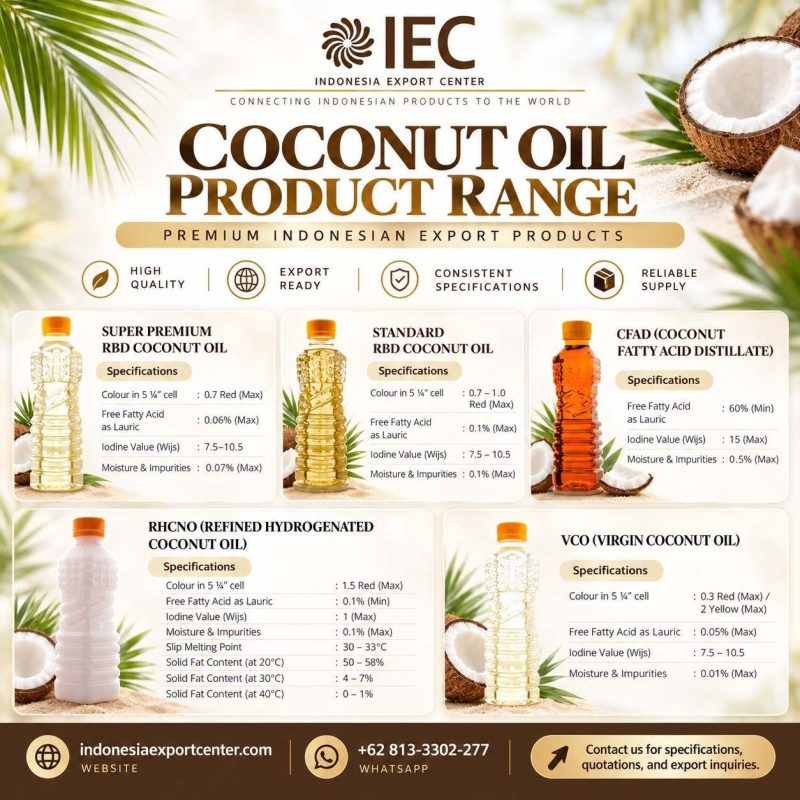
COCONUT OIL PRODUCT RANGE
PREMIUM INDONESIAN EXPORT PRODUCTS
HIGH QUALITY | EXPORT READY | CONSISTENT SPECIFICATIONS | RELIABLE SUPPLY
Super Premium RBD Coconut Oil | Skincare Ingredient Sourcing | Texture Evaluation | Formulation Compatibility | Bulk Procurement
Refined Coconut Oil for Professional Skincare Manufacturing
Are you sourcing refined coconut oil for skincare manufacturing and looking for a coconut-derived ingredient that can be evaluated for creams, lotions, body butters, balms or other skincare formulations?
For skincare brands and cosmetic manufacturers, choosing an oil ingredient involves more than reviewing its basic technical specifications.
The ingredient must also perform appropriately within the finished formulation.
Important considerations include:
- Texture and consistency
- Skin feel and spreadability
- Oil-phase compatibility
- Emulsion stability
- Melting and solidification behavior
- Appearance and odor
- Packaging compatibility
- Finished product stability
- Cosmetic safety and regulatory requirements
Indonesia Export Center (IEC) facilitates sourcing and export enquiries for Indonesian coconut oil products, including Super Premium Refined, Bleached and Deodorised (RBD) Coconut Oil.
The supplied Super Premium reference specifies:
- Colour in 5¼-inch Cell: 0.7 Red (Max)
- Free Fatty Acid as Lauric: 0.06% (Max)
- Iodine Value (Wijs): 7.5–10.5
- Moisture & Impurities: 0.07% (Max)
These values provide a starting point for technical ingredient evaluation.
However, they do not establish the oil’s texture, skin feel, cosmetic-grade status, emulsion compatibility or performance in a particular skincare formulation.
Skincare manufacturers should request appropriate product documentation, representative samples and formulation testing before commercial approval.
REQUEST SUPER PREMIUM RBD COCONUT OIL SPECIFICATIONS FOR SKINCARE MANUFACTURING
WhatsApp: https://wa.me/628133302277
Website: https://indonesiaexportcenter.com/
Manufacturer identity, cosmetic suitability, lot-specific COA, samples, stock, MOQ, packaging, certifications and delivery terms require verification.
1. Premium RBD Coconut Oil for Skincare – Product Overview
| Procurement Item | Information |
|---|---|
| Product | Super Premium RBD Coconut Oil |
| Product Type | Refined, Bleached and Deodorised Coconut Oil |
| Product Category | Coconut-Derived Oil |
| Proposed Sourcing Country | Indonesia |
| Target Market | Global |
| Primary Buyers | Skincare Brands and Manufacturers |
| Additional Buyers | Cosmetic Formulators, Contract Manufacturers, Ingredient Distributors |
| Commonly Used INCI | Cocos Nucifera (Coconut) Oil — Manufacturer Confirmation Required |
| Product Grade | Super Premium RBD |
| Intended Application | Skincare Formulation Evaluation |
| Cosmetic-Grade Suitability | To Be Verified |
| Reference Colour | 0.7 Red (Max), 5¼-inch Cell |
| Reference FFA as Lauric | 0.06% (Max) |
| Reference Iodine Value | 7.5–10.5 |
| Reference Moisture & Impurities | 0.07% (Max) |
| Texture Profile | Requires Sample Evaluation |
| Melting Characteristics | To Be Verified |
| Skin Feel | Requires Formulation Testing |
| Emulsion Compatibility | Requires Formulation Testing |
| Manufacturer | To Be Verified |
| Contractual Seller | To Be Confirmed |
| Exporter of Record | To Be Confirmed |
| Batch COA | To Be Requested and Verified |
| SDS | To Be Requested |
| MOQ | To Be Confirmed |
| Available Quantity | To Be Confirmed |
| Packaging | To Be Confirmed |
| Price per MT | Request Quotation |
| Lead Time | To Be Confirmed |
2. What Is Refined Coconut Oil for Skincare Manufacturing?
Refined coconut oil is coconut oil that has undergone processing intended to modify characteristics such as color, odor and certain impurities.
It may be evaluated as an oil-phase ingredient in suitable skincare formulations.
3. What Does RBD Mean?
RBD stands for Refined, Bleached and Deodorised.
4. Why Skincare Manufacturers Consider RBD Coconut Oil
Manufacturers may evaluate RBD Coconut Oil for its composition, physical characteristics and compatibility with the desired formulation.
5. Is RBD Coconut Oil a Finished Skincare Product?
No.
It is a potential raw material for further formulation and manufacturing.
6. Is Super Premium a Cosmetic Certification?
No.
Super Premium is the supplied product-grade designation, not evidence of cosmetic certification.
7. Is the Product Automatically Cosmetic Grade?
No.
Cosmetic-grade suitability requires appropriate verification.
8. Why Formulation Testing Matters
The behavior of an ingredient in a finished product cannot be determined solely from its reference specifications.
Texture and Sensory Performance in Skincare
9. Why Texture Matters
Texture influences how a skincare formulation is handled, dispensed, applied and perceived.
10. Coconut Oil and Physical State
Coconut oil can change between solid and liquid states depending on temperature.
This behavior is important when developing temperature-sensitive formulations.
11. Melting Characteristics
The melting behavior of the actual RBD Coconut Oil should be verified where it affects the formulation.
No specific melting-point specification has been supplied for Super Premium RBD Coconut Oil.
12. Texture at Room Temperature
The oil’s physical state depends on the actual temperature and product characteristics.
13. Texture at Elevated Temperature
Elevated temperatures may change the oil’s physical state and influence the formulation process.
14. Texture at Lower Temperature
Lower temperatures may promote solidification or crystallization.
15. Spreadability
Spreadability should be evaluated in the finished formulation.
16. Skin Feel
Skin feel is influenced by the complete formulation, not one ingredient alone.
17. Greasiness
Perceived greasiness should be evaluated through appropriate sensory testing.
18. Absorption Perception
Consumer perception of absorption depends on the overall formulation and testing conditions.
19. Residual Feel
Residual feel should be evaluated in the finished product.
20. Sensory Balance
Formulators may adjust the oil phase and other ingredients to achieve the intended sensory profile.
21. Consistency Across Temperatures
Temperature-dependent consistency should be evaluated where relevant.
22. Crystallization Behavior
Crystallization may affect the appearance and texture of certain formulations.
23. Graininess
Graininess may be a concern in some anhydrous formulations and should be assessed through stability testing.
24. Texture During Storage
Storage conditions may influence texture.
25. Texture During Application
The finished product should be tested under realistic application conditions.
26. Sensory Panel Evaluation
A defined sensory evaluation procedure may help compare candidate formulations.
Formulation Compatibility and Emulsion Performance
27. What Is Formulation Compatibility?
Formulation compatibility refers to whether an ingredient performs appropriately alongside the other ingredients and processing conditions.
28. Oil-Phase Compatibility
The compatibility of RBD Coconut Oil with other oil-phase ingredients should be evaluated.
29. Emulsion Compatibility
For emulsions, the ingredient should be evaluated with the selected emulsifier system.
30. Oil-in-Water Emulsions
The oil may be evaluated in suitable oil-in-water emulsion systems.
31. Water-in-Oil Emulsions
Suitability for water-in-oil systems requires formulation testing.
32. Emulsifier Selection
Emulsifier selection should be based on the full formulation and processing requirements.
33. Emulsion Stability
The finished emulsion should be evaluated for stability.
34. Phase Separation
Formulators should monitor potential phase separation.
35. Viscosity
The oil may influence viscosity, but actual behavior depends on the complete formulation.
36. Rheological Properties
Rheological testing may be relevant for creams and lotions.
37. Mixing Conditions
Mixing speed, time and temperature should be established during development.
38. Processing Temperature
Processing temperatures should be suitable for the ingredients and formulation.
39. Cooling Profile
Cooling conditions may influence crystallization and texture.
40. Homogenization
Homogenization requirements depend on the emulsion system.
41. Ingredient Interactions
Interactions with waxes, butters, emulsifiers and other ingredients should be evaluated.
42. Fragrance Compatibility
Fragrance compatibility should be assessed where relevant.
43. Preservative System Compatibility
The finished formulation’s preservative system must be appropriately evaluated.
44. Packaging Compatibility
The finished product should be assessed with the intended packaging.
45. Scale-Up Compatibility
Laboratory performance should be confirmed during pilot and production-scale trials.
Skincare Product Applications
46. Facial Creams
RBD Coconut Oil may be evaluated as part of the oil phase in suitable facial cream formulations.
47. Body Lotions
The oil may be considered for selected body lotion formulations.
48. Body Creams
It may be evaluated for appropriate body cream applications.
49. Body Butters
The oil may be considered for body butter formulations where its physical behavior is suitable.
50. Moisturizing Balms
It may be evaluated for selected balm formulations.
51. Cleansing Balms
The oil may be considered in suitable cleansing balm systems.
52. Massage Products
The oil may be evaluated for appropriate massage formulations.
53. Hand Creams
It may be considered for suitable hand care products.
54. Foot Care Products
The oil may be evaluated for appropriate foot care formulations.
55. Lip Care Products
Suitability for lip care formulations requires appropriate technical and safety evaluation.
56. Anhydrous Skincare Products
The oil may be evaluated in formulations that do not contain an added water phase.
57. Emulsified Skincare Products
The oil may be evaluated in emulsified products, subject to compatibility testing.
58. Private Label Skincare
Private label manufacturers may assess the ingredient for their formulation requirements.
59. Contract Manufacturing
Contract manufacturers may evaluate the ingredient against client-approved specifications.
60. Specialty Skincare Formulations
The oil may be considered for specialized formulations where its properties meet the design requirements.
Application suitability must be established through appropriate testing. No universal concentration, performance or safety claim is made.
Super Premium RBD Coconut Oil Reference Specifications
61. Technical Specification Table
| Quality Parameter | Super Premium Reference |
|---|---|
| Colour in 5¼-inch Cell | 0.7 Red (Max) |
| Free Fatty Acid as Lauric | 0.06% (Max) |
| Iodine Value (Wijs) | 7.5–10.5 |
| Moisture & Impurities | 0.07% (Max) |
These are supplied reference specifications, not verified batch COA results.
62. Color Specification
0.7 Red (Max), 5¼-inch Cell
The manufacturer should confirm the applicable color measurement system and method.
63. FFA Specification
0.06% (Max), expressed as Lauric
FFA is one of several parameters relevant to oil quality.
64. Iodine Value
7.5–10.5 (Wijs)
Iodine value is associated with the degree of unsaturation.
65. Moisture and Impurities
0.07% (Max)
Actual lot results require verification.
66. Does Low FFA Prove Better Skin Feel?
No.
Skin feel requires sensory and formulation testing.
67. Does Low Color Prove Cosmetic Suitability?
No.
Color is only one quality parameter.
68. Does Iodine Value Predict Emulsion Stability?
Not by itself.
Emulsion stability depends on the complete formulation.
69. Does Moisture Content Predict Finished Product Stability?
Not by itself.
Finished product stability requires separate testing.
70. Additional Technical Requirements
Buyers may request additional data depending on the formulation and regulatory requirements.
Cosmetic Ingredient Identity and INCI
71. Commonly Used INCI Name
The commonly used INCI name for coconut oil is:
Cocos Nucifera (Coconut) Oil
The actual supplied material’s correct INCI designation must be confirmed by the manufacturer.
72. INCI vs Commercial Grade
The INCI name identifies the ingredient.
The commercial grade describes a supplier’s product classification.
73. Manufacturer Declaration
Request a manufacturer-issued ingredient identity declaration.
74. Composition Information
Request appropriate information about the ingredient’s composition.
75. SDS
Request a current Safety Data Sheet for the actual product.
76. COA
Request a Certificate of Analysis linked to the relevant lot.
77. Technical Data Sheet
Request a current manufacturer-issued technical data sheet.
78. Regulatory Documentation
Request applicable documentation for the destination market.
79. Ingredient Labeling
The finished product manufacturer should verify labeling requirements.
80. Cosmetic Claims
Claims about ingredient benefits or finished product performance require appropriate substantiation.
Formulation Testing Before Commercial Approval
81. Representative Sample
Request a representative sample, subject to availability.
82. Raw Material Inspection
Review the sample’s identity and relevant quality characteristics.
83. Texture Evaluation
Evaluate texture under appropriate conditions.
84. Appearance Evaluation
Assess appearance where relevant.
85. Odor Evaluation
Assess odor under defined conditions.
86. Melting Behavior
Evaluate temperature-dependent behavior where relevant.
87. Prototype Formulation
Develop a suitable laboratory prototype.
88. Compatibility Testing
Assess compatibility with other ingredients.
89. Initial Stability Screening
Conduct appropriate preliminary stability testing.
90. Accelerated Stability Testing
Accelerated stability testing may help identify potential formulation problems.
91. Real-Time Stability Testing
Real-time stability evaluation may be necessary.
92. Freeze-Thaw Testing
Freeze-thaw testing may be relevant for certain products and distribution conditions.
93. Temperature Cycling
Temperature cycling may help evaluate texture and stability changes.
94. Centrifuge Testing
Centrifuge testing may be useful for certain emulsion systems.
95. Viscosity Monitoring
Viscosity may be monitored during stability evaluation.
96. Phase Separation Monitoring
Monitor relevant physical changes.
97. Color Monitoring
Assess color changes where relevant.
98. Odor Monitoring
Assess odor changes where relevant.
99. Packaging Compatibility Testing
Evaluate the finished product with its intended packaging.
100. Microbiological Evaluation
The finished product’s microbiological requirements should be assessed as applicable.
101. Preservative Efficacy Testing
Preservative efficacy testing may be necessary for appropriate formulations.
102. Safety Assessment
The finished product requires appropriate safety assessment.
103. Pilot Production
Pilot production may help confirm manufacturing feasibility.
104. Commercial Scale-Up
Scale-up should follow successful technical evaluation.
105. Product Approval
The formulator or responsible business should approve the ingredient and finished product before commercial use.
Super Premium vs Standard RBD Coconut Oil for Skincare
106. Reference Grade Comparison
| Quality Parameter | Super Premium RBD | Standard RBD |
|---|---|---|
| Colour in 5¼-inch Cell | 0.7 Red (Max) | 0.7–1.0 Red (Max) |
| FFA as Lauric | 0.06% (Max) | 0.1% (Max) |
| Iodine Value (Wijs) | 7.5–10.5 | 7.5–10.5 |
| Moisture & Impurities | 0.07% (Max) | 0.1% (Max) |
Technical clarification: The Standard RBD color reference combines a range and a maximum designation. The manufacturer should clarify the intended acceptance limit.
107. Does Super Premium Have Better Texture?
Not established by the supplied specifications.
108. Does Super Premium Improve Emulsion Stability?
Not automatically.
109. Does Lower FFA Mean Better Skincare Performance?
Not necessarily.
110. Can Standard RBD Be Used for Skincare?
It may be evaluated if it meets the required technical and regulatory criteria.
111. How Should Buyers Compare Grades?
Compare actual lot results and performance in the intended formulation.
112. Grade Selection
The appropriate grade is the one that meets the full approved specification and formulation requirements.
RBD Coconut Oil vs Virgin Coconut Oil for Skincare
113. Processing Difference
RBD Coconut Oil is refined, bleached and deodorised.
Virgin Coconut Oil is produced through different processing approaches.
114. Odor Considerations
RBD coconut oil is generally associated with a relatively neutral odor profile.
Virgin coconut oil may retain a more characteristic coconut aroma.
Actual sensory characteristics require verification.
115. Reference Specification Comparison
| Quality Parameter | Super Premium RBD | Virgin Coconut Oil |
|---|---|---|
| Colour in 5¼-inch Cell | 0.7 Red (Max) | 0.3 Red (Max) / 2 Yellow (Max) |
| FFA as Lauric | 0.06% (Max) | 0.05% (Max) |
| Iodine Value (Wijs) | 7.5–10.5 | 7.5–10.5 |
| Moisture & Impurities | 0.07% (Max) | 0.01% (Max) |
These are reference specifications, not verified batch results.
116. Texture Comparison
Texture should be compared through testing.
117. Formulation Compatibility
Both materials require formulation-specific evaluation.
118. Ingredient Positioning
Marketing positioning should reflect substantiated product characteristics.
119. Substitution Decisions
Substitution should require technical approval.
Skincare Manufacturing Quality Assurance
120. Manufacturer Qualification
Verify the actual manufacturer and relevant quality procedures.
121. Raw Material Specification
Obtain the current manufacturer-issued specification.
122. Batch COA
Request actual batch-specific results.
123. Lot Traceability
Ensure the material can be traced to the relevant lot.
124. Change Control
Relevant ingredient changes should be communicated under agreed procedures.
125. Stability Information
Request available ingredient stability information.
126. Storage Conditions
Confirm recommended storage conditions.
127. Shelf-Life Information
Shelf-life information should be supported by product-specific evidence.
128. Contaminant Requirements
Review applicable contaminant requirements.
129. Cosmetic Regulatory Compliance
Verify relevant requirements for the destination market.
130. Certification Verification
Verify any claimed certifications and their scope.
131. Incoming Quality Control
Establish an appropriate receiving inspection procedure.
132. Nonconforming Material
Define procedures for nonconforming lots.
Bulk Packaging and International Procurement
133. Bulk Quantity
Specify the required quantity in metric tons.
134. Minimum Order Quantity
No fixed MOQ has been verified.
135. Available Quantity
Availability must be confirmed.
136. Steel Drum Packaging
Buyers may request steel drum packaging information.
Availability requires confirmation.
137. IBC Tank Packaging
Buyers may request IBC packaging information.
Availability requires confirmation.
138. Flexitank Arrangements
Buyers may request flexitank arrangements.
Suitability and availability require verification.
139. Packaging Cleanliness
Packaging should protect the ingredient from contamination.
140. Packaging Compatibility
Packaging materials should be appropriate for the ingredient.
141. Temperature Management
Coconut oil may change physical state depending on temperature.
142. Storage and Transport
Storage and transport arrangements should protect the agreed product quality.
143. Packaging Traceability
Packaging should support product and lot identification.
Export Quotation and Shipping Terms
144. Price per MT
Request a current quotation.
145. Currency
Confirm the quotation currency.
146. FOB Indonesia
Under Incoterms® 2020, FOB risk generally transfers when goods are loaded on board at the named shipment port.
For certain containerised shipments, FCA may be more appropriate.
147. CFR Destination
Under CFR, the seller contracts and pays for carriage to the named destination port.
Risk generally transfers on board at origin.
148. CIF Destination
Under CIF, the seller contracts and pays for carriage and obtains the insurance required by the rule.
Risk generally transfers on board at origin.
For certain containerised shipments, CIP may be more appropriate.
149. Origin Port
The actual Indonesian shipment port must be confirmed.
150. Destination Port
The buyer should specify the destination port.
151. Freight and Insurance
Actual freight and insurance costs require confirmation.
152. Payment Terms
Payment terms should be agreed with the contractual seller.
153. Lead Time
No fixed lead time has been verified.
154. Export Documentation
Depending on the transaction, documents may include:
- Commercial invoice
- Packing list
- Bill of lading
- Certificate of Origin
- Certificate of Analysis
- Insurance documents
- Other applicable certificates
155. Import Compliance
The importer should verify destination-market requirements.
Skincare Ingredient Procurement Checklist
Ingredient Identity
-
Manufacturer identified
-
Product grade confirmed
-
INCI name confirmed
-
Ingredient identity documentation obtained
-
Intended skincare application defined
Technical Quality
-
Manufacturer specification obtained
-
Color specification confirmed
-
FFA specification confirmed
-
Iodine value confirmed
-
Moisture and impurities confirmed
-
Relevant additional tests identified
-
Batch COA requested
-
SDS requested
-
Cosmetic suitability verified
Formulation Compatibility
-
Representative sample evaluated
-
Texture evaluated
-
Melting behavior assessed
-
Skin feel evaluated
-
Spreadability assessed
-
Oil-phase compatibility tested
-
Emulsion compatibility tested where relevant
-
Stability testing performed
-
Packaging compatibility evaluated
-
Pilot production completed where required
Commercial Procurement
-
MOQ confirmed
-
Available quantity confirmed
-
Packaging confirmed
-
Price per MT obtained
-
Currency confirmed
-
Incoterm agreed
-
Named port confirmed
-
Payment terms agreed
-
Lead time confirmed
-
Export documentation reviewed
RFQ Template – Refined Coconut Oil for Skincare Manufacturing
Subject: RFQ – Super Premium RBD Coconut Oil for Skincare Manufacturing
Dear Indonesia Export Center Team,
We are evaluating Super Premium RBD Coconut Oil from Indonesia for skincare formulation and manufacturing.
Please provide the current manufacturer-issued specification, INCI documentation, SDS, lot-specific COA information, relevant physical property data, packaging options and commercial quotation.
Buyer Information
Company Name: [Company Name]
Country: [Country]
Business Type: [Skincare Brand / Cosmetic Manufacturer / Contract Manufacturer / Ingredient Distributor / Other]
Contact Person: [Name]
Email: [Email]
Phone / WhatsApp: [Number]
Product Requirements
Product: Super Premium RBD Coconut Oil
Expected INCI: Cocos Nucifera (Coconut) Oil — Manufacturer Confirmation Required
Intended Application: [Cream / Lotion / Balm / Body Butter / Cleanser / Other]
Required Quantity: [MT]
Expected Order Frequency: [One-Time / Monthly / Repeat Orders]
Reference Technical Specifications
| Parameter | Reference |
|---|---|
| Colour in 5¼-inch Cell | 0.7 Red (Max) |
| FFA as Lauric | 0.06% (Max) |
| Iodine Value (Wijs) | 7.5–10.5 |
| Moisture & Impurities | 0.07% (Max) |
Formulation Information Requested
Please confirm whether the manufacturer can provide:
- Ingredient identity and INCI declaration
- Melting characteristics
- Physical appearance information
- Odor information
- Fatty acid composition
- Available formulation guidance
- Relevant stability information
- Storage recommendations
- Sample availability
- Additional testing information
Quality Documentation Requested
Please provide:
- Actual manufacturer name and address
- Contractual seller and exporter of record
- Current manufacturer-issued specification
- Batch-specific COA availability
- Current SDS
- Cosmetic-grade suitability information
- Relevant contaminant information
- Certification information, if applicable
- Applicable regulatory statements
- Shelf-life information
- Independent testing options, if available
Packaging Requirements
Preferred Packaging: [Steel Drums / IBC / Flexitank / Other]
Preferred Net Fill: [Specify]
Additional Requirements: [Details]
Shipping Requirements
Destination Country: [Country]
Destination Port: [Port]
Preferred Incoterm: [FCA / FOB / CFR / CIF / CIP / Other]
Target Shipment Period: [Month / Year]
Commercial Information Requested
Please provide:
- MOQ
- Available quantity
- Price per MT
- Currency
- Packaging specifications
- Incoterm and named port
- Freight quotation if applicable
- Insurance information if applicable
- Production lead time
- Estimated shipment period
- Payment terms
- Quotation validity
- Export documentation
- Additional commercial conditions
We will evaluate the ingredient’s technical characteristics, formulation compatibility, regulatory suitability and commercial terms before making a purchasing decision.
Kind regards,
[Your Name] [Company Name] [Country]SEND YOUR SKINCARE INGREDIENT ENQUIRY
WhatsApp: https://wa.me/628133302277
Frequently Asked Questions – Refined Coconut Oil for Skincare Manufacturing
What is refined coconut oil for skincare manufacturing?
It is refined coconut oil evaluated as a potential ingredient for suitable skincare formulations.
What does RBD mean?
RBD stands for Refined, Bleached and Deodorised.
Can RBD Coconut Oil be used in skincare products?
It may be evaluated for suitable skincare applications, subject to technical and regulatory verification.
What is the commonly used INCI name?
Cocos Nucifera (Coconut) Oil. The actual material’s INCI designation should be confirmed by the manufacturer.
Is Super Premium RBD Coconut Oil automatically cosmetic grade?
No. Cosmetic-grade suitability requires verification.
Can RBD Coconut Oil be used in facial creams?
It may be evaluated for suitable facial cream formulations.
Can it be used in body lotions?
It may be evaluated for suitable body lotion formulations.
Can it be used in body butters?
It may be evaluated for suitable body butter formulations.
Can it be used in balms?
It may be evaluated for selected balm formulations.
Can it be used in cleansing balms?
It may be evaluated for suitable cleansing balm formulations.
Does refined coconut oil improve skincare texture?
Its effect depends on the complete formulation and must be tested.
Does refined coconut oil improve spreadability?
Spreadability must be evaluated in the finished formulation.
Is refined coconut oil non-greasy?
No universal non-greasy claim is made. Sensory feel depends on the formulation.
Is refined coconut oil non-comedogenic?
No such claim is established by the supplied information.
Is refined coconut oil hypoallergenic?
No such claim is established by the supplied information.
Does RBD Coconut Oil melt at room temperature?
Its physical state depends on temperature and actual product characteristics.
What is the melting point of Super Premium RBD Coconut Oil?
No melting-point specification has been supplied for this grade.
Can it be used in emulsions?
It may be evaluated in suitable emulsion systems.
Does it guarantee emulsion stability?
No. Stability requires formulation-specific testing.
Is it compatible with all emulsifiers?
Compatibility must be evaluated.
What is the color specification?
The supplied reference states 0.7 Red maximum in a 5¼-inch cell.
What is the FFA specification?
The supplied reference states 0.06% maximum FFA as Lauric.
What is the iodine value?
The supplied reference states 7.5–10.5.
What is the moisture and impurities specification?
The supplied reference states 0.07% maximum.
Can I request a sample?
Yes, subject to availability.
Can I request a COA?
Yes. Lot-specific availability must be confirmed.
Can I request an SDS?
Yes. Availability must be confirmed.
Are cosmetic certifications available?
Certification availability must be verified.
What is the MOQ?
No fixed MOQ has been verified.
Can I request 20 MT?
Yes, as a buyer enquiry. Availability must be confirmed.
Is steel drum packaging available?
Availability requires confirmation.
Is IBC packaging available?
Availability requires confirmation.
Can I request FOB Indonesia pricing?
Yes. The named shipment port should be agreed.
Can I request CIF destination pricing?
Yes, subject to supplier and freight confirmation.
Can I arrange repeat orders?
Recurring supply capability must be verified.
How do I request a quotation?
Contact IEC with your intended skincare application, technical requirements, quantity, packaging, destination port and delivery terms.
Source Refined Coconut Oil for Skincare Manufacturing with Confidence in Your Evaluation Process
For skincare brands and cosmetic manufacturers, selecting an ingredient requires more than a reference specification.
The most important questions are:
Does the ingredient meet the required technical quality?
Does it deliver the intended texture and sensory characteristics?
Is it compatible with the complete formulation?
Does the finished product meet the applicable safety and regulatory requirements?
The supplied Super Premium RBD Coconut Oil reference specifies:
Colour: 0.7 Red (Max), 5¼-inch Cell
FFA as Lauric: 0.06% (Max)
Iodine Value: 7.5–10.5
Moisture & Impurities: 0.07% (Max)
These reference parameters provide a starting point for ingredient evaluation.
Actual suitability for skincare manufacturing should be confirmed through manufacturer documentation, representative samples, formulation testing and appropriate quality assurance.
Indonesia Export Center welcomes enquiries from international skincare brands, cosmetic formulators, contract manufacturers and ingredient distributors evaluating Indonesian Super Premium RBD Coconut Oil.
Request Super Premium RBD Coconut Oil for Skincare Manufacturing
Product: Super Premium RBD Coconut Oil
Proposed Sourcing Country: Indonesia
Target Buyers: Skincare Brands, Cosmetic Formulators, Contract Manufacturers and Ingredient Importers
Commonly Used INCI: Cocos Nucifera (Coconut) Oil — Manufacturer Confirmation Required
Reference Colour: 0.7 Red (Max), 5¼-inch Cell
Reference FFA as Lauric: 0.06% (Max)
Reference Iodine Value: 7.5–10.5
Reference Moisture & Impurities: 0.07% (Max)
Texture and Skin Feel: Requires Formulation Testing
Melting Characteristics: To Be Verified
Emulsion Compatibility: Requires Formulation Testing
Cosmetic-Grade Suitability: To Be Verified
Manufacturer: To Be Verified
Batch COA: To Be Requested and Verified
SDS: To Be Requested
Certifications: To Be Verified
MOQ: To Be Confirmed
Available Quantity: To Be Confirmed
Packaging: To Be Confirmed
Price per MT: Request Quotation
Shipment Lead Time: To Be Confirmed
IEC | INDONESIA EXPORT CENTER
CONNECTING INDONESIAN PRODUCTS TO THE WORLD
Website: https://indonesiaexportcenter.com/
WhatsApp: +62 813-3302-277
REQUEST REFINED COCONUT OIL SKINCARE MANUFACTURING BULK QUOTATION
Please include your company name, destination country, intended skincare application, required quantity in MT, preferred packaging, destination port, requested Incoterm and target shipment period.
Skincare Formulation, Quality and Sourcing Disclaimer: This page provides general ingredient sourcing and formulation evaluation information, not cosmetic safety, dermatological, laboratory, legal or regulatory advice. The commonly used INCI name Cocos Nucifera (Coconut) Oil must be confirmed for the actual supplied material. The Super Premium grade name and supplied reference specifications do not establish cosmetic-grade certification, finished product safety, hypoallergenic properties, non-comedogenic performance, skin benefits or universal formulation compatibility. No melting-point or solid-fat-content specification has been supplied for Super Premium RBD Coconut Oil. The numerical values shown are reference specifications, not verified batch COA results. No manufacturer, INCI declaration, SDS, certification, stock, MOQ, packaging availability, production capacity, price, freight rate or lead time has been independently verified. Buyers should obtain manufacturer-issued documentation, actual batch-specific analytical results, representative samples and appropriate formulation, stability, safety and regulatory evaluations before purchasing. IEC facilitates sourcing and export enquiries; the actual manufacturer, contractual seller and exporter of record must be confirmed for each transaction.
