

IEC | INDONESIA EXPORT CENTER
CONNECTING INDONESIAN PRODUCTS TO THE WORLD
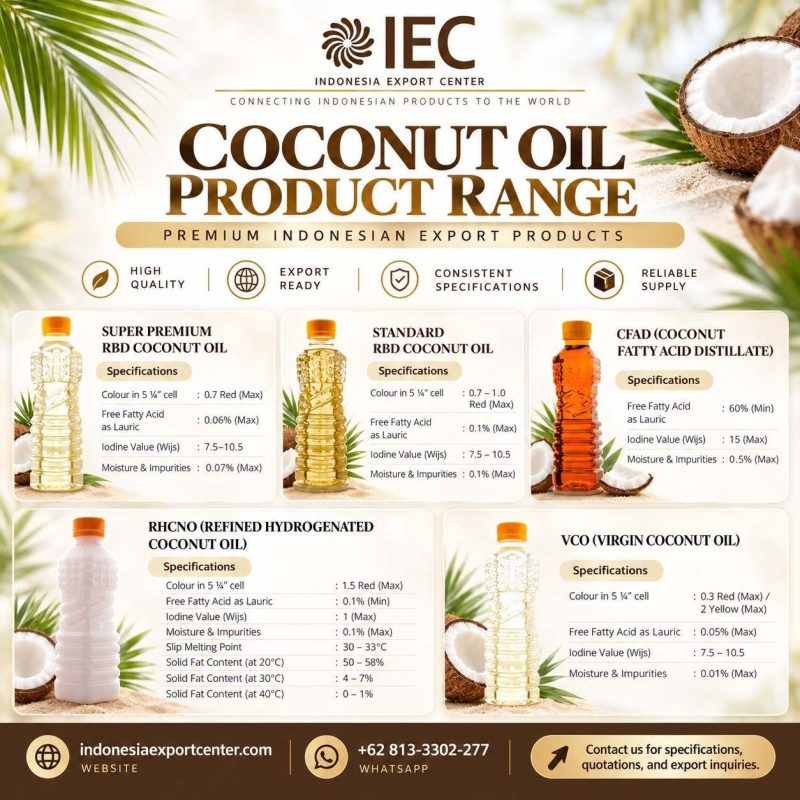
COCONUT OIL PRODUCT RANGE
PREMIUM INDONESIAN EXPORT PRODUCTS
HIGH QUALITY | EXPORT READY | CONSISTENT SPECIFICATIONS | RELIABLE SUPPLY
Super Premium RBD Coconut Oil | Reference FFA 0.06% Max as Lauric | Lot-Specific COA | Quality Assurance | Bulk Sourcing
Looking for a Low FFA RBD Coconut Oil Supplier?
Are you looking for a low FFA RBD coconut oil supplier for food manufacturing, ingredient distribution or international industrial procurement?
For food quality assurance teams, low free fatty acid (FFA) content is a measurable product requirement—not simply a marketing description.
Indonesia Export Center (IEC) facilitates sourcing and export enquiries for Indonesian coconut oil products, including Super Premium Refined, Bleached and Deodorised (RBD) Coconut Oil.
The supplied Super Premium RBD Coconut Oil reference specifies:
Free Fatty Acid as Lauric: 0.06% Maximum
This value is a reference specification limit, not a verified result for every available or future production lot.
Professional buyers should request a current manufacturer-issued specification and lot-specific Certificate of Analysis (COA) before accepting a shipment.
The full supplied Super Premium reference includes:
- Colour in 5¼-inch Cell: 0.7 Red (Max)
- Free Fatty Acid as Lauric: 0.06% (Max)
- Iodine Value (Wijs): 7.5–10.5
- Moisture & Impurities: 0.07% (Max)
IEC welcomes enquiries from food QA teams, procurement managers, ingredient manufacturers, importers and distributors seeking to evaluate Indonesian RBD Coconut Oil against clearly defined technical requirements.
REQUEST LOW FFA RBD COCONUT OIL SPECIFICATIONS AND BULK QUOTATION
WhatsApp: https://wa.me/628133302277
Website: https://indonesiaexportcenter.com/
Actual lot results, manufacturer identity, product availability, food-grade compliance, certifications, MOQ, packaging and shipment arrangements require confirmation.
1. Low FFA RBD Coconut Oil – Product Overview
| Procurement Item | Information |
|---|---|
| Product | Super Premium RBD Coconut Oil |
| Product Category | Refined Coconut Oil |
| Proposed Sourcing Country | Indonesia |
| Target Market | Global |
| Primary Audience | Food QA and QC Teams |
| Additional Buyers | Food Manufacturers, Importers, Ingredient Distributors |
| Product Grade | Super Premium RBD |
| Reference FFA as Lauric | 0.06% (Max) |
| Reference Colour | 0.7 Red (Max), 5¼-inch Cell |
| Reference Iodine Value | 7.5–10.5 |
| Reference Moisture & Impurities | 0.07% (Max) |
| Actual Lot FFA | Requires Lot-Specific Testing |
| Manufacturer | To Be Verified |
| Contractual Seller | To Be Confirmed |
| Exporter of Record | To Be Confirmed |
| Manufacturer Specification | To Be Requested and Verified |
| Lot-Specific COA | To Be Requested and Verified |
| Food-Grade Compliance | To Be Verified |
| Certifications | To Be Verified |
| MOQ | To Be Confirmed |
| Available Quantity | To Be Confirmed |
| Packaging | To Be Confirmed |
| Price per MT | Request Quotation |
| Shipment Lead Time | To Be Confirmed |
2. What Is Low FFA RBD Coconut Oil?
Low FFA RBD Coconut Oil is a commercial description for refined coconut oil with a relatively low free fatty acid level compared with an agreed specification or reference.
The term low FFA does not, by itself, establish a universal numerical threshold.
Buyers should define the acceptable maximum FFA in their purchase specification.
3. What Does FFA Mean?
FFA stands for Free Fatty Acid.
Free fatty acids are fatty acids present in an oil in an unesterified form.
FFA is a commonly monitored quality parameter for fats and oils.
4. Why Is FFA Important in Coconut Oil?
FFA measurement can help assess an oil’s condition and conformity with its agreed quality specification.
However, FFA is only one part of a broader quality assessment.
5. What Does FFA as Lauric Mean?
FFA as Lauric means the free fatty acid result is expressed as an equivalent percentage of lauric acid.
It is important not to confuse FFA expressed as lauric with the total lauric acid content of coconut oil.
They are different measurements.
6. Is 0.06% a Universal Low FFA Threshold?
No.
The supplied 0.06% (Max) value is the reference limit for this Super Premium RBD Coconut Oil grade.
It should not be presented as a universal international threshold for low FFA coconut oil.
7. Why Lot-Specific Testing Matters
Different production lots may have different analytical results.
A reference specification alone does not prove that every lot meets its limit.
8. Why QA Teams Need Actual Results
Quality teams need evidence showing whether the specific material offered or delivered conforms to the agreed requirements.
Super Premium RBD Coconut Oil Specifications
9. Reference Specification Table
| Quality Parameter | Super Premium Reference |
|---|---|
| Colour in 5¼-inch Cell | 0.7 Red (Max) |
| Free Fatty Acid as Lauric | 0.06% (Max) |
| Iodine Value (Wijs) | 7.5–10.5 |
| Moisture & Impurities | 0.07% (Max) |
Important: These are reference specification values, not verified analytical results for a particular lot.
10. FFA Reference: 0.06% Maximum
The supplied Super Premium reference specifies:
Free Fatty Acid as Lauric: 0.06% (Max)
This is the maximum value stated in the reference specification.
11. Colour Reference: 0.7 Red Maximum
The supplied reference specifies:
Colour in 5¼-inch Cell: 0.7 Red (Max)
12. Iodine Value: 7.5–10.5
The supplied reference specifies:
Iodine Value (Wijs): 7.5–10.5
13. Moisture and Impurities: 0.07% Maximum
The supplied reference specifies:
Moisture & Impurities: 0.07% (Max)
14. FFA Is Not a Complete Purity Test
A low FFA result does not establish overall purity.
Additional quality and safety requirements may apply.
15. FFA Is Not a Food Safety Certification
Meeting an FFA limit does not automatically establish food-grade suitability.
16. FFA Is Not a Guarantee of Shelf Life
Shelf life depends on multiple factors and requires product-specific evidence.
17. FFA Is Not the Same as Peroxide Value
FFA and peroxide value are different analytical parameters.
Both may be relevant to an oil quality assessment.
18. FFA Is Not the Same as Total Lauric Acid
FFA as Lauric expresses free fatty acids using lauric acid as the reporting basis.
Total lauric acid composition is a separate measurement.
Low FFA Grade Comparison
19. Super Premium vs Standard RBD Coconut Oil
| Quality Parameter | Super Premium RBD | Standard RBD |
|---|---|---|
| Colour in 5¼-inch Cell | 0.7 Red (Max) | 0.7–1.0 Red (Max) |
| Free Fatty Acid as Lauric | 0.06% (Max) | 0.1% (Max) |
| Iodine Value (Wijs) | 7.5–10.5 | 7.5–10.5 |
| Moisture & Impurities | 0.07% (Max) | 0.1% (Max) |
Technical note: The Standard RBD colour entry combines a range and a maximum designation. The actual acceptance limit should be clarified with the manufacturer.
20. Comparing FFA Limits
The supplied Super Premium grade has a maximum FFA reference of 0.06%.
The supplied Standard RBD grade has a maximum FFA reference of 0.1%.
21. Lower Limit vs Lower Actual Result
A grade with a lower specification maximum does not necessarily have a lower measured FFA than every batch of another grade.
Actual lot results must be compared.
22. Comparing Actual Lots
For a meaningful comparison, buyers should review COAs from identified lots.
23. Selecting a Grade for Food Manufacturing
The grade should satisfy the buyer’s complete technical and regulatory requirements.
24. Selecting a Grade for Ingredient Distribution
Distributors should consider their customers’ acceptance criteria and documentation requirements.
25. Grade Substitution
Substitution should not occur without buyer approval.
26. Comparing Prices
Any price difference must be established through actual quotations.
Lot-Specific FFA Verification
27. What Is a Production Lot?
A lot is an identified quantity of material defined under the manufacturer’s production and traceability system.
28. Why Lot Identification Matters
Lot identification connects the tested material with the relevant manufacturing and shipment records.
29. Lot Number on the COA
The COA should identify the lot or batch tested.
30. Lot Number on Packaging
Packaging should carry appropriate identification.
31. Lot Number on Shipping Records
Shipment records should support traceability to the supplied material.
32. COA Product Identity
The COA should identify the correct product and grade.
33. Actual FFA Result
The COA should report the actual measured FFA result.
34. FFA Reporting Basis
The COA should clearly state that FFA is expressed as Lauric.
35. FFA Test Method
The applicable analytical method should be identified.
36. Test Method Consistency
Comparisons are more meaningful when methods and reporting conventions are understood and appropriate.
37. Test Date
The testing date should be appropriate for the material and transaction.
38. Laboratory Identification
The issuing manufacturer or laboratory should be identifiable.
39. COA Authenticity
Buyers may verify the COA with the issuing organisation.
40. Multiple Lots in One Shipment
If a shipment includes multiple lots, the buyer should agree on the documentation and sampling requirements for each lot.
41. Composite Samples
The use of composite samples should be disclosed and agreed where applicable.
42. Sampling Procedure
Sampling methods should be appropriate for the oil, packaging and agreed inspection plan.
43. Independent Testing
Independent laboratory testing may be requested, subject to agreement and availability.
44. Retained Samples
Retained samples may support investigations where available and agreed.
45. Pre-Shipment Verification
Buyers may require specified tests before shipment.
46. Arrival Testing
Buyers may conduct agreed testing upon arrival.
47. Conflicting Results
The contract should define procedures for resolving conflicting results.
48. Lot Acceptance
Acceptance should be based on the agreed specification and inspection procedures.
49. Lot Rejection
The contract should define the applicable procedure for nonconforming material.
50. Corrective Action
Buyers may request information about corrective action procedures following quality deviations.
Understanding FFA Test Results
51. Specification Limit vs Actual Result
A specification limit is the maximum or range agreed for acceptance.
An actual result is the measurement reported for the tested material.
52. Example: Lot Meets the FFA Limit
Illustrative example only:
- Agreed FFA maximum: 0.06% as Lauric
- Hypothetical measured result: 0.04% as Lauric
The hypothetical result is below the stated maximum.
This is not a claim about an actual product lot.
53. Example: Lot Exceeds the FFA Limit
Illustrative example only:
- Agreed FFA maximum: 0.06% as Lauric
- Hypothetical measured result: 0.08% as Lauric
The hypothetical result exceeds the stated maximum.
The contractual nonconformity procedure should apply.
54. Measurement Uncertainty
Where relevant, buyers should consider how measurement uncertainty affects acceptance decisions.
55. Rounding Rules
The contract or testing protocol should establish appropriate reporting and rounding conventions.
56. Laboratory Method Differences
Results may require careful interpretation when different methods or reporting bases are used.
57. FFA Trend Monitoring
Repeat buyers may track FFA results across received lots.
58. Statistical Evaluation
Quality teams may use suitable statistical methods to evaluate historical lot results.
59. Supplier Performance Monitoring
Actual accepted shipment records can support supplier performance evaluation.
60. Avoiding Blanket Guarantees
No claim is made that every future lot will automatically meet the 0.06% maximum.
Each offered lot should be verified under the agreed procedure.
Low FFA RBD Coconut Oil for Food Manufacturing
61. Bakery Manufacturing
Low FFA RBD Coconut Oil may be evaluated for selected bakery applications.
62. Confectionery Manufacturing
The oil may be considered for selected confectionery formulations.
63. Food Ingredient Blending
The product may be evaluated for suitable ingredient blends.
64. Non-Dairy Creamer Manufacturing
Suitability depends on the required physical and compositional characteristics.
65. Processed Food Applications
The oil may be considered for appropriate processed food formulations.
66. Sensory Evaluation
RBD coconut oil is generally associated with a relatively neutral flavour and odour profile.
Actual sensory characteristics require verification.
67. Formulation Trials
Buyers should conduct appropriate formulation trials.
68. Processing Conditions
Application suitability depends on the actual manufacturing process.
69. Food-Grade Verification
Food-grade status requires product-specific verification.
70. Contaminant Testing
Relevant contaminant requirements should be identified for the intended market and use.
71. Shelf-Life Information
Shelf-life information should be supported by manufacturer evidence.
72. Storage Conditions
Appropriate storage conditions should be established.
Quality Assurance Beyond FFA
73. Why FFA Alone Is Insufficient
FFA does not measure every aspect of oil quality or safety.
74. Moisture and Impurities
The supplied Super Premium reference specifies 0.07% maximum.
75. Colour
The supplied Super Premium reference specifies 0.7 Red maximum.
76. Iodine Value
The supplied Super Premium reference specifies 7.5–10.5.
77. Peroxide Value
Peroxide value may be relevant to oxidation assessment.
No peroxide value limit has been supplied.
78. Fatty Acid Composition
Fatty acid composition may be relevant to product identity and application suitability.
79. Relevant Contaminants
Applicable contaminant requirements depend on intended use and destination market.
80. Food Safety Documentation
Request relevant food safety documentation.
81. Certifications
Verify the authenticity, scope and validity of applicable certificates.
82. Manufacturing Controls
Request information about the manufacturer’s quality and process controls.
83. Traceability
The manufacturer should be able to identify relevant production lots and records.
84. Customer-Specific Requirements
Food manufacturers may have additional internal specifications.
85. Destination-Market Compliance
Importers should verify applicable requirements before shipment.
Supplier Qualification and Bulk Export
86. Verify the Manufacturer
Request the actual manufacturer’s legal name and facility address.
87. Verify the Contractual Seller
Identify the legal entity responsible for the sale.
88. Verify the Exporter of Record
Confirm the exporter of record.
89. Request Manufacturer Specifications
Obtain current manufacturer-issued documentation.
90. Request Lot-Specific COA
Ask for analytical results for the relevant lot.
91. Confirm Product Availability
No available stock has been independently verified.
92. Confirm MOQ
No fixed MOQ has been verified.
93. Confirm Production Capacity
Capacity requires supplier verification.
94. Confirm Packaging
Potential enquiries include steel drums, IBC tanks and flexitank arrangements.
Availability and suitability require confirmation.
95. Confirm Price per MT
Request a current quotation.
96. Confirm Delivery Terms
Agree on the applicable Incoterms® 2020 rule and named place or port.
97. FOB Indonesia
Under FOB, risk generally transfers when the goods are loaded on board at the named shipment port.
For certain containerised shipments, FCA may be more appropriate.
98. CFR Destination
Under CFR, the seller contracts and pays for carriage to the named destination port, while risk generally transfers on board at origin.
99. CIF Destination
Under CIF, the seller contracts and pays for carriage and obtains the insurance required by the rule, while risk generally transfers on board at origin.
For certain containerised shipments, CIP may be more appropriate.
100. Confirm Shipment Port
The actual Indonesian port must be confirmed.
101. Confirm Destination Port
The buyer should specify the destination port.
102. Confirm Lead Time
No fixed production or shipment lead time has been verified.
103. Confirm Export Documentation
Depending on the transaction, documents may include:
- Commercial invoice
- Packing list
- Bill of lading
- Certificate of Origin
- Certificate of Analysis
- Insurance documents
- Other required certificates
104. Confirm Import Requirements
The importer should verify destination-market requirements.
105. Confirm Customs Classification
The correct tariff classification must be determined for the actual product.
No specific HS code is claimed.
Low FFA RBD Coconut Oil – QA Procurement Checklist
FFA Verification
-
Product grade confirmed
-
Manufacturer specification obtained
-
FFA maximum defined
-
Reporting basis confirmed as Lauric
-
Analytical method identified
-
Lot-specific COA obtained
-
Actual FFA result reviewed
-
Lot number verified
-
COA issuer verified
-
Acceptance procedure agreed
Additional Quality Requirements
-
Colour specification confirmed
-
Iodine value confirmed
-
Moisture and impurities confirmed
-
Additional tests identified
-
Food-grade suitability verified
-
Relevant contaminant requirements reviewed
-
Certifications verified where applicable
-
Traceability reviewed
Supplier Qualification
-
Manufacturer identified
-
Contractual seller confirmed
-
Exporter of record confirmed
-
Available quantity confirmed
-
MOQ confirmed
-
Packaging confirmed
-
Production capability evaluated
-
Lead time confirmed
Commercial and Logistics
-
Quantity in MT specified
-
Price per MT obtained
-
Currency confirmed
-
Incoterm agreed
-
Named port confirmed
-
Freight reviewed
-
Insurance reviewed
-
Payment terms agreed
-
Quotation validity confirmed
-
Export documents reviewed
RFQ Template – Low FFA RBD Coconut Oil Supplier
Subject: RFQ – Low FFA Super Premium RBD Coconut Oil from Indonesia
Dear Indonesia Export Center Team,
We are evaluating low FFA Super Premium RBD Coconut Oil from Indonesia for our ingredient sourcing requirements.
Please provide the current manufacturer-issued specification, lot-specific COA information, relevant quality documentation, packaging options and commercial quotation.
Buyer Information
Company Name: [Company Name]
Country: [Country]
Business Type: [Food Manufacturer / Ingredient Distributor / Importer / Other]
Contact Person: [Name]
Email: [Email]
Phone / WhatsApp: [Number]
Product Requirements
Product: Super Premium RBD Coconut Oil
Required Quantity: [MT]
Intended Application: [Food Manufacturing / Ingredient Blending / Other]
Order Frequency: [One-Time / Monthly / Repeat Orders]
Reference Technical Requirements
| Parameter | Reference Requirement |
|---|---|
| Colour in 5¼-inch Cell | 0.7 Red (Max) |
| FFA as Lauric | 0.06% (Max) |
| Iodine Value (Wijs) | 7.5–10.5 |
| Moisture & Impurities | 0.07% (Max) |
Please confirm the proposed product’s specification and the actual FFA results available for the offered lot.
Lot-Specific Quality Documentation
Please provide:
- Actual manufacturer name and address
- Contractual seller and exporter of record
- Current manufacturer-issued specification
- Lot or batch identification
- Lot-specific COA availability
- Actual FFA result as Lauric
- Applicable FFA analytical method
- Additional COA parameters
- Testing date and issuing laboratory
- Relevant food safety documentation
- Certification information, if applicable
- Product sample availability
- Independent testing options, if available
- Proposed quality acceptance procedure
Packaging Requirements
Preferred Packaging: [Steel Drums / IBC / Flexitank / Other]
Preferred Net Fill: [Specify]
Additional Requirements: [Details]
Shipping Requirements
Destination Country: [Country]
Destination Port: [Port]
Preferred Incoterm: [FCA / FOB / CFR / CIF / CIP / Other]
Target Shipment Period: [Month / Year]
Commercial Information Requested
Please provide:
- MOQ
- Available quantity
- Price per MT
- Currency
- Packaging specifications
- Incoterm and named port
- Freight quotation if applicable
- Insurance information if applicable
- Production lead time
- Estimated shipment period
- Payment terms
- Quotation validity
- Export documentation
- Additional commercial conditions
We will evaluate the actual lot-specific analytical results against our agreed acceptance criteria before proceeding.
Kind regards,
[Your Name] [Company Name] [Country]SEND YOUR LOW FFA RBD COCONUT OIL ENQUIRY
WhatsApp: https://wa.me/628133302277
Frequently Asked Questions – Low FFA RBD Coconut Oil Supplier
What is low FFA RBD Coconut Oil?
It is refined coconut oil described as having a relatively low free fatty acid level against an agreed reference or specification.
What does FFA stand for?
FFA stands for Free Fatty Acid.
What does FFA as Lauric mean?
It means the free fatty acid result is expressed as an equivalent percentage of lauric acid.
Is FFA as Lauric the same as total lauric acid?
No. They are different measurements.
What is the Super Premium FFA reference?
The supplied Super Premium reference specifies 0.06% maximum FFA as Lauric.
Is 0.06% a universal low FFA standard?
No. It is the supplied reference specification for this grade.
What is the Standard RBD FFA reference?
The supplied Standard RBD reference specifies 0.1% maximum FFA as Lauric.
Is Super Premium always lower in actual FFA than Standard RBD?
Not necessarily. Actual results must be compared lot by lot.
Can every lot be guaranteed below 0.06% FFA?
No blanket guarantee is made. Actual lot results require verification.
Why is lot-specific testing important?
Different lots may have different analytical results.
What is a lot-specific COA?
It is a Certificate of Analysis reporting test results for an identified lot or sample.
Can I request the actual FFA result?
Yes. Buyers should request the actual measured value.
Can I request the FFA test method?
Yes. The analytical method should be identified.
Can I request independent laboratory testing?
Yes, subject to agreement and availability.
Is low FFA the same as high purity?
No. FFA is only one quality parameter.
Does low FFA mean the product is food grade?
No. Food-grade suitability requires additional verification.
Does low FFA guarantee a longer shelf life?
No. Shelf-life claims require product-specific evidence.
Is low FFA RBD Coconut Oil suitable for bakery manufacturing?
It may be evaluated for selected bakery applications.
Is low FFA RBD Coconut Oil suitable for confectionery?
It may be evaluated for selected confectionery applications.
What other quality parameters should be checked?
Buyers may review colour, iodine value, moisture and impurities, oxidation-related parameters and relevant contaminants.
Can I request samples?
Samples may be requested, subject to availability.
What is the MOQ?
No fixed MOQ has been verified.
Can I request 20 MT?
Yes, as a buyer enquiry. Availability must be confirmed.
Is steel drum packaging available?
Availability requires confirmation.
Is IBC packaging available?
Availability requires confirmation.
Is flexitank packaging available?
Suitability and availability require confirmation.
Can I request FOB Indonesia pricing?
Yes. The named shipment port should be agreed.
Can I request CIF destination pricing?
Yes, subject to supplier and freight confirmation.
Can I arrange monthly procurement?
Recurring supply capability must be verified and agreed.
How do I request a quotation?
Contact IEC with your required FFA limit, quantity, intended application, packaging, destination port and delivery terms.
Source Low FFA RBD Coconut Oil with Lot-Specific Quality Evidence
For food quality assurance teams, the key procurement question is not simply whether an oil is described as low FFA.
The key question is whether the specific offered lot meets the agreed FFA limit using an appropriate analytical method.
The supplied Super Premium RBD Coconut Oil reference specifies:
FFA as Lauric: 0.06% Maximum
Additional reference parameters include:
Colour: 0.7 Red (Max), 5¼-inch Cell
Iodine Value: 7.5–10.5
Moisture & Impurities: 0.07% (Max)
These values provide a starting point for technical evaluation.
They must be supported by manufacturer documentation and lot-specific analytical results before being relied upon for purchasing decisions.
Indonesia Export Center welcomes enquiries from international food manufacturers, QA teams, importers and distributors evaluating Indonesian RBD Coconut Oil.
Request Low FFA RBD Coconut Oil Specifications and Bulk Pricing
Product: Super Premium RBD Coconut Oil
Proposed Sourcing Country: Indonesia
Target Buyers: Food QA Teams, Manufacturers, Ingredient Importers and Distributors
Reference FFA as Lauric: 0.06% (Max)
Reference Colour: 0.7 Red (Max), 5¼-inch Cell
Reference Iodine Value: 7.5–10.5
Reference Moisture & Impurities: 0.07% (Max)
Actual Lot FFA: To Be Verified
Manufacturer: To Be Verified
Lot-Specific COA: To Be Requested and Verified
Food-Grade Compliance: To Be Verified
Certifications: To Be Verified
MOQ: To Be Confirmed
Available Quantity: To Be Confirmed
Packaging: To Be Confirmed
Price per MT: Request Quotation
Shipment Lead Time: To Be Confirmed
IEC | INDONESIA EXPORT CENTER
CONNECTING INDONESIAN PRODUCTS TO THE WORLD
Website: https://indonesiaexportcenter.com/
WhatsApp: +62 813-3302-277
REQUEST LOW FFA RBD COCONUT OIL BULK QUOTATION
Please include your company name, destination country, intended application, required FFA maximum, quantity in MT, preferred packaging, destination port, requested Incoterm and target shipment period.
FFA, Quality and Sourcing Disclaimer: This page provides general technical sourcing and procurement information, not laboratory, food safety, legal or regulatory advice. The term “low FFA” does not establish a universal numerical threshold. The supplied 0.06% maximum FFA as Lauric value is a Super Premium RBD Coconut Oil reference specification, not a verified result for every lot or a blanket guarantee. No manufacturer, lot-specific COA, food-grade approval, certification, stock, MOQ, packaging availability, production capacity, price, freight rate or lead time has been independently verified. Buyers should obtain current manufacturer-issued specifications, lot-specific analytical results, relevant compliance documentation and agreed acceptance procedures before purchasing. IEC facilitates sourcing and export enquiries; the actual manufacturer, contractual seller and exporter of record must be confirmed for each transaction.
