

INDONESIA EXPORT CENTER | IEC
COCOPOT – COCONUT FIBER PLANT POT
A Practical Sourcing, Supplier Verification and Import Procurement Guide for International Buyers
Supplier Due Diligence | RFQ Preparation | Product Specifications | Incoterms | Export Documents | Customs Checks | Wholesale Import
Import Coconut Coir Pots from Indonesia with a Structured Procurement Process
Planning to import coir pots from Indonesia for your horticultural business, garden supply company, commercial nursery or wholesale distribution network?
International procurement involves more than finding a product and requesting a price.
Import managers must evaluate the manufacturing source, confirm product specifications, review samples, negotiate trade terms, arrange inspections, verify documentation and comply with the requirements of their destination market.
Indonesia Export Center (IEC) facilitates sourcing and export enquiries for coconut fiber plant pots from Indonesia.
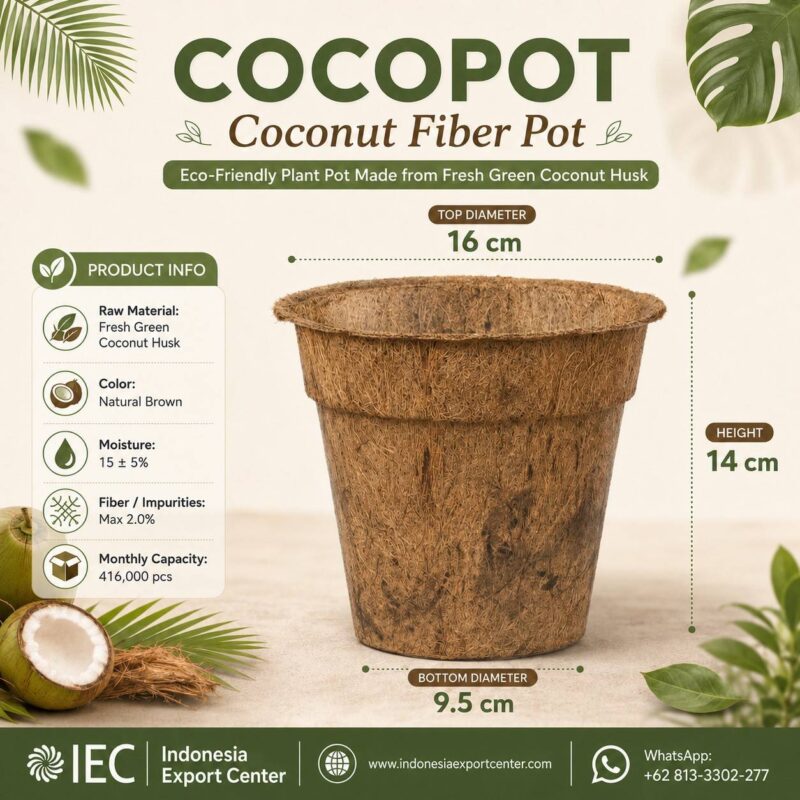
The supplied COCOPOT reference is a natural brown coconut fiber plant pot made using fresh green coconut husk.
Its stated dimensions are:
- Top Diameter: 16 cm
- Height: 14 cm
- Bottom Diameter: 9.5 cm
The reference also states:
- Moisture: 15 ± 5%
- Fiber / Impurities: Maximum 2.0%
- Monthly Capacity: 416,000 pieces
These are supplied reference specifications. The manufacturing source, full material composition, production availability, commercial terms and applicable import requirements must be verified before purchase.
This guide explains the steps international buyers can take to source and import coconut coir pots from Indonesia.
REQUEST A COCONUT COIR POT IMPORT QUOTATION
WhatsApp: https://wa.me/628133302277
Website: https://indonesiaexportcenter.com/
IEC acts as a sourcing and export facilitator. The contractual seller, physical manufacturer and exporter of record should be identified and confirmed for each transaction.
1. Coconut Coir Pots from Indonesia – Product Reference
| Specification | IEC Supplied Reference |
|---|---|
| Product | COCOPOT – Coconut Fiber Plant Pot |
| Country of Sourcing | Indonesia |
| Raw Material | Fresh Green Coconut Husk |
| Colour | Natural Brown |
| Top Diameter | 16 cm / 160 mm |
| Height | 14 cm / 140 mm |
| Bottom Diameter | 9.5 cm / 95 mm |
| Moisture | 15 ± 5% |
| Fiber / Impurities | Max. 2.0%, definition to be confirmed |
| Stated Monthly Capacity | 416,000 Pieces |
| Finished-Product Composition | To Be Confirmed |
| Binder Type and Content | To Be Confirmed |
| Unit Weight | To Be Confirmed |
| Wall Thickness | To Be Confirmed |
| Dimensional Tolerances | To Be Confirmed |
| MOQ | To Be Confirmed |
| Packaging | Subject to Supplier Confirmation |
| Production Lead Time | To Be Confirmed |
| Wholesale Price | Request Quotation |
| Shipping Terms | Subject to Agreement |
Buyer note: Product data should be converted into an agreed purchase specification before order confirmation.
Step-by-Step Guide to Importing Coconut Coir Pots from Indonesia
Step 1 – Define Your Import Requirements
Before contacting a supplier, prepare a clear purchasing brief.
Include:
- Company name and country
- Business type
- Intended product application
- Required pot dimensions
- Material requirements
- Initial order quantity
- Estimated annual demand
- Packaging requirements
- Destination port
- Preferred Incoterm
- Target delivery period
A complete purchasing brief helps suppliers prepare relevant proposals and reduces unnecessary quotation revisions.
Step 2 – Identify Your Intended Product Application
Coconut fiber pots may be evaluated for different horticultural applications.
Examples include:
- Commercial plant nurseries
- Greenhouse propagation
- Vegetable seedling production
- Flower nurseries
- Garden center distribution
- Ornamental plant production
- Landscape nursery supply
Different applications may require different pot sizes, handling characteristics and testing procedures.
The supplied 16 cm reference pot should not be assumed suitable for every application.
Step 3 – Confirm the Product Specifications
International buyers should obtain a written technical specification.
Important parameters include:
- Top diameter
- Bottom diameter
- Height
- Dimensional tolerances
- Wall thickness
- Unit weight
- Moisture content
- Material composition
- Binder information
- Impurity definition
- Packaging
The supplied reference does not include every parameter required for a complete purchase specification.
Step 4 – Clarify the Moisture Specification
The supplied COCOPOT reference states:
Moisture: 15 ± 5%
If interpreted as percentage points, this corresponds to approximately 10–20%.
However, the supplier and buyer should confirm:
- Measurement basis
- Testing method
- Sample preparation
- Acceptance criteria
- Reporting procedure
A numerical specification without an agreed testing method may create disputes during inspection.
Step 5 – Clarify the Fiber / Impurities Parameter
The supplied reference states:
Fiber / Impurities: Maximum 2.0%
The exact meaning of this parameter has not been established.
Buyers should request a written explanation of:
- What is measured
- Which materials are considered impurities
- Whether loose fibers are included
- Measurement basis
- Test procedure
- Acceptance criteria
Do not interpret the 2.0% value as a verified foreign-matter limit until the supplier confirms its definition.
Step 6 – Verify Binder and Additive Composition
The supplied product reference identifies fresh green coconut husk as the raw material.
However, the complete finished-product composition has not been provided.
Buyers should ask:
- Does the finished pot contain binders?
- What binder type is used, if any?
- What is the binder content?
- Are coatings present?
- Are processing additives used?
- Are material declarations available?
- Are relevant laboratory reports available?
Do not assume the finished product is binder-free, plastic-free, chemical-free, biodegradable or compostable without appropriate evidence.
Step 7 – Conduct Supplier Due Diligence
Supplier verification is an important part of international procurement.
Before paying a deposit, buyers should identify the relevant commercial parties.
Manufacturer Verification
Confirm:
- Legal business identity
- Manufacturing location
- Product manufacturing capability
- Production equipment
- Quality control procedures
- Available capacity
- Product experience
Trading and Export Verification
Confirm:
- Contractual seller
- Exporter of record
- Commercial invoice issuer
- Payment beneficiary
- Shipping documentation responsibilities
These entities may be different companies.
IEC facilitates sourcing and export enquiries and should not automatically be treated as the physical manufacturer or exporter of record.
Step 8 – Verify the Supplier’s Business Information
Potential verification documents include:
- Business registration information
- Company profile
- Registered business address
- Manufacturer identification
- Relevant export capability information
- Bank account details
- Authorised company contacts
The documents required will depend on the transaction and buyer’s risk assessment.
Step 9 – Confirm Manufacturing Capacity
The supplied reference states:
Monthly Capacity: 416,000 Pieces
This figure has not been independently verified.
Buyers should confirm:
- Actual manufacturing source
- Product-specific production capacity
- Available allocation
- Current production schedule
- Existing commitments
- Repeat-order capability
The stated capacity should not be treated as guaranteed inventory or immediately available production.
Step 10 – Request a Formal RFQ
An RFQ, or Request for Quotation, should contain enough information for suppliers to prepare a comparable commercial offer.
A suitable RFQ should specify:
- Product dimensions
- Quality requirements
- Quantity
- Packaging
- Destination
- Preferred Incoterm
- Delivery schedule
- Required documents
- Inspection requirements
A complete RFQ template is provided below.
Step 11 – Compare Supplier Quotations
When comparing quotations, review more than the unit price.
Recommended Comparison Criteria
| Evaluation Area | Buyer Questions |
|---|---|
| Product Specification | Are the dimensions and materials clearly defined? |
| Unit Price | What currency and quantity basis apply? |
| MOQ | Is the minimum order acceptable? |
| Production Lead Time | When can the goods be ready? |
| Quality Control | What inspection procedures are available? |
| Packaging | What is included in the quoted price? |
| Incoterm | Which transport responsibilities are included? |
| Payment Terms | When and how must payment be made? |
| Documentation | Which documents are included? |
| Supplier Identity | Who manufactures and sells the goods? |
| Quotation Validity | How long is the offer valid? |
Comparisons should use equivalent product specifications and trade terms.
Step 12 – Request Product Samples
Samples can help buyers evaluate the product before bulk procurement.
Potential checks include:
- Dimensions
- Unit weight
- Wall thickness
- Appearance
- Material consistency
- Dry handling strength
- Wet handling strength
- Growing media compatibility
Sample availability, charges and shipping arrangements require supplier confirmation.
Buyers should also check whether any import conditions apply to samples made from plant-derived materials.
Step 13 – Approve a Golden Sample
A golden sample is an approved physical product reference.
It should be linked to:
- Product code
- Specification revision
- Dimensions
- Material information
- Visual criteria
- Approval date
- Authorised approver
The approved sample should support, not replace, written measurable specifications.
Step 14 – Define Quality Acceptance Criteria
Before production, agree on:
- Dimensional tolerances
- Moisture testing
- Impurity testing
- Visual defect limits
- Packaging requirements
- Sampling method
- Inspection responsibilities
- Nonconformity handling
Without agreed acceptance criteria, quality disputes may be difficult to resolve.
Step 15 – Understand Incoterms
Incoterms are internationally recognised trade rules used to allocate delivery obligations, costs and risks between seller and buyer.
The selected rule should be stated with a named place or port and the applicable Incoterms version.
For example, a contract may specify FOB [Named Port of Shipment], Incoterms 2020, if appropriate to the shipment.
The appropriate rule depends on the transaction and transport arrangements.
Common Trade Terms
| Incoterm | General Meaning | Key Buyer Consideration |
|---|---|---|
| FCA | Free Carrier | Seller delivers to the named carrier or place under the agreed rule |
| FOB | Free on Board | Used for sea or inland waterway transport; seller delivers goods on board at the named shipment port |
| CFR | Cost and Freight | Seller pays freight to the named destination port, but risk transfers at shipment |
| CIF | Cost, Insurance and Freight | Seller arranges freight and required insurance to the named destination port; risk transfers at shipment |
| DAP | Delivered at Place | Seller delivers to the named destination, ready for unloading; import clearance is generally the buyer’s responsibility |
Important: Freight payment responsibility and transfer of risk are not necessarily the same.
For containerised cargo, buyers should consider whether FCA is more appropriate than FOB based on the actual delivery arrangement.
Step 16 – Select the Appropriate Shipping Method
International coconut coir pot shipments may be transported using:
- Less-than-container-load sea freight
- Full-container-load sea freight
- Air freight for suitable small or urgent shipments
The appropriate method depends on:
- Shipment volume
- Weight
- Packaging
- Delivery urgency
- Destination
- Freight costs
No verified container loading quantity has been supplied.
Step 17 – Calculate Container Loading
Container loading calculations require confirmed product and packaging data.
Buyers should request:
- Pieces per pack
- Pieces per carton
- Carton dimensions
- Carton gross weight
- Pallet dimensions
- Pallet configuration
- Nesting arrangement
- Total shipment volume
Potential container options include:
- 20ft dry container
- 40ft dry container
- 40ft high-cube container
Actual capacity depends on the packed cargo and container constraints.
Step 18 – Confirm Export Packaging
Packaging should be suitable for the agreed shipping method.
Potential requirements include:
- Bulk packing
- Master cartons
- Palletisation
- Product identification
- Lot identification
- Shipping marks
- Moisture protection where appropriate
These are potential buyer requirements, not confirmed standard COCOPOT packaging services.
Step 19 – Prepare the Purchase Order
The purchase order should clearly identify:
- Buyer
- Contractual seller
- Product specification
- Quantity
- Unit price
- Total value
- Currency
- Incoterm
- Named place or port
- Delivery schedule
- Packaging
- Quality acceptance criteria
- Payment terms
- Required documentation
Any approved drawings or samples should be referenced.
Step 20 – Review Payment Terms and Transaction Security
Payment terms should be agreed before production.
Potential arrangements may include:
- Deposit and balance payment
- Payment against agreed documents
- Documentary letter of credit
- Other mutually agreed methods
Availability depends on the seller, buyer and transaction.
Recommended Payment Checks
- Confirm the legal seller.
- Verify the bank beneficiary.
- Ensure account details match agreed documents.
- Independently verify changes to payment instructions.
- Confirm invoice details.
- Review contractual remedies for non-delivery or nonconformity.
Buyers should apply their own financial and legal due diligence.
Step 21 – Confirm Production Scheduling
After commercial agreement, confirm:
- Order acceptance
- Product specification revision
- Production allocation
- Estimated completion date
- Quality inspection schedule
- Packaging readiness
- Shipping arrangements
Production lead time has not been supplied for the IEC reference and requires confirmation.
Step 22 – Arrange Pre-Shipment Inspection
Buyers may request inspection before the goods are shipped.
Potential inspection areas include:
- Product identification
- Quantity
- Dimensions
- Moisture
- Impurities, using the agreed definition
- Visual quality
- Packaging
- Shipping marks
Inspection procedures should be agreed before production.
Step 23 – Review Export Documents
International shipments commonly involve commercial and transport documentation.
Depending on the transaction, documents may include:
- Commercial invoice
- Packing list
- Bill of lading or other transport document
- Certificate of Origin, where applicable
- Product specification sheet
- Material declaration, if required
- Inspection report, if agreed
- Other destination-specific documents
The actual requirements depend on the shipment and destination.
Step 24 – Verify the HS Code
The correct Harmonized System classification is important for customs clearance.
Classification depends on the finished product’s material composition, manufacturing characteristics and applicable tariff rules.
No verified HS code has been established for the supplied COCOPOT reference.
Importers should confirm classification with their customs broker or the relevant customs authority.
Do not automatically use a tariff code intended for raw coconut fiber, cocopeat or another coconut product.
Step 25 – Check Destination Import Requirements
Import requirements vary between countries.
Buyers should verify:
- Customs classification
- Import duty
- Taxes
- Import permits, where applicable
- Plant-health requirements
- Material restrictions
- Packaging requirements
- Labelling rules
- Environmental marketing requirements
- Required declarations or certificates
Plant-derived finished products may be subject to destination-specific controls.
The importer should confirm the actual requirements before shipment.
Step 26 – Understand Plant-Health and Biosecurity Checks
Coconut fiber pots are made using plant-derived material.
Depending on the destination, product processing and classification, import authorities may apply relevant biosecurity or plant-health requirements.
Buyers should check whether the shipment requires:
- Product treatment information
- Manufacturing declarations
- Inspection
- Specific certificates
- Import permits
- Other supporting documents
Requirements should not be assumed to be identical across markets.
Step 27 – Check Environmental Marketing Claims
Importers planning to resell coconut fiber pots should verify any environmental claims.
Claims requiring evidence may include:
- Biodegradable
- Compostable
- Plastic-free
- Chemical-free
- Organic-certified
- Direct-plantable
No such certification has been established for the supplied IEC reference.
Retail claims should comply with the destination market’s applicable rules.
Step 28 – Arrange Customs Clearance
Customs clearance may involve:
- Import declaration
- Tariff classification
- Customs valuation
- Supporting documentation
- Duty and tax payment
- Regulatory checks
- Cargo release
The importer should coordinate with a qualified customs broker or the relevant authority.
Step 29 – Calculate Total Landed Cost
The supplier’s unit price is only one component of the import cost.
A landed-cost calculation may include:
- Product value
- Export packing
- Origin transport
- Freight
- Insurance, where applicable
- Customs duties
- Import taxes
- Customs brokerage
- Port or terminal charges
- Destination transport
- Warehousing
Avoid comparing quotations with different Incoterms as though they include the same costs.
Step 30 – Example Landed Cost Worksheet
| Cost Component | Buyer Input |
|---|---|
| Product Value | [Currency / Amount] |
| Export Packing | [Amount] |
| Origin Charges | [Amount] |
| International Freight | [Amount] |
| Insurance | [Amount] |
| Import Duty | [Amount] |
| Import Taxes | [Amount] |
| Customs Brokerage | [Amount] |
| Destination Charges | [Amount] |
| Inland Delivery | [Amount] |
| Total Landed Cost | [Calculated Amount] |
| Number of Usable Pots | [Pieces] |
| Landed Cost per Usable Pot | [Calculated Amount] |
The applicable calculation depends on the agreed Incoterm and destination rules.
Step 31 – Receive and Inspect the Shipment
Upon delivery, buyers should check:
- Shipment identification
- Carton count
- Packaging condition
- Visible damage
- Product quantity
- Product dimensions
- Lot information
- Required documentation
Any discrepancies should be documented promptly according to the contract and relevant transport or insurance procedures.
Step 32 – Establish Repeat-Order Quality Control
For ongoing imports, buyers may benefit from:
- Approved product specifications
- Golden sample records
- Lot traceability
- Supplier performance reviews
- Inspection records
- Corrective action procedures
- Delivery performance monitoring
This helps manage consistency across repeat shipments.
Import Risk Management Checklist
Before placing a wholesale order, review the following areas.
Supplier Due Diligence
-
Manufacturer identity verified
-
Contractual seller identified
-
Exporter of record identified
-
Company registration information reviewed
-
Payment beneficiary verified
-
Production capability assessed
Product Specifications
-
Pot dimensions confirmed
-
Dimensional tolerances agreed
-
Unit weight confirmed
-
Wall thickness confirmed
-
Material composition reviewed
-
Binder information reviewed
-
Moisture test method agreed
-
Impurity parameter clarified
Quality Control
-
Samples evaluated
-
Golden sample approved
-
Inspection plan agreed
-
Defect criteria defined
-
Pre-shipment inspection arranged if required
Commercial Terms
-
MOQ confirmed
-
Price and currency agreed
-
Incoterm and named place agreed
-
Payment terms agreed
-
Production lead time confirmed
-
Quotation validity checked
Shipping and Customs
-
Packaging approved
-
Loading estimate confirmed
-
Freight quotation reviewed
-
HS classification checked
-
Import requirements verified
-
Required documents identified
-
Customs broker appointed if needed
Coconut Coir Pots Import RFQ Template
Subject: RFQ – Import Coconut Coir Pots from Indonesia
Dear Indonesia Export Center Team,
We are interested in importing coconut fiber plant pots from Indonesia for wholesale distribution or commercial horticultural use.
Please review our purchasing requirements and provide a sourcing proposal.
Buyer Information
Company Name: [Company Name]
Country: [Country]
Business Type: [Importer / Wholesaler / Nursery / Garden Center Distributor / Other]
Contact Person: [Name]
Email: [Email]
WhatsApp: [Number]
Product Requirements
Product: COCOPOT – Coconut Fiber Plant Pot
Intended Application: [Details]
Top Diameter: [mm]
Height: [mm]
Bottom Diameter: [mm]
Dimensional Tolerances: [± mm]
Wall Thickness: [mm]
Target Unit Weight: [g]
Required Material Composition: [Details]
Moisture Requirement: [Details]
Impurity Requirement: [Details]
Initial Order Quantity: [Pieces]
Estimated Annual Demand: [Pieces]
Supplier Verification Requirements
Manufacturer Identification: Required
Manufacturing Location: Required
Contractual Seller Identification: Required
Exporter of Record Identification: Required
Business Registration Information: [Required / Not Required]
Production Capacity Confirmation: Required
Quality Requirements
Product Samples: [Required / Not Required]
Golden Sample Approval: [Required / Not Required]
Material Composition Declaration: [Required / Not Required]
Binder Information: [Required / Not Required]
Laboratory Testing: [Specify]
Pre-Shipment Inspection: [Required / Not Required]
Lot Traceability: [Required / Not Required]
Packaging Requirements
Packing Format: [Bulk / Master Carton / Other]
Pieces per Carton: [Pieces]
Palletisation: [Required / Not Required]
Product Identification: [Required / Not Required]
Shipping Marks: [Details]
Shipping Requirements
Destination Country: [Country]
Destination Port: [Port]
Final Delivery Location: [City / Warehouse]
Preferred Incoterm: [FCA / FOB / CFR / CIF / DAP / Other]
Preferred Container: [20ft / 40ft / 40ft HC / To Be Recommended]
Target Delivery Period: [Month / Year]
Documentation Requirements
Commercial Invoice: Required
Packing List: Required
Transport Document: Required
Certificate of Origin: [If Applicable]
Product Specification: Required
Material Declaration: [Required / Not Required]
Inspection Report: [Required / Not Required]
Other Destination-Specific Documents: [Details]
Please provide:
- Proposed manufacturer information
- Contractual seller and exporter of record
- Complete product specifications
- Dimensional tolerances
- Unit weight and wall thickness
- Finished-product material composition
- Binder and additive information
- Moisture testing method
- Definition of the fiber / impurities parameter
- Available laboratory reports
- Sample availability and costs
- MOQ
- Wholesale unit price
- Product-specific production capacity
- Available production allocation
- Production lead time
- Quality control procedures
- Inspection options
- Packaging specifications
- Pieces per carton
- Carton dimensions and gross weight
- Estimated container loading
- Available Incoterm quotations
- Export documentation information
- Payment terms
- Quotation validity
We look forward to receiving your proposal.
Kind regards,
[Your Name] [Company Name] [Country]SEND YOUR COCONUT COIR POT IMPORT ENQUIRY
WhatsApp: https://wa.me/628133302277
Frequently Asked Questions – Importing Coconut Coir Pots from Indonesia
How do I import coconut coir pots from Indonesia?
Start by defining your product requirements, verifying the supplier, requesting samples and quotations, confirming import rules, agreeing on trade terms and arranging shipping and customs clearance.
Can international buyers source coconut coir pots through IEC?
IEC facilitates international sourcing and export enquiries, subject to supplier availability and agreed commercial arrangements.
Does IEC manufacture coconut coir pots?
IEC should not automatically be considered the physical manufacturer. The actual manufacturing source should be identified during procurement.
What are the supplied COCOPOT dimensions?
16 cm top diameter, 14 cm height and 9.5 cm bottom diameter.
What is the raw material?
The supplied reference identifies fresh green coconut husk.
What is the moisture specification?
15 ± 5%, with the measurement method subject to confirmation.
What does the maximum 2.0% fiber / impurities value mean?
The exact parameter definition and testing method require supplier clarification.
Are binders used in COCOPOT?
Binder presence and composition have not been confirmed.
What is the minimum order quantity?
MOQ must be confirmed with the proposed supplier.
What is the wholesale price?
Pricing depends on the confirmed product specification, quantity, packaging and commercial terms.
What is the stated monthly capacity?
416,000 pieces, subject to verification. Available production allocation must be confirmed separately.
Can I request product samples?
Sample enquiries may be submitted, subject to availability and applicable import requirements.
Which Incoterm should I use?
The appropriate Incoterm depends on the transaction and transport arrangement. Buyers should agree on a named place or port and the applicable Incoterms version.
What is the HS code for coconut coir pots?
No verified HS classification has been established for the supplied reference. The importer should confirm the appropriate classification with a customs broker or customs authority.
Do coconut coir pots require a phytosanitary certificate?
Requirements depend on the destination, product composition, processing and applicable regulations. Importers should verify whether any plant-health documents are required.
Are coconut coir pots biodegradable?
The finished product requires appropriate product-specific evidence before biodegradability can be claimed.
How many coconut coir pots fit in a shipping container?
The loading quantity depends on confirmed product dimensions, weight, nesting and packaging. No verified loading figure has been supplied.
Can I request a CIF quotation?
A CIF quotation enquiry may be submitted for an appropriate sea shipment, subject to supplier and logistics arrangements.
Can IEC support repeat wholesale orders?
Repeat-order requirements may be submitted for feasibility review, subject to confirmed manufacturing capacity and commercial terms.
Request a Coconut Coir Pot Import Quotation from Indonesia
Source Coconut Fiber Plant Pots from Indonesia with Clear Product Specifications and Commercial Terms
Indonesia Export Center (IEC) welcomes enquiries from international import managers, wholesale distributors, commercial nurseries, garden supply companies and procurement teams.
Product: COCOPOT – Coconut Fiber Plant Pot
Country of Sourcing: Indonesia
Raw Material: Fresh Green Coconut Husk
Colour: Natural Brown
Reference Top Diameter: 16 cm
Reference Height: 14 cm
Reference Bottom Diameter: 9.5 cm
Reference Moisture: 15 ± 5%
Reference Fiber / Impurities: Max. 2.0%, Definition Subject to Confirmation
Stated Monthly Capacity: 416,000 Pieces, Subject to Verification
Finished-Product Composition: To Be Confirmed
Binder Information: To Be Confirmed
MOQ: To Be Confirmed
Packaging: Subject to Supplier Confirmation
Wholesale Price: Request Quotation
Production Lead Time: To Be Confirmed
Container Loading Quantity: To Be Calculated
HS Classification: To Be Verified
Destination Import Requirements: To Be Verified by the Importer
Export Terms: Subject to Commercial Agreement
Contact IEC to discuss product specifications, supplier verification, sample enquiries, wholesale pricing, quality inspection, Incoterms, export documentation and international shipping arrangements.
INDONESIA EXPORT CENTER | IEC
Your Export & Sourcing Partner from Indonesia
Website: https://indonesiaexportcenter.com/
WhatsApp: +62 813-3302-277
REQUEST YOUR COCONUT COIR POT IMPORT QUOTATION
Please include your company name, required pot specifications, order quantity, destination country, destination port and preferred Incoterm.
Import and Commercial Disclaimer: IEC facilitates sourcing and export enquiries. The physical manufacturer, contractual seller and exporter of record must be confirmed for each transaction. Supplied reference specifications, production capacity, MOQ, pricing, packaging, lead time and shipping arrangements require supplier verification. Customs classification, import permits, plant-health requirements, duties, taxes and destination-specific compliance obligations must be verified by the importer and relevant professionals. This page provides general procurement guidance and does not replace legal, customs or regulatory advice.
