

INDONESIA EXPORT CENTER | IEC
COCOPOT – COCONUT FIBER PLANT POT
Coconut Coir Pot Sourcing for Commercial Plant Nurseries, Propagation Facilities and Professional Horticultural Growers
Nursery Applications | Transplant Workflow | Product Trials | Supplier Quality Assurance | Bulk Procurement | Export Sourcing
Coconut Coir Pots for Commercial Nursery Operations
Looking for coir pots for commercial nurseries or a wholesale sourcing partner for coconut fiber plant pots?
Indonesia Export Center (IEC) facilitates sourcing and export enquiries for coconut fiber plant pots from Indonesia, supporting commercial nurseries, horticultural growers and professional procurement teams with product information, sample requests, supplier assessments and wholesale quotations.
For commercial plant nurseries, selecting a growing container involves more than comparing material or purchase price.
Pot dimensions, wet handling strength, compatibility with nursery equipment, growing media performance, transplant procedures and repeat-order consistency can all influence operational efficiency.
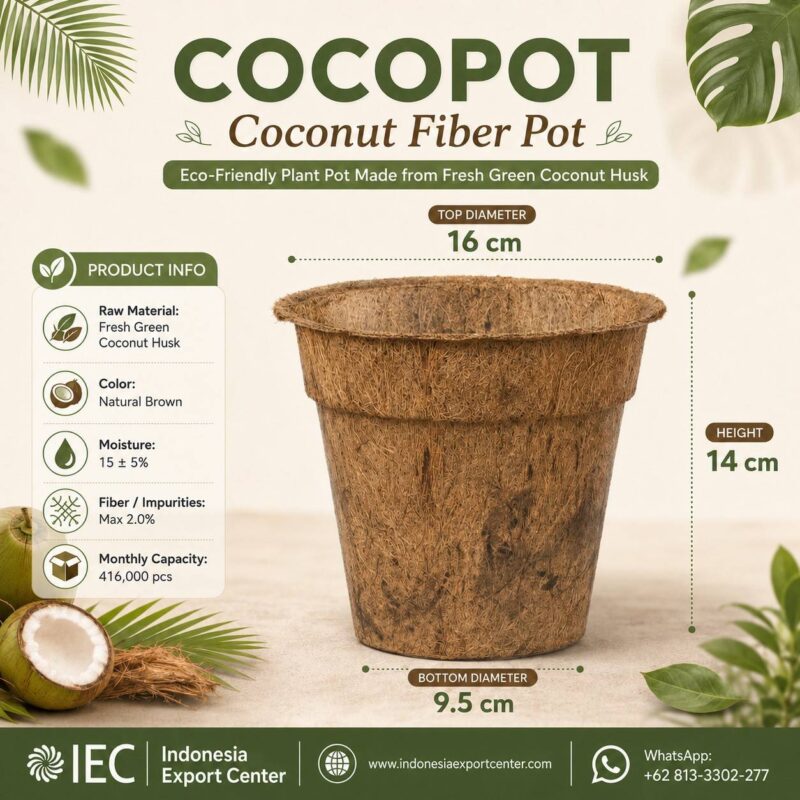
The supplied IEC COCOPOT reference is a natural brown coconut fiber plant pot made from fresh green coconut husk.
Its reference dimensions are:
- Top Diameter: 16 cm
- Height: 14 cm
- Bottom Diameter: 9.5 cm
The stated monthly production capacity is 416,000 pieces, subject to verification with the actual manufacturing source.
IEC welcomes enquiries from commercial nurseries, propagation facilities, horticultural growers, garden supply distributors and professional nursery procurement teams worldwide.
REQUEST A COMMERCIAL NURSERY COIR POT QUOTATION
WhatsApp: https://wa.me/628133302277
Website: https://indonesiaexportcenter.com/
IEC facilitates sourcing and export enquiries. Manufacturing capability, product availability and commercial terms require supplier confirmation.
Coconut Coir Pots – Product Specifications
| Specification | IEC Product Reference |
|---|---|
| Product | COCOPOT – Coconut Fiber Plant Pot |
| Country of Sourcing | Indonesia |
| Raw Material | Fresh Green Coconut Husk |
| Colour | Natural Brown |
| Moisture | 15 ± 5% |
| Fiber / Impurities | Maximum 2.0%, definition to be confirmed |
| Top Diameter | 16 cm |
| Height | 14 cm |
| Bottom Diameter | 9.5 cm |
| Stated Monthly Capacity | 416,000 Pieces |
| Unit Weight | To Be Confirmed |
| Wall Thickness | To Be Confirmed |
| Finished-Product Composition | To Be Confirmed |
| Dimensional Tolerances | To Be Confirmed |
| MOQ | To Be Confirmed |
| Packaging | Subject to Supplier Confirmation |
| Wholesale Price | Request Quotation |
| Export Terms | Subject to Agreement |
Important: These values are supplied reference specifications. Complete finished-product composition, production allocation, dimensional tolerances and test methods require verification.
1. Coconut Fiber Pots for Professional Nursery Production
Commercial nurseries may evaluate coconut fiber pots for selected plant production and handling applications.
Potential buyers include:
- Ornamental plant nurseries
- Commercial propagation facilities
- Horticultural growers
- Wholesale plant producers
- Tree and shrub nurseries
- Garden supply distributors
- Professional nursery procurement teams
The finished product should be tested for compatibility with the intended crop, growing media and nursery system.
2. Why Pot Selection Matters in Commercial Nurseries
Plant containers can influence multiple stages of nursery operations.
Important considerations include:
- Filling efficiency
- Handling requirements
- Watering procedures
- Growing media containment
- Pot stability
- Transport handling
- Transplanting workflow
- Storage
- Procurement cost
The appropriate container depends on the nursery’s operating methods and production goals.
3. Commercial Nursery Workflow Overview
A typical nursery production workflow may include:
- Receiving and storing empty pots
- Inspecting incoming pots
- Filling pots with growing media
- Planting or transplanting seedlings
- Placing pots in nursery trays or growing areas
- Irrigating and maintaining plants
- Monitoring plant development
- Preparing plants for movement or sale
- Transplanting or transferring plants
- Recording production results
Each stage may present different product requirements.
4. Incoming Pot Inspection
Before using a new shipment, nurseries should inspect representative samples.
Recommended Checks
- Product identification
- Quantity
- Dimensions
- Visible damage
- Shape consistency
- Surface condition
- Packaging integrity
- Moisture, where required
Any discrepancies should be documented according to the agreed supplier quality procedure.
5. Pot Filling and Growing Media Compatibility
Commercial nurseries should evaluate how the pot performs during growing media filling.
Potential evaluation areas include:
- Pot stability
- Resistance to deformation
- Growing media retention
- Filling efficiency
- Compatibility with manual or automated systems
The supplied reference does not include verified automated filling performance data.
6. Nursery Tray and Bench Compatibility
Nursery trays, benches and handling equipment may require specific container dimensions.
Buyers should compare:
- Top diameter
- Bottom diameter
- Height
- Wall thickness
- Shape consistency
- Equipment clearance
The reference dimensions alone do not establish compatibility with any particular nursery system.
7. Irrigation and Moisture Management
Watering practices may affect the performance of natural fiber containers.
Nurseries should assess:
- Water movement
- Moisture behaviour
- Pot stability after irrigation
- Wet handling strength
- Growing media containment
- Drying conditions
No verified irrigation performance data has been supplied for the IEC reference product.
8. Root Development and Growing Performance
Plant growth performance depends on multiple factors, including:
- Crop species
- Growing media
- Irrigation
- Fertilization
- Temperature
- Nursery management
- Container properties
Commercial growers should conduct controlled trials before making claims about root development or plant performance.
9. Transplant Workflow for Commercial Nurseries
Transplanting is an important stage in nursery operations.
The appropriate procedure depends on the crop, container and growing system.
Recommended Evaluation Areas
- Ease of handling
- Pot integrity during movement
- Root ball stability
- Compatibility with transplanting equipment
- Plant stress
- Labour requirements
- Post-transplant performance
The supplied product reference does not establish that the pot can be planted directly into soil without removal.
10. Can Coconut Coir Pots Be Planted Directly?
Direct planting should not be assumed solely because a pot contains coconut fiber.
The finished product’s composition, structural properties and behaviour under actual growing conditions must be assessed.
Before recommending direct planting, growers should verify:
- Complete material composition
- Breakdown behaviour
- Root penetration
- Soil conditions
- Crop compatibility
- Relevant product testing
Until these factors are confirmed, transplant procedures should follow the nursery’s validated method.
11. Commercial Nursery Transplant Trial
A structured trial can help nurseries evaluate whether a new pot is suitable for their production process.
Stage 1 – Trial Planning
Define:
- Crop species
- Growing media
- Irrigation method
- Trial duration
- Pot quantity
- Comparison container
- Performance criteria
Stage 2 – Pot Preparation
Inspect and record the dimensions, weight and visible condition of trial pots.
Stage 3 – Nursery Production
Use the pots under the intended growing conditions.
Stage 4 – Transplant Assessment
Evaluate handling, root ball stability, labour requirements and plant condition.
Stage 5 – Post-Transplant Monitoring
Monitor plant performance using the nursery’s established assessment method.
Stage 6 – Trial Review
Compare the results against the agreed acceptance criteria.
12. Suggested Nursery Trial Record
| Trial Parameter | Information to Record |
|---|---|
| Crop Species | To Be Specified |
| Growing Media | To Be Specified |
| Pot Dimensions | Measured Values |
| Pot Quantity | Pieces |
| Trial Duration | Days or Weeks |
| Irrigation Method | To Be Specified |
| Comparison Container | To Be Specified |
| Handling Performance | Observations |
| Transplant Performance | Observations |
| Plant Condition | Recorded Results |
| Final Assessment | Approved / Rejected / Further Testing |
13. IEC Cocopot Reference Dimensions
| Measurement | Dimension |
|---|---|
| Top Diameter | 16 cm |
| Height | 14 cm |
| Bottom Diameter | 9.5 cm |
These dimensions describe the supplied reference product.
Alternative sizes or shapes may be submitted for feasibility review, but availability has not been confirmed.
14. Dimensional Tolerances for Nursery Equipment
Commercial nurseries may require consistent dimensions for efficient handling.
Suggested Specification Format
| Parameter | Reference Value | Acceptance Tolerance |
|---|---|---|
| Top Diameter | 160 mm | To Be Agreed |
| Height | 140 mm | To Be Agreed |
| Bottom Diameter | 95 mm | To Be Agreed |
| Wall Thickness | To Be Measured | To Be Agreed |
| Unit Weight | To Be Measured | To Be Agreed |
Important: The reference values are converted from the supplied centimetre dimensions. No dimensional tolerance has been verified.
15. Raw Material and Finished-Product Composition
The supplied reference identifies fresh green coconut husk as the raw material.
However, the complete composition of the finished coconut fiber pot has not been supplied.
Commercial nurseries should request information about:
- Coconut fiber content
- Binders or adhesives
- Coatings
- Other additives
- Manufacturing process
- Material consistency
- Available test reports
These details may affect nursery performance and product claims.
16. Moisture Specification
The supplied reference states:
Moisture: 15 ± 5%
If interpreted as percentage points, this corresponds to approximately 10–20%.
The supplier and buyer should confirm the measurement method, sampling procedure and contractual acceptance criteria.
17. Wet and Dry Handling Strength
Commercial nursery operations may expose pots to different handling conditions.
Potential evaluation areas include:
- Dry handling
- Wet handling
- Lifting
- Transport
- Stacking
- Tray movement
- Transplanting
The supplied reference does not include verified wet or dry strength test results.
18. Product Samples Before Bulk Procurement
Samples help nurseries evaluate product suitability before purchasing larger quantities.
Recommended Sample Checks
- Confirm dimensions.
- Measure unit weight.
- Review wall thickness.
- Examine surface condition.
- Assess dry handling strength.
- Test wet handling performance.
- Evaluate nursery tray compatibility.
- Conduct application trials.
- Record results.
- Approve or reject the product.
Sample availability, costs and shipping arrangements require confirmation.
19. Golden Sample Approval
A golden sample is an approved physical reference used for comparison during future production.
For recurring nursery orders, the approved sample should be linked to a written specification.
Recommended Approval Record
- Product identification
- Sample reference number
- Dimensions
- Unit weight
- Wall thickness
- Material information
- Visual acceptance criteria
- Approval date
- Authorised approver
20. Supplier Quality Assurance Checklist
Commercial nurseries should evaluate supplier quality assurance before placing large orders.
Manufacturer Information
-
Actual manufacturer identified
-
Factory location verified
-
Production capability reviewed
-
Product-specific capacity confirmed
-
Available production allocation confirmed
Product Specifications
-
Dimensions confirmed
-
Dimensional tolerances agreed
-
Wall thickness defined
-
Unit weight defined
-
Material composition reviewed
-
Moisture specification agreed
Quality Control
-
Inspection procedures documented
-
Sampling plan agreed
-
Visual defect criteria defined
-
Acceptance criteria agreed
-
Inspection records available
-
Nonconformity procedure agreed
Samples and Testing
-
Samples evaluated
-
Golden sample approved
-
Nursery application trial completed
-
Wet handling performance tested
-
Transplant workflow assessed
Packaging and Logistics
-
Pack format confirmed
-
Units per carton confirmed
-
Carton dimensions confirmed
-
Palletisation requirements agreed
-
Shipping marks agreed
Commercial Terms
-
MOQ confirmed
-
Wholesale price confirmed
-
Production lead time agreed
-
Payment terms agreed
-
Export terms agreed
21. Incoming Quality Control for Repeat Shipments
Commercial nurseries should establish a receiving inspection procedure.
Suggested Receiving Procedure
- Verify shipment identification.
- Check carton condition.
- Confirm received quantity.
- Select representative samples.
- Measure key dimensions.
- Inspect visible defects.
- Compare samples with the approved specification.
- Record results.
- Accept, quarantine or reject the lot according to agreed criteria.
22. Nonconformity and Corrective Action
When product deviations occur, buyers and suppliers should document the issue.
Potential information includes:
- Purchase order number
- Lot number
- Product code
- Description of deviation
- Quantity affected
- Inspection evidence
- Corrective action
- Preventive action
- Resolution status
The corrective action process should be agreed before recurring orders begin.
23. Lot Traceability
Lot identification may help buyers track production and inspection records.
Potential information includes:
- Product code
- Production date
- Lot number
- Quantity
- Inspection status
- Packaging reference
The proposed supplier’s actual traceability capability must be confirmed.
24. Wholesale MOQ and Order Quantities
The minimum order quantity for the IEC reference product has not been confirmed.
MOQ may depend on:
- Product specification
- Order volume
- Packaging
- Production scheduling
- Shipping arrangements
Commercial nurseries should provide their initial order quantity and expected annual demand when requesting a quotation.
25. Production Capacity and Repeat Orders
The supplied IEC reference states:
Monthly Capacity: 416,000 Pieces
This figure is not independently verified and does not guarantee available production allocation.
For recurring nursery procurement, buyers should confirm:
- Actual manufacturing source
- Product-specific capacity
- Available production allocation
- Production lead time
- Packaging capacity
- Quality consistency
- Repeat-order scheduling
26. Nursery Procurement Forecasting
Commercial nurseries may benefit from forecasting container requirements.
Suggested Forecasting Data
| Parameter | Buyer Input |
|---|---|
| Monthly Plant Production | Plants |
| Pots Required per Plant | Pieces |
| Expected Pot Usage | Pieces |
| Trial and Replacement Allowance | To Be Determined |
| Total Planned Demand | Pieces |
| Ordering Frequency | To Be Agreed |
| Required Delivery Dates | To Be Provided |
Forecasting should account for actual nursery operations and the agreed supply lead time.
27. Packaging for Commercial Nursery Supply
Packaging should support efficient storage and handling.
Potential packaging enquiries include:
- Bulk packing
- Master cartons
- Palletised shipments
- Product identification labels
- Lot identification
- Shipping marks
These are possible packaging requirements, not confirmed standard services.
Recommended Packing Data
| Parameter | Information Required |
|---|---|
| Units per Pack | Pieces |
| Units per Carton | Pieces |
| Carton Dimensions | cm |
| Net Carton Weight | kg |
| Gross Carton Weight | kg |
| Pallet Configuration | To Be Confirmed |
| Lot Identification | If Available |
| Shipping Marks | As Agreed |
28. Storage and Handling
Storage conditions may affect natural fiber products.
Commercial nurseries should evaluate:
- Warehouse temperature
- Humidity
- Ventilation
- Stacking pressure
- Packaging integrity
- Storage duration
The supplied reference does not include verified shelf-life or maximum storage temperature data.
29. Container Shipping for Global Nursery Buyers
For larger orders, container shipping may be considered.
Potential options include:
- 20ft dry container
- 40ft dry container
- 40ft high-cube container
Actual loading quantities depend on product dimensions, weight, nesting, packaging, palletisation and container payload.
No verified pieces-per-container quantity has been supplied.
30. Export Documentation
Depending on the destination and import requirements, documents may include:
- Commercial invoice
- Packing list
- Bill of lading
- Certificate of Origin, where applicable
- Product specification sheet
- Manufacturer declarations, if required
- Inspection records, where agreed
- Other applicable certificates or declarations
The final document requirements should be confirmed before shipment.
31. Destination Import Requirements
Import requirements differ by country.
Commercial nursery buyers should verify:
- Tariff classification
- Customs duty
- Applicable taxes
- Plant-health requirements
- Product composition
- Packaging requirements
- Required certificates
- Import permits, where applicable
The actual finished product and destination country determine the applicable requirements.
32. FCA, FOB, CFR and CIF Quotations
The appropriate Incoterms 2020 rule and named place should be agreed before purchase.
FCA
Delivery to the nominated carrier or another designated party at the agreed place.
FOB
Delivery on board the vessel at the named port of shipment.
CFR
The seller pays the agreed freight to the named destination port, with risk transferring under the applicable rule.
CIF
Similar to CFR, with the required insurance arranged by the seller.
For containerised shipments, FCA, CPT or CIP may be more appropriate in certain arrangements.
33. Total Cost of Ownership for Nursery Pots
Commercial nurseries should evaluate more than the purchase price.
Potential cost components include:
- Unit purchase price
- International freight
- Import costs
- Storage
- Handling labour
- Product damage
- Filling efficiency
- Transplant labour
- Quality losses
- Waste handling
The total cost depends on the nursery’s actual operating conditions.
34. Nursery Pot Cost per Usable Plant
A useful internal calculation is:
Pot-Related Cost per Usable Plant = Total Relevant Pot Procurement and Handling Costs ÷ Number of Usable Plants Produced
This metric may help buyers compare different container options.
The comparison should use consistent assumptions and include relevant quality or productivity effects.
35. Supplier Verification
Before purchasing, commercial nursery buyers should identify:
- Actual manufacturer
- Registered supplier identity
- Factory location
- Production capability
- Quality control procedures
- Contractual seller
- Exporter of record
- Payment beneficiary
IEC facilitates sourcing and export enquiries and should not automatically be considered the physical manufacturer.
36. How to Source Coconut Coir Pots for Commercial Nurseries Through IEC
Step 1 – Submit Your Nursery Requirements
Provide crop type, intended application, dimensions and order quantity.
Step 2 – Review Product Specifications
Confirm material composition, moisture, dimensions and quality requirements.
Step 3 – Request Samples
Evaluate samples where available and permitted under applicable import conditions.
Step 4 – Conduct Nursery Trials
Test the product under actual nursery operating conditions.
Step 5 – Approve a Golden Sample
Record the approved reference product and specifications.
Step 6 – Review Supplier Quality Assurance
Confirm inspection procedures, production capacity and repeat-order consistency.
Step 7 – Confirm Packaging
Specify bulk packing, cartons, palletisation and identification requirements.
Step 8 – Request a Quotation
Provide your quantity, destination and preferred Incoterm.
Step 9 – Agree on Quality Control
Approve inspection procedures and acceptance criteria.
Step 10 – Coordinate Shipping
Confirm production allocation, packing, documentation and logistics arrangements.
Commercial Nursery Coconut Coir Pots RFQ Template
Subject: Coconut Coir Pots for Commercial Nurseries – Wholesale Sourcing Enquiry
Dear Indonesia Export Center Team,
We are interested in sourcing coconut fiber plant pots from Indonesia for commercial nursery operations.
Please review our product specifications, nursery application requirements, quality assurance expectations and wholesale purchasing needs.
Buyer Information
Company Name: [Company Name]
Country: [Country]
Business Type: [Commercial Nursery / Propagation Facility / Horticultural Grower / Distributor]
Contact Person: [Name]
Email: [Email]
WhatsApp: [Number]
Nursery Application
Crop Type: [Crop / Plant Species]
Intended Application: [Propagation / Nursery Production / Plant Handling / Other]
Growing Media: [Details]
Irrigation Method: [Details]
Nursery Tray or Equipment Requirements: [Details]
Transplant Workflow: [Details]
Product Requirements
Product: Coconut Fiber Plant Pot / Cocopot
Top Diameter: [mm]
Height: [mm]
Bottom Diameter: [mm]
Required Dimensional Tolerance: [± mm]
Required Wall Thickness: [mm]
Target Unit Weight: [g]
Material Requirements: [Details]
Moisture Requirement: [Details]
Initial Order Quantity: [Pieces]
Estimated Annual Volume: [Pieces]
Quality Assurance Requirements
Samples Required: [Yes / No]
Golden Sample Approval Required: [Yes / No]
Nursery Application Trial Required: [Yes / No]
Wet Handling Testing Required: [Yes / No]
Transplant Workflow Testing Required: [Yes / No]
Material Composition Declaration Required: [Yes / No]
Laboratory Testing Required: [Yes / No]
Pre-Shipment Inspection Required: [Yes / No]
Lot Identification Required: [Yes / No]
Packaging Requirements
Pack Format: [Bulk / Master Carton / Other]
Units per Carton: [Pieces]
Palletisation Required: [Yes / No]
Product Identification Required: [Yes / No]
Lot Identification Required: [Yes / No]
Shipping Requirements
Destination Country: [Country]
Destination Port: [Port]
Final Delivery Location: [City / Warehouse]
Preferred Incoterm: [FCA / FOB / CFR / CIF / Other]
Preferred Container: [20ft / 40ft / 40ft HC / To Be Recommended]
Target Delivery Period: [Month / Year]
Please provide:
- Proposed supplier and manufacturer information
- Complete product specifications
- Dimensional tolerance information
- Unit weight and wall thickness
- Finished-product material composition
- Sample availability and costs
- Golden sample approval procedure
- MOQ
- Wholesale unit price
- Production capacity information
- Available production allocation
- Production lead time
- Quality control procedures
- Available laboratory test reports
- Inspection and lot identification capability
- Packaging options
- Units per carton
- Carton dimensions and gross weight
- Palletisation options
- Estimated container loading
- Export documentation information
- FCA or FOB quotation, as applicable
- CFR or CIF quotation, if available
- Contractual seller and exporter of record
- Payment terms
- Quotation validity
We look forward to receiving your sourcing proposal.
Kind regards,
[Your Name]
[Company Name]
[Country]
SEND YOUR COMMERCIAL NURSERY WHOLESALE ENQUIRY
WhatsApp: https://wa.me/628133302277
Frequently Asked Questions – Coir Pots for Commercial Nurseries
Are coconut coir pots suitable for commercial nurseries?
They may be considered for selected nursery applications. Suitability depends on the finished product, crop, growing media and operating conditions.
Does IEC manufacture coconut coir pots directly?
IEC facilitates sourcing and export enquiries and should not automatically be considered the physical manufacturer.
What is the raw material?
The supplied reference identifies fresh green coconut husk.
What are the product dimensions?
16 cm top diameter, 14 cm height and 9.5 cm bottom diameter.
What is the moisture specification?
15 ± 5%.
What is the stated monthly capacity?
416,000 pieces, subject to verification.
What is the MOQ for commercial nurseries?
MOQ must be confirmed with the proposed supplier.
Can I request product samples?
Sample enquiries may be submitted, subject to availability and applicable import conditions.
Can coconut coir pots be used with automated nursery equipment?
Compatibility should be verified through dimensional checks and equipment trials.
Can coconut coir pots be planted directly into soil?
Direct planting should not be assumed without product-specific testing and verification.
Are coconut coir pots biodegradable?
Finished-product biodegradability requires product-specific evidence.
Can I request dimensional tolerances?
Dimensional tolerances may be proposed and must be agreed with the supplier.
What is a golden sample?
A golden sample is an approved physical reference used for comparison during future production.
Can I request third-party inspection?
Inspection requirements may be discussed, subject to an agreed scope and provider availability.
Can I request recurring wholesale shipments?
Repeat-order requirements may be submitted for feasibility review.
Can IEC arrange international shipping quotations?
Shipping quotation enquiries may be submitted, subject to route availability and commercial arrangements.
How do I request a commercial nursery quotation?
Send your company information, crop application, product specifications, quality requirements, order quantity and destination to IEC via WhatsApp.
Request Wholesale Coconut Coir Pots for Commercial Nurseries
Source Coconut Fiber Plant Pots from Indonesia for Professional Nursery Production
Indonesia Export Center (IEC) welcomes enquiries from commercial nurseries, propagation facilities, horticultural growers, wholesale plant producers and nursery procurement teams worldwide.
Product: COCOPOT – Coconut Fiber Plant Pot
Country of Sourcing: Indonesia
Raw Material: Fresh Green Coconut Husk
Colour: Natural Brown
Reference Moisture: 15 ± 5%
Reference Fiber / Impurities: Max. 2.0%, Definition Subject to Confirmation
Top Diameter: 16 cm
Height: 14 cm
Bottom Diameter: 9.5 cm
Stated Monthly Capacity: 416,000 Pieces, Subject to Verification
MOQ: To Be Confirmed
Packaging: Subject to Supplier Confirmation
Wholesale Price: Request Quotation
Production Lead Time: To Be Confirmed
Container Loading Quantity: To Be Calculated
Destination Import Requirements: To Be Verified by the Importer
Export Terms: Subject to Commercial Agreement
Contact IEC to discuss coconut coir pot sourcing, commercial nursery applications, transplant workflow testing, product samples, supplier quality assurance, bulk procurement and international export quotations.
INDONESIA EXPORT CENTER | IEC
Your Export & Sourcing Partner from Indonesia
Website: https://indonesiaexportcenter.com/
WhatsApp: +62 813-3302-277
REQUEST YOUR COMMERCIAL NURSERY COIR POT QUOTATION
Please include your company name, nursery application, product specifications, quality requirements, target quantity and delivery destination.
Commercial and Product Disclaimer: IEC facilitates sourcing and export enquiries. Product specifications, manufacturing capacity, MOQ, packaging, pricing and export arrangements require supplier confirmation. Product suitability for nursery applications, transplant workflows, direct planting, biodegradability and other performance claims must be established through appropriate testing. Destination import requirements must be verified by the importer under the rules applicable at the time of import.
