

INDONESIA EXPORT CENTER | IEC
COCOPOT – COCONUT FIBER POT
Coconut Coir Pot Sourcing for Dutch Horticulture Importers, Professional Nurseries & Wholesale Distributors
Professional Nursery Procurement | Bulk Supply | Product Sampling | Quality Specifications | EU Import Planning | Netherlands Shipping
Wholesale Coconut Coir Pots for the Netherlands
Looking for a coir pots supplier for the Netherlands to support your professional nursery operations, horticultural distribution business, or garden retail supply chain?
Indonesia Export Center (IEC) facilitates sourcing and export inquiries for coconut fiber plant pots from Indonesia.
For Dutch horticulture buyers, selecting a suitable supplier involves more than comparing unit prices. Product dimensions, nursery handling, moisture specifications, quality consistency, packaging, and import requirements should all be assessed before placing a commercial order.
IEC welcomes sourcing inquiries from Netherlands-based importers, professional nurseries, greenhouse supply companies, and wholesale garden product distributors.
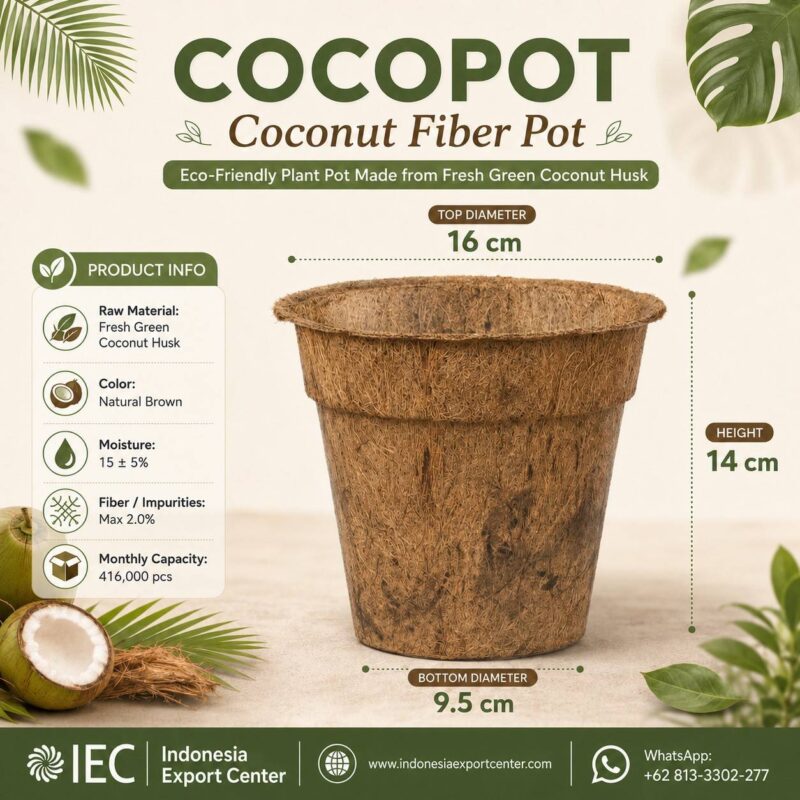
The supplied IEC COCOPOT reference is a natural brown coconut fiber plant pot made from fresh green coconut husk.
Its reference dimensions are:
- Top Diameter: 16 cm
- Height: 14 cm
- Bottom Diameter: 9.5 cm
The stated monthly production capacity is 416,000 pieces, subject to verification with the actual manufacturing source.
REQUEST A COCONUT COIR POT QUOTATION FOR THE NETHERLANDS
WhatsApp: https://wa.me/628133302277
Website: https://indonesiaexportcenter.com/
IEC acts as a sourcing and export facilitation partner. Product availability, manufacturing capability, and export arrangements require supplier confirmation.
Coconut Coir Pots for Dutch Buyers – Product Specifications
| Specification | IEC Product Reference |
|---|---|
| Product | COCOPOT – Coconut Fiber Pot |
| Country of Sourcing | Indonesia |
| Raw Material | Fresh Green Coconut Husk |
| Color | Natural Brown |
| Moisture | 15 ± 5% |
| Fiber / Impurities | Maximum 2.0%, definition to be confirmed |
| Top Diameter | 16 cm |
| Height | 14 cm |
| Bottom Diameter | 9.5 cm |
| Stated Monthly Capacity | 416,000 Pieces |
| Unit Weight | To Be Confirmed |
| Wall Thickness | To Be Confirmed |
| Dimensional Tolerances | To Be Confirmed |
| MOQ | To Be Confirmed |
| Packaging | Subject to Supplier Confirmation |
| Wholesale Price | Request Quotation |
| Export Terms | Subject to Agreement |
Important: These are supplied reference specifications. The complete composition of the finished pot, available production allocation, and measurement methods require verification.
1. Coconut Coir Pots for the Dutch Horticulture Sector
The Netherlands is an important European horticultural trading and production market, with established greenhouse, nursery, and plant distribution activities.
For professional buyers, coconut fiber plant pots may be considered for applications such as:
- Nursery plant production
- Plant propagation programs
- Garden retail product ranges
- Horticultural supply distribution
- Selected transplanting applications
- Private-label garden products
The suitability of any coir pot for a particular growing system must be verified through product testing.
Why Professional Buyers Need Detailed Specifications
Nursery procurement decisions often depend on repeatable dimensions, handling performance, product quality, and compatibility with existing production systems.
A product that appears suitable in a catalog may still require testing before adoption in commercial nursery operations.
2. Professional Nursery Procurement Requirements
Dutch horticulture buyers may require more detailed product information than general retail customers.
Recommended procurement specifications include:
| Parameter | Procurement Requirement |
|---|---|
| Top Diameter | Confirmed Measurement |
| Bottom Diameter | Confirmed Measurement |
| Height | Confirmed Measurement |
| Wall Thickness | Agreed Specification |
| Unit Weight | Measured Value |
| Dimensional Tolerance | Agreed Range |
| Moisture | Agreed Test Method and Limit |
| Material Composition | Supplier Declaration |
| Drainage Characteristics | Application-Specific |
| Nesting Configuration | If Applicable |
| Packaging Quantity | Confirmed |
| Quality Acceptance Criteria | Written Agreement |
These details should be established before confirming a recurring supply arrangement.
3. IEC Coconut Fiber Pot Reference Dimensions
The IEC reference product has the following dimensions:
| Measurement | Dimension |
|---|---|
| Top Diameter | 16 cm |
| Height | 14 cm |
| Bottom Diameter | 9.5 cm |
These measurements describe the supplied reference product.
Alternative sizes or shapes may be submitted for feasibility review, but custom manufacturing availability is not established by the reference.
4. Material Composition and Coconut Husk Origin
The supplied product information identifies fresh green coconut husk as the raw material.
However, the complete composition of the finished coconut fiber pot has not been supplied.
Professional importers should request clarification concerning:
- Coconut fiber content
- Binders or adhesives
- Coatings
- Other additives
- Material consistency
- Applicable product testing
This information is particularly important when evaluating environmental claims or destination-market requirements.
5. Moisture Specification
The supplied reference states:
Moisture: 15 ± 5%
If the tolerance is expressed in percentage points, this corresponds to approximately 10–20%.
The buyer and supplier should confirm the measurement method and contractual acceptance criteria.
Moisture is relevant to product weight, storage, packaging, and quality control.
6. Dimensional Consistency for Nursery Operations
Professional nurseries may use standardized handling systems and production layouts.
Pot dimensions can affect compatibility with:
- Nursery trays
- Benches
- Potting equipment
- Handling systems
- Transport racks
- Retail display configurations
Buyer Recommendation
Test physical samples with the intended nursery equipment before committing to bulk orders.
No verified dimensional tolerance or equipment compatibility claim has been supplied for the IEC reference product.
7. Product Handling and Structural Performance
Coconut fiber pots should be evaluated under actual operating conditions.
Potential nursery testing areas include:
- Handling strength
- Shape retention
- Wet handling
- Water movement
- Growing media retention
- Stability
- Transplanting performance
The supplied reference does not include independently verified performance test results.
8. Sampling for Dutch Nursery Buyers
Product samples allow procurement teams to assess suitability before purchasing larger quantities.
Recommended Sample Evaluation
- Measure dimensions.
- Check unit weight.
- Examine wall thickness.
- Evaluate surface consistency.
- Test handling characteristics.
- Review intended growing application.
- Assess packaging requirements.
- Record observations and acceptance criteria.
Sample availability, cost, and shipping arrangements require supplier confirmation.
9. Golden Sample Approval
A golden sample is an approved physical product used as a reference for future production.
For recurring nursery procurement, the approved sample should be linked to a written specification.
Recommended Approval Records
- Product identification
- Dimensions
- Material information
- Weight
- Moisture requirements
- Visual acceptance criteria
- Approval date
This helps buyers and suppliers maintain consistent expectations.
10. Wholesale Supply and MOQ
The minimum order quantity for the IEC reference product has not been confirmed.
MOQ may depend on:
- Order volume
- Product specifications
- Packaging requirements
- Production scheduling
- Shipping arrangements
Dutch buyers should provide the expected initial order and annual purchasing forecast when requesting a quotation.
11. Production Capacity and Repeat Orders
The supplied IEC reference states:
Monthly Capacity: 416,000 Pieces
This figure is not independently verified and does not guarantee available production allocation.
For Repeat Orders, Confirm:
- Actual manufacturing source
- Product-specific capacity
- Available production allocation
- Lead time
- Production schedule
- Quality consistency
- Packaging availability
Professional nurseries planning seasonal supply should request a written delivery schedule.
12. Packaging for Dutch Horticultural Importers
Packaging should be appropriate for the buyer’s handling, storage, and distribution requirements.
Potential packaging inquiries include:
- Bulk packing
- Master cartons
- Palletized shipments
- Retail packaging
- Private-label cartons
- Product identification labels
These options require supplier confirmation.
Recommended Packing Data
| Packing Parameter | Information Required |
|---|---|
| Units per Pack | Pieces |
| Units per Carton | Pieces |
| Carton Dimensions | cm |
| Net Carton Weight | kg |
| Gross Carton Weight | kg |
| Pallet Dimensions | If Applicable |
| Pallet Gross Weight | If Applicable |
| Shipping Marks | As Agreed |
13. Palletization for European Distribution
Palletization may be important for buyers operating warehouses or distribution centers.
Dutch importers should specify:
- Preferred pallet dimensions
- Maximum pallet height
- Maximum pallet weight
- Warehouse handling requirements
- Packaging protection
- Unloading arrangements
If wood packaging material is used, applicable international wood packaging requirements should be checked.
No confirmed pallet configuration has been supplied for the IEC reference product.
14. Container Shipping from Indonesia to the Netherlands
For larger orders, container shipping may be considered.
Potential options include:
- 20ft dry container
- 40ft dry container
- 40ft high-cube container
The practical loading quantity depends on:
- Product dimensions
- Unit weight
- Nesting configuration
- Carton dimensions
- Palletization
- Container payload
- Cargo securing
No verified pieces-per-container quantity has been supplied.
15. Shipping to Rotterdam and Other Dutch Destinations
The Port of Rotterdam is a major European container gateway and may be considered as a destination for Netherlands-bound shipments.
Buyers may request quotations based on:
- Port of Rotterdam
- Another suitable destination port
- An agreed inland delivery location
Actual routes, freight rates, transit times, and destination services must be confirmed with the logistics provider.
16. Importing Coconut Coir Pots into the European Union
The Netherlands is part of the European Union.
Importers should review applicable EU customs, product, and plant-health requirements before shipment.
Important Areas to Verify
- Product classification under the EU Combined Nomenclature
- Applicable customs duty
- Import VAT
- Customs declaration requirements
- Country-of-origin information
- Plant-health requirements
- Product composition
- Packaging obligations
- Applicable product safety requirements
The specific obligations depend on the finished product and its intended use.
17. EU Plant-Health Requirements
Coconut-derived horticultural products may require plant-health review depending on their composition, processing, and classification.
Importers should confirm whether the specific finished coconut fiber pot is subject to phytosanitary controls or other requirements.
Do not assume that rules for raw coconut fiber, growing media, live plants, and finished fiber pots are identical.
Buyer Recommendation
Consult the Netherlands Food and Consumer Product Safety Authority (NVWA) and relevant import specialists.
Official reference: https://www.nvwa.nl/
18. Customs Classification and Import Duties
The correct EU tariff classification must be established for the actual finished product.
Applicable duty rates and trade measures should be checked using the relevant EU customs resources.
Buyer Recommendation
Ask your customs broker to verify:
- Product classification
- Country of origin
- Applicable customs duty
- Import VAT treatment
- Any additional import measures
- Required supporting documents
Official reference: https://trade.ec.europa.eu/access-to-markets/
19. EORI and Customs Clearance
EU importers generally need an appropriate Economic Operators Registration and Identification (EORI) number for relevant customs activities.
The importer should confirm the applicable registration and customs procedures with Dutch Customs or its customs representative.
Official reference: https://www.douane.nl/
20. EU Packaging and Waste Obligations
Packaging placed on the EU market may be subject to applicable packaging and waste requirements.
Dutch importers should verify their responsibilities concerning:
- Packaging materials
- Packaging declarations
- Producer responsibility
- Labeling
- Waste management
- Relevant EU and Dutch rules
Requirements may depend on the importer’s role, the packaging type, and the applicable implementation dates.
21. Environmental Claims for the Dutch Market
Coconut husk is a natural plant-derived material.
However, finished-product environmental claims require evidence.
Claims such as the following should be verified:
- Biodegradable
- Compostable
- Home compostable
- Plastic-free
- Chemical-free
- Sustainable
- Direct-plantable
The finished pot’s composition and performance determine whether a claim can be supported.
Buyers should review applicable EU and Dutch consumer protection requirements before using such statements in marketing or packaging.
22. Quality Control for Professional Nursery Supply
A written quality control plan helps define acceptable product variation.
Recommended Inspection Areas
- Dimensions
- Unit weight
- Moisture
- Wall thickness
- Shape consistency
- Surface condition
- Visible defects
- Packaging
- Quantity
Buyer Recommendation
Agree on sampling procedures and acceptance criteria before production.
23. Third-Party Inspection
Professional importers may request independent inspection.
Potential inspection stages include:
- Pre-production inspection
- During-production inspection
- Pre-shipment inspection
- Container loading inspection
Inspection scope, provider availability, and costs require agreement.
IEC does not claim that independent inspection is automatically included.
24. Landed Cost Planning for Netherlands Buyers
The landed cost is broader than the supplier’s unit price.
Potential Cost Components
| Cost Component | Description |
|---|---|
| Product Price | Agreed purchase cost |
| Export Packaging | Cartons, labels, pallets |
| Origin Charges | Applicable export and handling costs |
| Ocean Freight | International shipping |
| Cargo Insurance | If Applicable |
| Customs Duty | Based on classification and applicable rules |
| Import VAT | Subject to applicable tax treatment |
| Customs Brokerage | Clearance services |
| Destination Charges | Port and terminal handling |
| Inland Transportation | Delivery to Dutch warehouse |
The importer should account for which charges are already included under the agreed Incoterm.
25. Landed Cost per Pot
A useful procurement calculation is:
Landed Cost per Pot = Total Applicable Landed Shipment Cost ÷ Usable Pots Received
Illustrative Example
Assume a hypothetical shipment has:
- Product cost: EUR 10,000
- Freight and insurance: EUR 2,500
- Customs duty and applicable nonrecoverable fees: EUR 500
- Brokerage and destination charges: EUR 700
- Inland transportation: EUR 800
Illustrative total: EUR 14,500
If the shipment contains 20,000 usable pots:
EUR 14,500 ÷ 20,000 = EUR 0.725 per pot
This example is not an IEC quotation or current freight estimate.
Recoverable import VAT may be treated differently for accounting and cost purposes and should be assessed by the importer.
26. FCA, FOB, CFR and CIF Quotations
The appropriate Incoterms 2020 rule and named place should be agreed before purchase.
FCA
Delivery to the nominated carrier or another designated party at the agreed place.
FOB
Delivery on board the vessel at the named port of shipment.
CFR
The seller pays the agreed freight to the named destination port, with risk transferring under the applicable rule.
CIF
Similar to CFR, with the required insurance arranged by the seller.
For containerized shipments, FCA, CPT, or CIP may be more suitable in certain arrangements.
27. Export Documentation
Depending on the shipment and destination requirements, documents may include:
- Commercial invoice
- Packing list
- Bill of lading
- Certificate of Origin, where applicable
- Product specification sheet
- Inspection records, where agreed
- Relevant customs documentation
- Other required certificates or declarations
The actual document list should be confirmed before shipment.
28. Supplier Verification for Dutch Procurement Teams
International buyers should identify the actual manufacturing and commercial parties.
Recommended Verification Areas
- Registered supplier identity
- Actual manufacturer
- Factory location
- Production capability
- Quality control procedures
- Contractual seller
- Exporter of record
- Payment beneficiary
IEC acts as a sourcing and export facilitation partner and should not automatically be treated as the physical manufacturer.
29. Procurement Checklist for Netherlands Buyers
Product
-
Product dimensions confirmed
-
Material composition reviewed
-
Moisture specification agreed
-
Samples evaluated
-
Nursery application tested
-
Quality criteria approved
Supplier
-
Actual manufacturer identified
-
Production capacity checked
-
MOQ confirmed
-
Wholesale price confirmed
-
Lead time agreed
-
Repeat-order arrangements discussed
Packaging
-
Packing configuration approved
-
Units per carton confirmed
-
Carton dimensions confirmed
-
Palletization requirements agreed
-
Shipping marks confirmed
EU Import
-
Customs classification verified
-
Plant-health requirements checked
-
Import duty reviewed
-
VAT treatment reviewed
-
EORI and customs procedures confirmed
-
Packaging obligations reviewed
Shipping
-
Destination confirmed
-
Incoterm agreed
-
Freight quotation reviewed
-
Inspection requirements agreed
-
Export documentation checked
30. How to Source Coconut Coir Pots for the Netherlands Through IEC
Step 1 – Submit Your Product Requirements
Provide the intended nursery application, dimensions, and quantity.
Step 2 – Review Product Specifications
Confirm material information, moisture, dimensions, and tolerances.
Step 3 – Request Samples
Evaluate samples under your intended operating conditions where available.
Step 4 – Define Packaging
Specify bulk packing, cartons, palletization, or private-label requirements.
Step 5 – Verify Import Requirements
Confirm EU and Dutch import requirements with qualified advisers.
Step 6 – Request a Quotation
Provide your destination, order volume, and preferred Incoterm.
Step 7 – Agree on Quality Control
Approve the reference sample and inspection requirements.
Step 8 – Confirm Shipment Arrangements
Verify production allocation, packing, loading, and export documentation.
Netherlands Coconut Coir Pots Wholesale RFQ Template
Subject: Coconut Coir Pots Wholesale – Netherlands Horticulture Import Inquiry
Dear Indonesia Export Center Team,
We are interested in sourcing coconut fiber plant pots from Indonesia for professional horticultural use and wholesale distribution in the Netherlands.
Please review our product, quality, packaging, and export requirements.
Buyer Information
Company Name: [Company Name]
Country: Netherlands
Business Type: [Professional Nursery / Horticultural Distributor / Importer / Garden Retailer]
Contact Person: [Name]
Email: [Email]
WhatsApp: [Number]
Product Requirements
Product: Coconut Fiber Plant Pot / Cocopot
Top Diameter: [cm]
Height: [cm]
Bottom Diameter: [cm]
Required Wall Thickness: [mm]
Target Unit Weight: [g]
Material Requirements: [Details]
Moisture Requirement: [Percentage / Tolerance]
Intended Nursery Application: [Details]
Initial Order Quantity: [Pieces]
Estimated Annual Volume: [Pieces]
Quality Requirements
Samples Required: [Yes / No]
Material Composition Declaration Required: [Yes / No]
Laboratory Testing Required: [Yes / No]
Dimensional Tolerances Required: [Details]
Third-Party Inspection Required: [Yes / No]
Packaging Requirements
Packing Format: [Bulk / Master Carton / Retail Carton]
Palletization Required: [Yes / No]
Preferred Pallet Dimensions: [Details]
Private-Label Packaging Required: [Yes / No]
Special Warehouse Requirements: [Details]
Shipping Requirements
Destination Country: Netherlands
Destination Port: [Rotterdam / Other]
Final Delivery Location: [City / Postal Code]
Preferred Incoterm: [FCA / FOB / CFR / CIF / Other]
Preferred Container: [20ft / 40ft / 40ft HC / To Be Recommended]
Target Delivery Period: [Month / Year]
Please provide:
- Proposed supplier and manufacturer information
- Complete product specifications
- Finished-product material composition
- Sample availability and costs
- Dimensional tolerances
- MOQ
- Wholesale unit price
- Production capacity information
- Available production allocation
- Production lead time
- Quality control procedures
- Available product test reports
- Packaging options
- Units per carton
- Carton dimensions and gross weight
- Palletization options
- Estimated container loading
- Export documentation information
- FCA or FOB quotation, as applicable
- CFR or CIF quotation, if available
- Contractual seller and exporter of record
- Payment terms
- Quotation validity
We look forward to receiving your sourcing proposal.
Best regards,
[Your Name]
[Company Name]
Netherlands
SEND YOUR NETHERLANDS WHOLESALE RFQ
WhatsApp: https://wa.me/628133302277
Frequently Asked Questions – Coir Pots Supplier Netherlands
Can I source coconut coir pots from Indonesia for the Netherlands?
Yes, sourcing inquiries can be submitted. Import eligibility, product availability, and commercial terms must be confirmed before shipment.
Does IEC manufacture coconut coir pots directly?
IEC facilitates sourcing and export inquiries. It should not automatically be considered the physical manufacturer.
What is the raw material of the IEC cocopot?
The supplied product reference identifies fresh green coconut husk.
What are the product dimensions?
16 cm top diameter, 14 cm height, and 9.5 cm bottom diameter.
What is the reference color?
Natural brown.
What is the moisture specification?
15 ± 5%.
What is the stated monthly capacity?
416,000 pieces, subject to verification.
Can these coir pots be used in professional nurseries?
They may be evaluated for nursery applications, but suitability should be verified through product testing under the intended conditions.
Can I request samples for nursery trials?
Sample inquiries may be submitted, subject to availability and commercial arrangements.
What is the MOQ for Dutch importers?
MOQ must be confirmed with the proposed supplier.
Can I request wholesale prices in EUR?
A quotation in EUR may be requested, subject to the seller’s agreement.
Can I request palletized shipments?
Palletization requirements may be discussed, subject to supplier and logistics capability.
Can IEC arrange shipments to Rotterdam?
Shipping quotation inquiries for Rotterdam may be submitted, subject to carrier availability and commercial arrangements.
Are phytosanitary certificates required?
Requirements depend on the specific finished product and applicable EU plant-health rules. Importers should verify the requirements with the relevant authorities.
What is the import duty for coconut coir pots in the Netherlands?
The applicable duty depends on the confirmed EU tariff classification and rules in effect at import.
Is an EORI number required?
An EORI number is generally required for relevant EU customs activities. The importer should confirm the applicable requirements.
Are coconut coir pots biodegradable?
Finished-product biodegradability requires product-specific evidence.
Can I request private-label packaging?
Private-label packaging inquiries may be submitted for feasibility review.
Can I request third-party inspection?
Independent inspection requirements may be discussed, subject to an agreed scope and provider availability.
How do I request a quotation for the Netherlands?
Send your company details, required specifications, quantity, packaging requirements, and destination to IEC via WhatsApp.
Request Wholesale Coconut Coir Pots for the Netherlands
Source Coconut Fiber Plant Pots from Indonesia for Professional Horticultural Supply
Indonesia Export Center (IEC) welcomes inquiries from Dutch horticulture importers, professional nurseries, greenhouse supply companies, and wholesale garden product distributors.
Product: COCOPOT – Coconut Fiber Plant Pot
Country of Sourcing: Indonesia
Raw Material: Fresh Green Coconut Husk
Color: Natural Brown
Reference Moisture: 15 ± 5%
Reference Fiber / Impurities: Max. 2.0%, Definition Subject to Confirmation
Top Diameter: 16 cm
Height: 14 cm
Bottom Diameter: 9.5 cm
Stated Monthly Capacity: 416,000 Pieces, Subject to Verification
MOQ: To Be Confirmed
Packaging: Subject to Supplier Confirmation
Wholesale Price: Request Quotation
Production Lead Time: To Be Confirmed
Container Loading Quantity: To Be Calculated
EU Import Requirements: To Be Verified by the Importer
Export Terms: Subject to Commercial Agreement
Contact IEC to discuss professional nursery procurement, product samples, bulk orders, palletization, quality control, and shipping quotations for the Netherlands.
INDONESIA EXPORT CENTER | IEC
Your Export & Sourcing Partner from Indonesia
Website: https://indonesiaexportcenter.com/
WhatsApp: +62 813-3302-277
REQUEST YOUR NETHERLANDS COIR POT WHOLESALE QUOTATION
Please include your company name, intended nursery application, product specifications, target quantity, packaging requirements, and Dutch destination.
Commercial and Import Disclaimer: IEC facilitates sourcing and export inquiries. Product specifications, manufacturing capacity, MOQ, packaging, pricing, and export arrangements require supplier confirmation. EU customs classification, plant-health requirements, applicable duties, VAT, labeling, packaging obligations, and other import requirements must be verified by the importer and qualified advisers under the rules applicable at the time of import.
