

INDONESIA EXPORT CENTER | IEC
COCOPOT – COCONUT FIBER POT
Natural Coconut Husk Plant Pots for Eco-Gardening Distributors
Natural Fiber Material | Biodegradability Verification | Wholesale Sourcing | Bulk Export Inquiries
Looking for biodegradable coir pots wholesale sourcing options for your gardening, nursery, horticultural, or sustainable product distribution business?
Coconut coir pots are plant containers manufactured using coconut husk fiber.
Because coconut fiber is a natural plant-derived material, coir pots are frequently considered by buyers looking for alternatives to conventional plastic nursery pots.
However, an important distinction must be made:
Natural coconut fiber is not, by itself, proof that every finished coir pot is biodegradable or compostable under all conditions.
The environmental performance of a finished pot depends on its complete composition, manufacturing process, and the conditions in which it is used or disposed of.
For international wholesale buyers, verifying these characteristics is essential before making environmental claims in retail packaging or marketing.
Indonesia Export Center (IEC) facilitates sourcing and export inquiries for Indonesian coconut fiber pots.
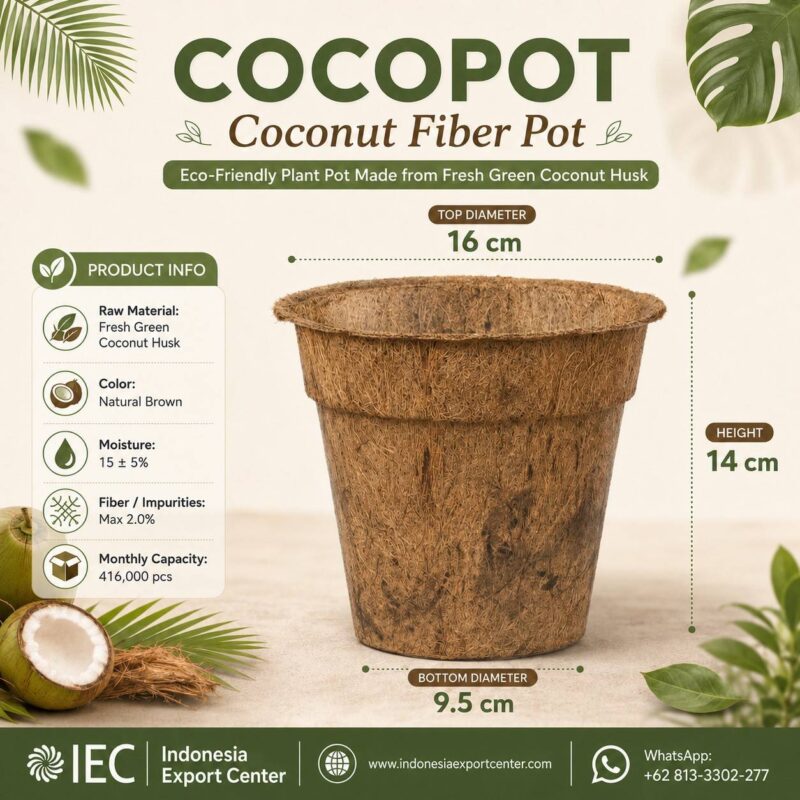
Our supplied cocopot reference features a natural brown plant pot made from fresh green coconut husk, with a 16 cm top diameter, 14 cm height, and 9.5 cm bottom diameter.
IEC welcomes inquiries from eco-gardening distributors, plant nurseries, garden retailers, horticultural wholesalers, and international importers.
Request Coconut Coir Pots Wholesale Information:
https://wa.me/628133302277
Natural Coconut Coir Pots – Product Overview
| Product Information | Supplied Reference |
|---|---|
| Product | Coconut Coir Pot / Cocopot |
| Origin | Indonesia |
| Raw Material | Fresh Green Coconut Husk |
| Color | Natural Brown |
| Moisture | 15 ± 5% |
| Fiber / Impurities | Maximum 2.0%, definition to be confirmed |
| Top Diameter | 16 cm |
| Height | 14 cm |
| Bottom Diameter | 9.5 cm |
| Stated Monthly Capacity | 416,000 Pieces |
| Biodegradability of Finished Product | Requires product-specific verification |
| Compostability Certification | Not established in the supplied reference |
| Complete Material Composition | To be confirmed |
| MOQ | To be confirmed |
| Wholesale Price | Request quotation |
| Packaging | To be confirmed |
Important: This product is positioned as a natural coconut fiber plant pot. Any finished-product biodegradability or compostability claim must be supported by appropriate evidence.
1. What Are Biodegradable Coir Pots?
The term biodegradable coir pots is commonly used in searches for plant pots made from coconut fiber.
Coconut coir is derived from the fibrous husk of coconuts.
Under suitable conditions, certain natural organic materials can undergo biological degradation.
However, whether a finished coir pot meets a particular biodegradability claim depends on more than its raw material.
Factors That Matter
- Full material composition
- Binders or adhesives
- Coatings
- Manufacturing process
- Product thickness
- Moisture conditions
- Temperature
- Microbial environment
- Time required for degradation
Buyer Recommendation
Before labeling a product biodegradable, request evidence that supports the exact claim and intended disposal environment.
2. Natural Coconut Fiber vs. Verified Biodegradable Products
These terms should not be treated as identical.
Natural Coconut Fiber
Describes the plant-derived fiber material.
Biodegradable Product
Describes a product’s ability to undergo biological degradation under specified conditions.
Compostable Product
Describes a product that meets applicable compostability criteria under specified conditions and standards.
Key Distinction
A natural-fiber product may contain additional ingredients that influence its environmental behavior.
Do not assume that a coconut fiber pot is certified biodegradable, home compostable, industrially compostable, or plastic-free without appropriate verification.
3. Why Eco-Gardening Buyers Consider Coconut Coir Pots
Coconut fiber pots may be relevant to buyers seeking natural-material products for gardening and horticulture.
Coconut-Based Raw Material
The supplied IEC reference identifies fresh green coconut husk as the raw material.
Natural Brown Appearance
The pot has a natural brown appearance suitable for natural-material product positioning.
Horticultural Applications
Coir pots may be evaluated for selected nursery, seedling, and plant-growing applications.
Wholesale Distribution
Importers and distributors can request bulk supply information for their intended markets.
Environmental Product Positioning
Natural coconut fiber may support marketing focused on plant-derived materials, provided that specific environmental claims are accurate and substantiated.
4. IEC Coconut Coir Pot Specifications
| Specification | Reference Details |
|---|---|
| Raw Material | Fresh Green Coconut Husk |
| Color | Natural Brown |
| Moisture | 15 ± 5% |
| Fiber / Impurities | Maximum 2.0% |
| Stated Monthly Capacity | 416,000 Pieces |
Raw Material
The supplied product reference identifies fresh green coconut husk.
This does not establish that the finished pot contains no binders, adhesives, or other additives.
Moisture
The supplied reference specifies 15 ± 5%, corresponding to approximately 10–20% when interpreted as percentage-point tolerance.
Fiber / Impurities
The supplied reference states a maximum of 2.0%.
The exact meaning and measurement method require clarification before this parameter is used as a contractual quality requirement.
5. Coconut Coir Pot Dimensions
IEC’s supplied cocopot reference has the following dimensions.
| Dimension | Measurement |
|---|---|
| Top Diameter | 16 cm |
| Height | 14 cm |
| Bottom Diameter | 9.5 cm |
Additional Measurements to Confirm
Buyers should request:
- Pot weight
- Wall thickness
- Internal dimensions
- Drainage configuration
- Dimensional tolerances
- Growing volume
These details have not been established in the supplied reference.
6. How to Verify Biodegradability Claims
Wholesale buyers should request evidence before making environmental claims.
Step 1 – Confirm the Complete Composition
Request information about:
- Coconut fiber content
- Binders
- Adhesives
- Coatings
- Additives
- Other components
Step 2 – Identify the Intended Environment
A biodegradability claim should specify the relevant conditions.
Examples may include:
- Soil
- Home composting
- Industrial composting
- Other defined environments
Step 3 – Identify the Applicable Standard
Testing should be appropriate for the claim and destination market.
Step 4 – Request Test Reports
Ask for reports covering the actual finished product.
Step 5 – Review the Scope of Evidence
Confirm:
- Product identification
- Test method
- Test conditions
- Test duration
- Results
- Laboratory information
- Applicable limitations
Step 6 – Review Marketing Language
Ensure the proposed claim does not exceed the evidence.
7. Biodegradable vs. Compostable Coir Pots
| Comparison | Biodegradable | Compostable |
|---|---|---|
| Main Concept | Biological degradation under specified conditions | Meeting defined compostability requirements |
| Environmental Conditions | Must be identified | Must be identified |
| Time Requirement | Depends on claim and method | Defined by applicable standard |
| Testing | Claim-specific | Standard-specific |
| Certification | Depends on market and claim | Depends on standard and market |
| IEC Finished-Pot Status | Not independently verified | Not established |
Important Note
Compostability is not guaranteed merely because a product is made from coconut husk.
8. Home Composting vs. Industrial Composting
Home and industrial composting are different environments.
Home Composting
Conditions can vary significantly depending on climate, management, and the compost system.
Industrial Composting
Industrial systems may use controlled processing conditions.
Why This Matters
Evidence supporting one environment should not automatically be used to claim performance in another.
Buyer Recommendation
Confirm which environment the product has actually been tested for.
9. Can Coconut Coir Pots Be Planted Directly into Soil?
Some natural-fiber plant pots are marketed for direct planting.
However, suitability depends on the finished product.
Factors to Evaluate
- Pot strength
- Water absorption
- Root penetration
- Drainage
- Degradation behavior
- Plant species
- Growing conditions
Important Limitation
The supplied IEC reference does not include a verified direct-planting performance test.
Buyers should test the pot for their intended growing system before making direct-planting claims.
10. Coconut Coir Pots vs. Plastic Nursery Pots
| Comparison | Coconut Coir Pots | Conventional Plastic Pots |
|---|---|---|
| Main Material | Coconut-based fiber | Plastic polymer |
| Appearance | Natural brown | Varies |
| Product Composition | Requires finished-product confirmation | Depends on polymer and additives |
| Biodegradability | Must be verified | Depends on material |
| Compostability | Must be verified | Depends on material and certification |
| Water Resistance | Product-specific | Product-specific |
| Durability | Product-specific | Product-specific |
| End-of-Life Claims | Require evidence | Require evidence |
The appropriate product depends on performance requirements, cost, intended use, and destination-market regulations.
11. Environmental Claims for Retail Packaging
Environmental marketing claims should be accurate, specific, and supported by evidence.
Claims That Require Verification
- 100% biodegradable
- Certified compostable
- Home compostable
- Plastic-free
- Chemical-free
- Zero waste
- Carbon-neutral
- Environmentally harmless
Safer Product Descriptions
Where supported by the material information, buyers may describe the product as:
Coconut Fiber Plant Pot
Made from Coconut Husk Fiber
Natural Brown Coconut Fiber Pot
Important Note
Even broad claims such as “eco-friendly” should be reviewed against applicable destination-market advertising rules.
12. Standards and Testing for Environmental Claims
Different markets may apply different rules to biodegradability and compostability claims.
Buyer Responsibilities
Confirm:
- Destination country
- Intended environmental claim
- Applicable standard
- Required testing
- Certification requirements
- Labeling rules
Product-Specific Evidence
Testing should identify the actual finished pot.
A report for raw coconut fiber alone may not substantiate a claim about the complete manufactured pot.
13. Material Composition and Binder Verification
A critical sourcing question is whether the finished cocopot contains additional materials.
Questions to Ask
- What percentage of the finished pot is coconut fiber?
- Are binders used?
- Are adhesives used?
- Are synthetic polymers present?
- Are coatings applied?
- Are colorants added?
- Is a full material declaration available?
- Has the finished product been tested?
Why This Matters
Material composition affects product performance and environmental claims.
14. Wholesale Applications for Coconut Coir Pots
Coconut fiber pots may be considered for:
Plant Nurseries
For selected plant-growing applications.
Garden Retailers
For natural-material gardening product ranges.
Horticultural Distributors
For distribution to nurseries, growers, and retail outlets.
Agricultural Supply Businesses
For selected plant propagation and cultivation applications.
Sustainable Product Distributors
For buyers seeking coconut-derived products, subject to verified environmental claims.
15. Wholesale Pricing Factors
The price of coconut coir pots depends on the agreed product and order requirements.
Main Price Drivers
- Pot dimensions
- Pot weight
- Material composition
- Order quantity
- Packaging
- Customization
- Quality testing
- Production availability
- Export terms
Environmental Testing Costs
If a buyer requires independent biodegradability or compostability testing, the testing scope, cost, and responsibilities should be agreed separately.
Price Availability
No verified current wholesale unit price has been supplied.
Buyers should request a formal quotation.
16. Minimum Order Quantity
The supplied reference does not specify a confirmed MOQ.
MOQ May Depend On
- Standard or custom size
- Packaging
- Production scheduling
- Order volume
- Custom labeling
- Supplier commercial policy
Buyers should request MOQ confirmation for their exact requirements.
17. Monthly Production Capacity
IEC’s supplied reference identifies:
416,000 Pieces per Month
This is a stated capacity figure, subject to confirmation.
It does not guarantee:
- Immediate inventory
- Reserved production
- Guaranteed monthly allocation
- Acceptance of every order quantity
18. Wholesale Packaging and Export Preparation
Packaging should protect the pots during storage and transportation.
Buyer Considerations
- Pot dimensions
- Pot weight
- Nesting feasibility
- Carton configuration
- Handling protection
- Moisture exposure
- Labeling requirements
Important Note
No fixed packaging configuration or container loading quantity has been established in the supplied reference.
19. Container Shipping for Coconut Coir Pots
Container loading depends on the actual product and packing plan.
Variables
- Pot size
- Pot weight
- Carton dimensions
- Pieces per carton
- Nesting arrangement
- Palletization
- Container type
Buyer Recommendation
Request a verified loading estimate before comparing freight cost per piece.
20. Export Documentation and Import Requirements
Depending on the destination, documents may include:
- Commercial invoice
- Packing list
- Bill of lading
- Certificate of Origin, where applicable
- Product specifications
- Inspection records, where agreed
- Applicable regulatory documentation
- Customs declarations
Importers should confirm destination-market requirements with their customs broker.
21. Supplier Verification for Eco-Gardening Buyers
International buyers should verify:
- Legal supplier identity
- Manufacturing arrangements
- Product composition
- Quality control
- Production capability
- Contractual seller
- Exporter of record
- Payment beneficiary
IEC’s Role
Indonesia Export Center facilitates sourcing and export inquiries.
IEC should not automatically be treated as the manufacturer, factory owner, contractual seller, or exporter of record.
22. How to Source Coconut Coir Pots Wholesale from Indonesia
Step 1 – Define the Intended Market
Identify the destination country and intended product positioning.
Step 2 – Confirm Product Dimensions
Use the reference size or submit custom requirements.
Step 3 – Request Material Composition
Verify the full finished-product composition.
Step 4 – Define Environmental Claims
Identify the exact claims you intend to make.
Step 5 – Request Supporting Evidence
Ask for relevant test reports or certification information.
Step 6 – Evaluate Samples
Assess physical and application performance.
Step 7 – Confirm MOQ and Price
Obtain a written quotation.
Step 8 – Approve Packaging
Confirm retail and transport packaging requirements.
Step 9 – Agree on Commercial Terms
Confirm payment, delivery, and quotation validity.
Step 10 – Arrange Inspection and Shipment
Coordinate quality checks, export documents, and freight.
23. Common Mistakes When Buying Biodegradable Coir Pots
Assuming Natural Means Certified Biodegradable
Natural material content does not establish finished-product certification.
Assuming Compostability
Compostability requires appropriate evidence.
Ignoring Binders
Additional materials may affect environmental performance.
Using Unsupported Retail Claims
Marketing statements should match verified test results.
Ignoring Pot Performance
Biodegradability alone does not establish suitability for every plant-growing application.
Comparing Different Product Sizes
Dimensions can affect price and performance.
Assuming Monthly Capacity Means Available Stock
Production capacity must be distinguished from confirmed availability.
24. Eco-Gardening Distributor Procurement Checklist
Before placing a wholesale order:
Product
-
Product dimensions confirmed
-
Raw material confirmed
-
Full composition requested
-
Moisture specification agreed
-
Fiber / impurities parameter clarified
-
Pot weight confirmed
-
Wall thickness confirmed
Environmental Claims
-
Intended claims identified
-
Applicable market rules reviewed
-
Relevant test reports requested
-
Finished-product evidence reviewed
-
Certification status verified
-
Packaging claims approved
Commercial
-
MOQ confirmed
-
Unit price confirmed
-
Packaging costs confirmed
-
Production availability confirmed
-
Lead time confirmed
-
Payment terms agreed
-
Quotation validity confirmed
Logistics
-
Packing configuration approved
-
Container loading estimate confirmed
-
Destination port confirmed
-
Incoterm agreed
-
Import requirements reviewed
25. Why Work with Indonesia Export Center?
Indonesia Export Center (IEC) facilitates sourcing and export inquiries for Indonesian coconut-derived products.
IEC welcomes inquiries from:
- Eco-gardening distributors
- Horticultural wholesalers
- Plant nurseries
- Garden retailers
- International importers
- Sustainable product sourcing teams
Buyers may submit requests concerning:
- Product specifications
- Material composition
- Environmental test evidence
- Samples
- MOQ
- Wholesale prices
- Packaging
- Production availability
- Export quotations
All product availability, testing, certifications, pricing, and commercial terms are subject to confirmation.
Biodegradable Coir Pots Wholesale RFQ Template
Subject: Coconut Coir Pots Wholesale – Material, Biodegradability Evidence & Export Quotation
Dear Indonesia Export Center Team,
We are interested in importing coconut coir pots from Indonesia for our gardening or horticultural product business.
Please provide available product specifications, material composition information, environmental test evidence, MOQ, wholesale pricing, and export quotation.
Buyer Information
Company Name: [Company Name]
Country: [Country]
Business Type: [Importer / Eco-Gardening Distributor / Horticultural Wholesaler / Retailer]
Contact Person: [Name]
Email: [Email]
WhatsApp: [Number]
Product Requirements
Product: Coconut Coir Pot / Cocopot
Raw Material: Fresh Green Coconut Husk
Color: Natural Brown
Required Moisture: [Percentage]
Full Material Composition Required: [Yes / No]
Binder Information Required: [Yes / No]
Coating Information Required: [Yes / No]
Dimensions
Top Diameter: [cm]
Height: [cm]
Bottom Diameter: [cm]
Wall Thickness: [mm]
Target Pot Weight: [g]
Environmental Requirements
Intended Market: [Country]
Intended Claim: [Biodegradable / Home Compostable / Industrially Compostable / Natural Fiber Only]
Required Test Standard: [Standard / To Be Confirmed]
Finished-Product Test Report Required: [Yes / No]
Certification Required: [Yes / No]
Direct-Planting Performance Required: [Yes / No]
Quantity and Packaging
Initial Order Quantity: [Pieces]
Expected Monthly Volume: [Pieces]
Sample Required: [Yes / No]
Packaging Type: [Bulk / Carton / Retail]
Private-Label Requirements: [Details]
Shipping
Destination Country: [Country]
Destination Port: [Port]
Preferred Incoterm: [FOB / CFR / CIF / FCA / Other]
Target Shipment Date: [Date]
Please provide:
- Product specifications
- Full finished-product material composition
- Binder and additive information
- Available biodegradability test evidence
- Available compostability test evidence
- Certification status
- Sample availability
- MOQ
- Wholesale unit price
- Packaging configuration
- Packaging costs
- Production availability
- Production lead time
- Container loading estimate
- Export quotation
- Available export documents
- Payment terms
- Quotation validity
We look forward to receiving your product information and quotation.
Best regards,
[Your Name]
[Company Name]
[Country]
[Contact Information]
SEND YOUR COCONUT COIR POTS INQUIRY VIA WHATSAPP:
https://wa.me/628133302277
Frequently Asked Questions About Biodegradable Coir Pots Wholesale
What are biodegradable coir pots?
The term commonly refers to plant pots made using coconut fiber and marketed for potential biological degradation. Actual finished-product biodegradability must be verified.
Are all coconut coir pots biodegradable?
Not necessarily. Finished-product composition and test conditions matter.
Are coconut coir pots compostable?
Compostability must be verified under an appropriate standard and specified conditions.
Are coconut coir pots home compostable?
This claim requires product-specific evidence.
Are coconut coir pots plastic-free?
The full material composition must be verified before making that claim.
Are coconut coir pots chemical-free?
Such a broad claim should not be made without an appropriate factual basis.
What is the raw material?
The supplied IEC reference identifies fresh green coconut husk.
What is the product color?
Natural brown.
What is the moisture specification?
15 ± 5%.
What is the fiber / impurities specification?
Maximum 2.0%, with the exact definition requiring confirmation.
What is the standard top diameter?
16 cm.
What is the standard height?
14 cm.
What is the bottom diameter?
9.5 cm.
Can buyers request custom sizes?
Custom-size requests may be submitted, subject to feasibility and MOQ.
Can coconut coir pots be planted directly into soil?
Suitability depends on product construction and application testing.
What is the stated monthly production capacity?
416,000 pieces, subject to confirmation.
Is that capacity guaranteed available?
No. Actual production availability must be confirmed.
What is the MOQ?
MOQ must be confirmed for the requested order.
Can buyers request samples?
Sample inquiries may be submitted, subject to availability.
What is the wholesale price?
Pricing depends on product specifications, quantity, packaging, and commercial terms.
Can buyers request environmental test reports?
Yes. Availability and scope must be confirmed.
Can buyers request private-label packaging?
Private-label requirements may be submitted for feasibility review.
How many pots fit in a container?
Container loading depends on the actual packaging and shipment configuration.
Does IEC manufacture the pots?
IEC facilitates sourcing and export inquiries. The actual manufacturer and contractual parties should be confirmed.
How can I request a quotation?
Send your specifications, quantity, intended environmental claims, destination, and packaging requirements to IEC via WhatsApp.
Request Natural Coconut Coir Pots Wholesale Quotation
Sourcing Coconut Fiber Plant Pots for Your Eco-Gardening Business?
Indonesia Export Center (IEC) welcomes inquiries from international distributors, importers, garden retailers, and horticultural procurement teams.
Product: Cocopot / Coconut Fiber Pot
Origin: Indonesia
Raw Material: Fresh Green Coconut Husk
Color: Natural Brown
Moisture: 15 ± 5%
Fiber / Impurities: Max 2.0%, Definition Subject to Confirmation
Top Diameter: 16 cm
Height: 14 cm
Bottom Diameter: 9.5 cm
Stated Monthly Capacity: 416,000 Pieces, Subject to Confirmation
Finished-Product Biodegradability: Requires Verification
Compostability Certification: Not Established
Material Composition: To Be Confirmed
MOQ: To Be Confirmed
Wholesale Price: Request Quotation
Packaging: To Be Confirmed
Production Lead Time: To Be Confirmed
Export Terms: Subject to Commercial Agreement
Contact IEC to discuss product specifications, environmental documentation requirements, bulk quantities, and export quotations.
Indonesia Export Center (IEC)
Your Reliable Export & Sourcing Partner from Indonesia
Website: https://indonesiaexportcenter.com/
WhatsApp: +62 813-3302-277
REQUEST WHOLESALE QUOTATION VIA WHATSAPP:
https://wa.me/628133302277
Please include your company name, destination country, intended application, required environmental claims, proposed order quantity, packaging requirements, and destination port.
Environmental Claims Disclaimer: Coconut fiber is a natural plant-derived material, but this page does not claim that the finished cocopot has been independently certified biodegradable or compostable. Such claims require verification of the complete product composition and appropriate supporting evidence.
Commercial Disclaimer: Product specifications and monthly capacity are supplied references. Actual availability, MOQ, prices, packaging, lead times, testing, and shipment terms must be confirmed for each transaction.
