

IEC | INDONESIA EXPORT CENTER
COCONUT SHELL CHARCOAL BRIQUETTES
A Step-by-Step Import Guide for International Buyers, Distributors & Procurement Managers
Supplier Sourcing | RFQ | Product Samples | Quality Control | Export Documents | Container Shipping | Customs Clearance
Planning to import coconut charcoal briquettes from Indonesia for your wholesale business, hookah distribution network, restaurant supply company, or private-label brand?
Importing charcoal briquettes involves more than finding a supplier and comparing prices.
A successful import transaction requires careful coordination between product selection, technical specifications, supplier verification, sample approval, quality control, packaging, payment arrangements, export documentation, and international shipping.
Charcoal also requires particular attention to transport classification and carrier acceptance because some charcoal products may present self-heating and fire hazards.
This guide explains how international buyers can organize the import process, from the first request for quotation to shipment arrival.
Indonesia Export Center (IEC) facilitates sourcing and export inquiries for Indonesian coconut shell charcoal briquettes, including:
- Coconut shisha charcoal cubes
- Hexagonal coconut BBQ charcoal briquettes
IEC acts as a sourcing and export facilitation partner. The actual manufacturer, contractual seller, exporter of record, and responsible logistics parties should be identified and confirmed for each transaction.
Request Coconut Charcoal Briquettes Quotation via WhatsApp:
https://wa.me/628133302277
Import Coconut Charcoal Briquettes from Indonesia: 10-Step Overview
| Step | Import Stage | Main Buyer Action |
|---|---|---|
| 1 | Define Requirements | Select product, specifications, quantity, and destination |
| 2 | Send RFQ | Request a technical and commercial quotation |
| 3 | Verify Supplier | Check supplier identity, capabilities, and transaction parties |
| 4 | Evaluate Samples | Review product quality and performance |
| 5 | Agree on QC | Define testing, inspection, and acceptance criteria |
| 6 | Confirm Contract | Agree on price, Incoterms, payment, and responsibilities |
| 7 | Approve Packaging | Finalize cartons, artwork, labeling, and packing |
| 8 | Monitor Production | Confirm schedule and batch identification |
| 9 | Inspect and Ship | Review COA, shipment documents, cargo classification, and carrier acceptance |
| 10 | Clear and Receive | Complete destination customs clearance and incoming inspection |
Each step should be completed according to the specific product, buyer requirements, and applicable regulations.
Step 1 – Define Your Coconut Charcoal Product Requirements
Before contacting suppliers, decide which type of charcoal briquettes your business needs.
Coconut Shisha Charcoal Briquettes
Shisha charcoal is commonly evaluated by hookah distributors, wholesalers, and private-label brands.
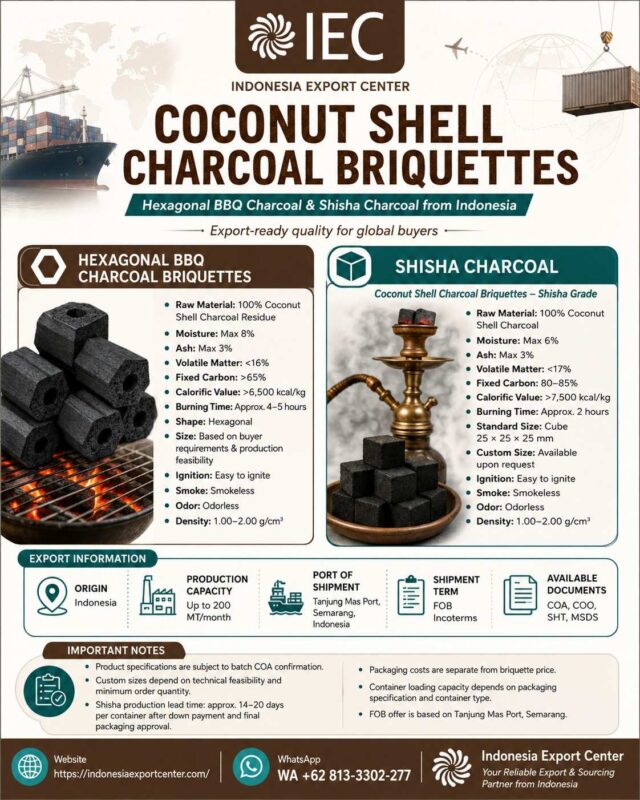
IEC Shisha Charcoal Reference Specifications
| Specification | Reference Details |
|---|---|
| Product | Coconut Shell Charcoal Briquettes – Shisha Grade |
| Raw Material | 100% Coconut Shell Charcoal |
| Shape | Cube |
| Standard Size | 25 × 25 × 25 mm |
| Moisture | Maximum 6% |
| Ash | Maximum 3% |
| Volatile Matter | Less than 17% |
| Fixed Carbon | 80–85% |
| Calorific Value | Greater than 7,500 kcal/kg |
| Burning Time | Approximately 2 hours |
| Density | 1.00–2.00 g/cm³ |
| Ignition | Described as easy to ignite; verification required |
| Smoke | Described as smokeless; verification required |
| Odor | Described as odorless; verification required |
Hexagonal Coconut BBQ Charcoal Briquettes
BBQ charcoal may be relevant to restaurant suppliers, outdoor cooking distributors, and wholesale buyers.
IEC Hexagonal BBQ Charcoal Reference Specifications
| Specification | Reference Details |
|---|---|
| Product | Hexagonal Coconut BBQ Charcoal Briquettes |
| Raw Material | 100% Coconut Shell Charcoal Residue |
| Shape | Hexagonal |
| Size | Based on buyer requirements and production feasibility |
| Moisture | Maximum 8% |
| Ash | Maximum 3% |
| Volatile Matter | Less than 16% |
| Fixed Carbon | Greater than 65% |
| Calorific Value | Greater than 6,500 kcal/kg |
| Burning Time | Approximately 4–5 hours |
| Density | 1.00–2.00 g/cm³ |
| Ignition | Described as easy to ignite; verification required |
| Smoke | Described as smokeless; verification required |
| Odor | Described as odorless; verification required |
These are supplied reference specifications rather than independently verified results for a particular production batch.
Final acceptance should be based on agreed test methods, reporting bases, and batch-specific evidence.
Step 2 – Prepare a Complete Request for Quotation (RFQ)
A clear RFQ helps suppliers prepare a relevant quotation.
Essential RFQ Information
Include:
- Company name
- Destination country
- Product type
- Required shape and dimensions
- Technical specifications
- Initial order quantity
- Expected monthly volume
- Packaging requirements
- Destination port
- Preferred Incoterm
- Target shipment date
Why Detailed RFQs Matter
Incomplete inquiries can lead to quotations based on different assumptions.
For example, two prices may not be comparable if they refer to different:
- Product grades
- Packaging formats
- Order quantities
- Shipment terms
- Quality requirements
Request a Written Quotation
Ask for a quotation identifying:
- Product description
- Unit price
- Currency
- Quantity
- MOQ
- Packaging costs
- Shipment term
- Named port or place
- Production lead time
- Payment terms
- Quotation validity
Send Your RFQ to IEC:
https://wa.me/628133302277
Step 3 – Verify the Supplier and Transaction Parties
Supplier verification is an important part of first-time importing.
Confirm Business Identity
Buyers should verify:
- Legal company name
- Business registration
- Business address
- Authorized representatives
- Contact information
- Contracting entity
- Payment beneficiary
Confirm Manufacturing Arrangements
Ask whether the company is:
- The manufacturer
- A trading company
- A sourcing intermediary
- An export facilitator
- The exporter of record
These roles may be held by different parties.
IEC’s Role
Indonesia Export Center facilitates sourcing and export inquiries.
IEC should not automatically be treated as the manufacturer, factory owner, or exporter of record.
The relevant transaction parties should be identified in the commercial agreement.
Supplier Due Diligence
Depending on order value and risk, buyers may request:
- Company documents
- Product samples
- Factory information
- Production capability evidence
- References
- Independent verification
- Quality documentation
A supplier’s stated capacity should not be treated as guaranteed availability.
Step 4 – Request and Evaluate Product Samples
Samples help buyers assess whether a product meets their intended application.
What to Evaluate
Physical Characteristics
- Shape
- Dimensions
- Unit weight
- Cracks
- Chipping
- Breakage
- Dust and fines
Technical Specifications
- Moisture
- Ash
- Volatile matter
- Fixed carbon
- Calorific value
Performance
- Ignition behavior
- Visible smoke
- Unwanted odor
- Burning duration
- Heat consistency
Sample Approval
Buyers should document:
- Sample identification
- Evaluation date
- Test procedure
- Results
- Acceptance decision
Important Limitation
A satisfactory sample does not automatically guarantee identical results in every future production batch.
Commercial orders should include appropriate batch acceptance procedures.
Step 5 – Establish Quality Control and Inspection Requirements
Quality control should be agreed before commercial production.
Technical Acceptance
Define the required values for:
- Moisture
- Ash
- Volatile matter
- Fixed carbon
- Calorific value
Physical Acceptance
Define:
- Dimensional tolerances
- Unit weight tolerances
- Maximum breakage
- Maximum dust and fines
- Acceptable visual defects
Performance Acceptance
Where required, define:
- Ignition test method
- Burning-time test method
- Smoke evaluation procedure
- Odor evaluation procedure
- Acceptance thresholds
Sampling Plan
Agree on:
- Lot definition
- Sampling points
- Sample quantity
- Sample preparation
- Laboratory submission
- Retained samples
Third-Party Inspection
Independent inspection may be requested, subject to availability, cost, and agreement.
Step 6 – Review the Certificate of Analysis (COA)
A Certificate of Analysis can support technical quality verification.
Recommended COA Information
Buyers should review:
- Product name
- Batch or sample identification
- Laboratory identity
- Report number
- Test date
- Test methods
- Reporting basis
- Moisture result
- Ash result
- Volatile matter result
- Fixed carbon result
- Calorific value result
Specification vs. COA
A specification states the required quality.
A COA reports measured or calculated results for an identified sample or batch.
They are not interchangeable.
Reporting Basis
Buyers should confirm whether analytical results are reported on an as-received, dry, or other defined basis.
Step 7 – Negotiate Price, MOQ, Incoterms and Payment Terms
Commercial terms should be agreed before production begins.
Price per Metric Ton
Request a written price based on:
- Product grade
- Quantity
- Packaging
- Quality requirements
- Shipment term
- Named port or place
Minimum Order Quantity
No fixed MOQ has been supplied for IEC’s referenced charcoal products.
MOQ should be confirmed for each inquiry.
Packaging Costs
The supplied reference states:
Packaging costs are separate from the briquette price.
Payment Terms
Payment terms should identify:
- Currency
- Deposit, if applicable
- Balance payment conditions
- Beneficiary
- Payment method
- Required documents
- Remedies for nonconformity
Payment Verification
Before transferring funds, buyers should verify the beneficiary and payment instructions through an independently confirmed communication channel.
Step 8 – Choose the Right Incoterm
Incoterms help define delivery responsibilities, costs, and risk transfer between seller and buyer.
FOB – Free on Board
IEC’s supplied reference identifies:
FOB Tanjung Mas Port, Semarang, Indonesia
FOB should be used with a named port and an identified Incoterms edition.
FCA – Free Carrier
FCA may be appropriate where containerized cargo is handed over to a carrier before loading onto the vessel.
CFR – Cost and Freight
Under CFR, the seller arranges carriage to the named destination port, but the risk-transfer point is not the same as the freight-paid destination.
CIF – Cost, Insurance and Freight
CIF includes specified seller obligations for freight and cargo insurance, subject to the applicable Incoterms rules.
Buyer Recommendation
Choose the Incoterm based on the actual handover, freight arrangements, and commercial responsibilities.
A freight-inclusive quotation should not be assumed available until confirmed.
Step 9 – Confirm Packaging and Labeling
Packaging should be approved before production or packing begins.
Wholesale Packaging
Define:
- Net weight
- Gross weight
- Carton dimensions
- Carton material
- Number of units
- Shipping marks
Private-Label Packaging
Additional requirements may include:
- Brand artwork
- Printing specifications
- Barcode
- Product name
- Country-of-origin information
- Consumer safety warnings
- Destination-market labeling
Artwork Approval
Confirm the final artwork and packaging specification in writing.
Important Note
Custom packaging depends on supplier capabilities, MOQ, and cost confirmation.
Packaging preparation and printing may require additional time.
Step 10 – Confirm Production Schedule and Batch Traceability
Production Planning
The supplier should confirm:
- Production start
- Expected completion
- Packaging readiness
- Inspection timing
- Shipment readiness
IEC Shisha Charcoal Lead Time Reference
The supplied reference indicates:
Approximately 14–20 days per container after down payment and final packaging approval.
This is an indicative shisha charcoal production period, subject to supplier confirmation.
It does not automatically include:
- Artwork preparation
- Packaging procurement
- Printing
- Inland transportation
- Ocean transit
- Customs clearance
BBQ Charcoal Lead Time
No separate verified BBQ charcoal production lead time has been supplied.
Batch Identification
Where agreed, production lots should be linked to inspection and laboratory records.
Step 11 – Verify Dangerous Goods Classification and Shipping Acceptance
This is a particularly important step when importing charcoal.
Why Charcoal Shipping Requires Attention
Charcoal may present self-heating and fire hazards.
The applicable transport classification depends on the product and relevant regulations.
Before Booking Ocean Freight
Confirm:
- Product classification
- Applicable IMDG Code requirements
- Carrier acceptance
- Packaging requirements
- Marking and labeling
- Required transport documents
- Container suitability
- Stowage or segregation requirements
Do Not Assume General Cargo Status
Charcoal should not automatically be treated as unrestricted general cargo.
SDS/MSDS
An SDS or MSDS may provide safety and transport information, but it does not by itself establish an exemption from applicable maritime transport requirements.
Important Sequence
Transport classification and carrier feasibility should be checked early in the sourcing process, before committing to packaging, shipment dates, or freight arrangements.
Step 12 – Conduct Pre-Shipment Inspection
A pre-shipment inspection may help verify product and packaging conformity.
Product Inspection
Check:
- Correct product type
- Correct dimensions
- Visual condition
- Breakage
- Dust and fines
- Batch identification
Laboratory Verification
Review:
- Moisture
- Ash
- Volatile matter
- Fixed carbon
- Calorific value
- Other agreed parameters
Packaging Inspection
Check:
- Carton quantity
- Carton dimensions
- Net and gross weights
- Labels
- Shipping marks
- Packaging condition
Shipment Readiness
Verify:
- Container suitability
- Transport classification
- Carrier acceptance
- Required documents
Shipment approval should follow the agreed acceptance criteria.
Step 13 – Prepare Export Documents
Documentation requirements depend on the transaction, destination country, and cargo classification.
Common Commercial Documents
- Commercial invoice
- Packing list
- Bill of lading or other transport document
- Applicable customs declarations
Quality Documents
- Certificate of Analysis, where required
- Laboratory reports, where agreed
- Inspection reports, where agreed
Origin Documents
- Certificate of Origin, where applicable
Safety and Transport Documents
- Safety Data Sheet, where required
- Dangerous goods documentation, where applicable
- Other documents required by the carrier or authorities
IEC Supplied Document Reference
The supplied reference identifies:
- COA
- COO
- SHT
- MSDS
The exact meaning and applicability of the document identified as SHT require confirmation.
Actual document availability must be verified for each transaction.
Step 14 – Arrange Container Loading and Ocean Shipment
Reference Indonesian Loading Port
Tanjung Mas Port, Semarang, Indonesia
Container Planning
Actual container loading depends on:
- Carton dimensions
- Gross weight
- Packaging configuration
- Container type
- Cargo securing requirements
- Applicable transport restrictions
No Guaranteed Container Payload
The supplied reference does not establish a fixed loading quantity per container.
Buyers should request a shipment-specific loading plan.
Loading Verification
Where agreed, inspection may record:
- Container number
- Seal number
- Carton count
- Loading condition
- Photographic evidence
Step 15 – Complete Import Customs Clearance
Destination customs clearance is the importer’s responsibility unless the agreed transaction structure provides otherwise.
Import Compliance Checklist
Buyers should verify:
- Correct customs classification
- Applicable duties and taxes
- Import licensing requirements
- Product restrictions
- Labeling rules
- Safety requirements
- Customs documentation
- Importer-of-record obligations
HS Code Verification
Do not assume that the tariff classification for raw coconut shell charcoal automatically applies to finished charcoal briquettes.
The correct classification should be confirmed with the destination customs authority or a qualified customs broker.
Country-Specific Requirements
Import rules vary by country.
First-time importers should consult a qualified customs broker or relevant authority before shipment.
Step 16 – Inspect the Goods After Arrival
Incoming inspection can help buyers identify shipping damage or discrepancies.
Arrival Inspection
Check:
- Container and seal condition
- Carton count
- Carton damage
- Water exposure
- Product breakage
- Labeling
- Shipment documentation
Quality Claims
Any claim procedure should follow the agreed contract, applicable insurance conditions, and required notice periods.
Retained Samples
Where agreed, retained samples and documented inspection records may help resolve disputes.
Coconut Charcoal Import Cost Breakdown
The total import cost may include more than the product price.
| Cost Component | What It Covers |
|---|---|
| Product Price | Charcoal briquettes |
| Packaging | Retail, wholesale, or private-label packing |
| Sampling | Product samples and delivery |
| Laboratory Testing | Technical analysis |
| Inspection | Third-party or pre-shipment inspection |
| Inland Logistics | Movement to the relevant handover point |
| Export Handling | Applicable export-related costs |
| Ocean Freight | International carriage |
| Cargo Insurance | Agreed insurance coverage |
| Destination Charges | Port and terminal charges |
| Customs Brokerage | Import declaration services |
| Duties and Taxes | Destination-country charges |
| Inland Delivery | Transport to the buyer’s facility |
Actual cost responsibility depends on the contract and Incoterm.
Common Mistakes First-Time Coconut Charcoal Importers Should Avoid
Comparing Prices Without Matching Specifications
Different product grades and packaging can produce different quotations.
Ordering Without Sample Evaluation
Samples can help identify suitability issues before commercial purchasing.
Ignoring Laboratory Reporting Bases
Moisture, ash, volatile matter, fixed carbon, and calorific value should be compared using compatible methods and bases.
Assuming Sample Approval Guarantees Production Quality
Commercial batches require their own quality acceptance procedures.
Treating IEC as the Factory Without Verification
IEC facilitates sourcing and export inquiries; the actual manufacturing and contractual roles should be confirmed.
Overlooking Packaging Costs
Packaging costs are separate from the briquette price.
Assuming Fixed Container Loading Quantities
Container payload depends on packaging and transport requirements.
Ignoring Dangerous Goods Classification
Charcoal transport classification and carrier acceptance should be verified before shipment.
Assuming the SDS Is Sufficient for Shipping Approval
Additional documentation or classification evidence may be required.
Using the Wrong HS Code
Finished briquettes should be classified according to their actual characteristics and applicable customs rules.
Paying an Unverified Beneficiary
Payment details should be independently verified before funds are transferred.
Coconut Charcoal Briquettes Import Checklist
Use this checklist before confirming your purchase order.
Product and Supplier
-
Product type confirmed
-
Technical specifications agreed
-
Supplier identity verified
-
Manufacturer and contractual seller identified
-
Exporter-of-record arrangements confirmed
-
MOQ confirmed
Samples and Quality
-
Samples evaluated
-
Sample approval documented
-
Sampling plan agreed
-
Laboratory methods agreed
-
Reporting bases confirmed
-
COA requirements agreed
-
Inspection requirements agreed
-
Acceptance criteria agreed
Commercial Terms
-
Product price confirmed
-
Packaging costs confirmed
-
Incoterm agreed
-
Named port or place confirmed
-
Payment terms agreed
-
Beneficiary verified
-
Production schedule confirmed
Packaging and Logistics
-
Packaging specifications approved
-
Artwork approved where applicable
-
Destination labeling requirements checked
-
Cargo classification verified
-
Carrier acceptance confirmed
-
Container plan confirmed
-
Required transport documents confirmed
Import Clearance
-
Customs classification verified
-
Import permits checked
-
Duties and taxes reviewed
-
Customs broker appointed where needed
-
Arrival inspection procedure agreed
Why Work with Indonesia Export Center?
Indonesia Export Center (IEC) provides a point of contact for international buyers exploring coconut shell charcoal briquette sourcing from Indonesia.
IEC’s role is to facilitate sourcing inquiries and help buyers communicate relevant product, quality, packaging, and shipment requirements.
Areas Buyers Can Discuss with IEC
- Product selection
- Technical specifications
- Sample inquiries
- Packaging requirements
- Quality documentation
- Inspection requests
- Production availability
- MOQ
- Export quotations
- Shipment arrangements
Availability, pricing, and services require confirmation for each inquiry.
IEC Export Supply Information
| Export Item | Supplied Reference |
|---|---|
| Origin | Indonesia |
| Stated Production Capacity | Up to 200 MT/month |
| Reference Loading Port | Tanjung Mas Port, Semarang, Indonesia |
| Reference Shipment Term | FOB |
| Identified Documents | COA, COO, SHT, MSDS |
| Shisha Production Lead Time | Approximately 14–20 days per container after down payment and final packaging approval |
| BBQ Production Lead Time | To be confirmed |
| MOQ | To be confirmed |
| Packaging Costs | Separate from briquette price |
The stated production capacity is subject to confirmation and does not guarantee available stock or reserved production.
Coconut Charcoal Briquettes Import RFQ Template
Subject: Coconut Charcoal Briquettes Import Inquiry – Indonesia
Dear Indonesia Export Center Team,
We are interested in importing coconut shell charcoal briquettes from Indonesia for commercial distribution.
Please review our requirements and advise on available products, technical specifications, commercial terms, and export arrangements.
Buyer Information
Company Name: [Company Name]
Country: [Country]
City: [City]
Business Type: [Importer / Distributor / Wholesaler / Restaurant Supplier / Hookah Brand]
Contact Person: [Name]
Email: [Email]
WhatsApp: [Number]
Product Requirements
Product Type: [Shisha Charcoal / Hexagonal BBQ Charcoal]
Required Shape: [Cube / Hexagonal / Custom]
Required Dimensions: [mm]
Maximum Moisture: [Percentage]
Maximum Ash: [Percentage]
Maximum Volatile Matter: [Percentage]
Required Fixed Carbon: [Percentage]
Minimum Calorific Value: [kcal/kg]
Target Burning Time: [Duration and Test Conditions]
Maximum Breakage: [Percentage and Method]
Sample and QC Requirements
Samples Required: [Yes / No]
Independent Laboratory Testing: [Yes / No]
Batch COA Required: [Yes / No]
Third-Party Inspection: [Yes / No]
Sampling Procedure: [Details]
Acceptance Criteria: [Details]
Packaging Requirements
Packaging Type: [Wholesale / Retail / Private Label]
Net Weight per Carton: [kg]
Carton Dimensions: [cm]
Artwork Available: [Yes / No]
Labeling Requirements: [Details]
Import and Shipping Requirements
Initial Order Quantity: [Metric Tons]
Expected Monthly Volume: [Metric Tons]
Destination Country: [Country]
Destination Port: [Port]
Preferred Incoterm: [FOB / FCA / CFR / CIF / Other]
Preferred Container Type: [20ft / 40ft / To Be Confirmed]
Target Shipment Date: [Date]
Cargo Classification Requirements: [Details]
Required Import Documents: [Details]
Please provide:
- Available product specifications
- Product datasheet
- Supplier and manufacturing arrangement information
- Sample availability and costs
- Laboratory testing options
- Batch COA availability
- Inspection options
- MOQ
- Price per metric ton
- Packaging options and costs
- Production availability
- Production lead time
- Payment terms
- FOB Semarang quotation
- Freight-inclusive quotation feasibility
- Cargo classification and carrier acceptance requirements
- Export documentation
- Quotation validity
We look forward to receiving your quotation and further information.
Best regards,
[Your Name]
[Company Name]
[Country]
[Contact Information]
SEND YOUR IMPORT RFQ VIA WHATSAPP:
https://wa.me/628133302277
Frequently Asked Questions About Importing Coconut Charcoal Briquettes from Indonesia
How do I import coconut charcoal briquettes from Indonesia?
Define your product requirements, send an RFQ, verify the supplier, evaluate samples, agree on QC and commercial terms, confirm transport compliance, arrange shipment, and complete destination customs clearance.
Can first-time importers buy coconut charcoal briquettes from Indonesia?
Yes, subject to supplier availability, commercial agreement, and compliance with applicable import and transport requirements.
What types of coconut charcoal briquettes are available through IEC sourcing inquiries?
Shisha charcoal cubes and hexagonal BBQ charcoal briquettes.
What is the standard shisha charcoal size?
25 × 25 × 25 mm cubes.
What is the shape of BBQ charcoal?
Hexagonal.
What is the moisture specification for shisha charcoal?
Maximum 6%.
What is the moisture specification for BBQ charcoal?
Maximum 8%.
What is the ash specification?
Maximum 3% for both supplied product references.
What is the fixed carbon specification for shisha charcoal?
80–85%.
What is the fixed carbon specification for BBQ charcoal?
Greater than 65%.
What is the calorific value specification for shisha charcoal?
Greater than 7,500 kcal/kg.
What is the calorific value specification for BBQ charcoal?
Greater than 6,500 kcal/kg.
Can buyers request samples before placing a bulk order?
Yes, subject to sample availability and costs.
Can buyers request independent laboratory testing?
Yes, subject to laboratory availability and agreement.
Can buyers request third-party inspection?
Yes, subject to inspection availability and agreement.
What is the MOQ?
No fixed MOQ has been supplied.
What is the price per metric ton?
Pricing requires a current quotation based on product specifications, quantity, packaging, and shipment terms.
Are packaging costs included?
No. Packaging costs are separate from the briquette price.
What is the stated production capacity?
Up to 200 metric tons per month, subject to confirmation.
How long does shisha charcoal production take?
Approximately 14–20 days per container after down payment and final packaging approval, subject to confirmation.
Is the same production lead time available for BBQ charcoal?
No separate verified BBQ charcoal lead time has been supplied.
Which Indonesian port is referenced?
Tanjung Mas Port, Semarang, Indonesia.
What Incoterm is referenced?
FOB Tanjung Mas Port, Semarang, subject to the final agreement.
Can buyers request CIF quotations?
Buyers may request freight-inclusive pricing, subject to feasibility and confirmation.
What export documents are available?
The supplied reference identifies COA, COO, SHT, and MSDS. Actual availability and applicability require confirmation.
Is coconut charcoal classified as dangerous goods?
Classification depends on the specific product and applicable transport regulations. It must be verified before shipment.
Does an MSDS guarantee shipping acceptance?
No. Carrier acceptance and applicable transport requirements must be confirmed separately.
What HS code should importers use?
The correct classification depends on the finished product and destination customs rules. Buyers should verify it with a qualified customs broker or customs authority.
Does IEC own the charcoal factory?
IEC acts as a sourcing and export facilitation partner. Manufacturing arrangements should be confirmed for each transaction.
How can I request a quotation?
Send your company information, product specifications, quantity, packaging requirements, and destination port to IEC via WhatsApp.
Start Importing Coconut Charcoal Briquettes from Indonesia
Looking for an Indonesian Coconut Charcoal Briquette Sourcing Partner?
Indonesia Export Center (IEC) welcomes inquiries from international importers, distributors, wholesalers, restaurant suppliers, hookah brands, and private-label businesses.
Products:
- Coconut Shisha Charcoal Cubes
- Hexagonal Coconut BBQ Charcoal Briquettes
Origin: Indonesia
Shisha Standard Size: 25 × 25 × 25 mm
BBQ Shape: Hexagonal
Shisha Moisture Reference: Max 6%
BBQ Moisture Reference: Max 8%
Ash Reference: Max 3%
Shisha Fixed Carbon Reference: 80–85%
BBQ Fixed Carbon Reference: Greater than 65%
Shisha Calorific Value Reference: Greater than 7,500 kcal/kg
BBQ Calorific Value Reference: Greater than 6,500 kcal/kg
Samples: Subject to Availability
Batch COA: Subject to Testing Arrangements
Independent Laboratory Testing: Subject to Agreement
Third-Party Inspection: Subject to Availability and Agreement
Stated Production Capacity: Up to 200 MT/Month, Subject to Confirmation
MOQ: To Be Confirmed
Packaging Costs: Separate from Briquette Price
Shisha Production Lead Time: Approximately 14–20 Days per Container After Down Payment and Final Packaging Approval, Subject to Confirmation
BBQ Production Lead Time: To Be Confirmed
Reference Loading Port: Tanjung Mas Port, Semarang, Indonesia
Reference Shipment Term: FOB
Contact IEC to discuss your sourcing requirements, technical specifications, samples, quality control, export documentation, and shipment arrangements.
Indonesia Export Center (IEC)
Your Reliable Export & Sourcing Partner from Indonesia
Website: https://indonesiaexportcenter.com/
WhatsApp: +62 813-3302-277
REQUEST COCONUT CHARCOAL IMPORT QUOTATION VIA WHATSAPP:
https://wa.me/628133302277
Please include your company name, destination country, product type, required specifications, proposed order quantity, packaging requirements, and destination port.
