

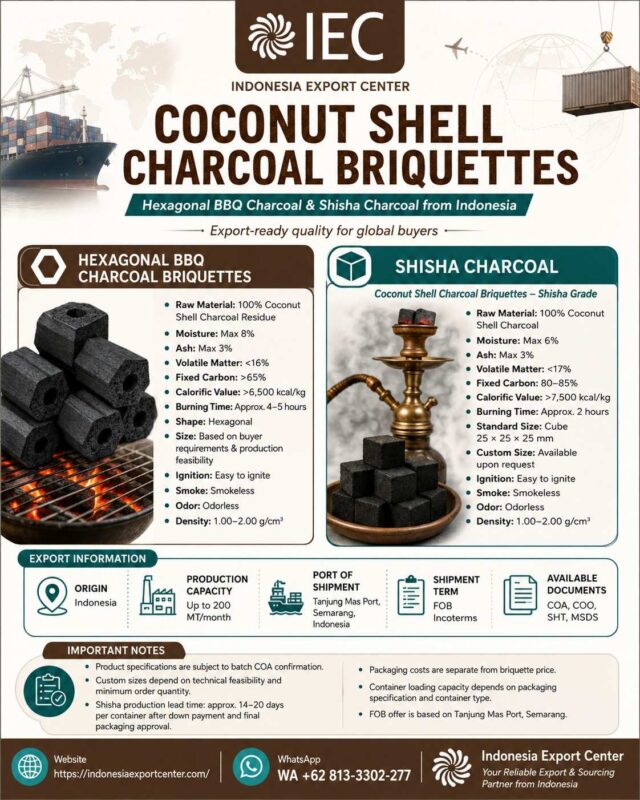
IEC | INDONESIA EXPORT CENTER
COCONUT SHELL CHARCOAL BRIQUETTES
Moisture Specifications and Quality Control for Indonesian Shisha & BBQ Charcoal Briquettes
Moisture Testing | Storage Conditions | Packaging Protection | Batch COA | Pre-Shipment Quality Control
What is the recommended coconut charcoal briquette moisture content, and how can international buyers verify it before shipment?
Moisture content is an important quality parameter when sourcing coconut shell charcoal briquettes for hookah, shisha, BBQ, wholesale distribution, and private-label products.
Excessive moisture may affect ignition behaviour, combustion performance, storage stability, packaging condition, and consistency between production batches.
However, a moisture percentage should not be evaluated without considering the test method, sampling procedure, reporting basis, and condition of the product when tested.
Indonesia Export Center (IEC) facilitates sourcing and export inquiries for Indonesian coconut shell charcoal briquettes.
IEC’s supplied product references specify:
- Shisha Charcoal Moisture: Maximum 6%
- Hexagonal BBQ Charcoal Moisture: Maximum 8%
These are reference product specifications, not independently verified moisture results for every production batch.
Buyers should request agreed testing methods and batch-specific quality documentation before accepting a commercial shipment.
Request Coconut Charcoal Moisture Specifications and COA Information:
https://wa.me/628133302277
Coconut Charcoal Briquette Moisture Content at a Glance
| Product | Reference Moisture Limit | Reference Shape |
|---|---|---|
| Coconut Shisha Charcoal Briquettes | Maximum 6% | 25 × 25 × 25 mm cube |
| Hexagonal Coconut BBQ Charcoal Briquettes | Maximum 8% | Hexagonal |
The stated moisture limits are subject to batch-specific verification.
What Is Moisture Content in Coconut Charcoal Briquettes?
Moisture content represents the amount of water present in a charcoal sample, expressed as a percentage according to a specified test method.
Moisture may be associated with the product’s processing, handling, storage, and surrounding environmental conditions.
Why Moisture Content Matters
Moisture content can be relevant to:
- Ignition characteristics
- Combustion performance
- Storage conditions
- Packaging integrity
- Product weight
- Batch consistency
- Quality acceptance
A product should be evaluated using both moisture results and its other technical specifications.
IEC Reference Moisture Specifications
Shisha Charcoal
Maximum Moisture: 6%
The supplied shisha charcoal reference includes:
| Specification | Reference Details |
|---|---|
| Product | Coconut Shell Charcoal Briquettes – Shisha Grade |
| Raw Material | 100% Coconut Shell Charcoal |
| Moisture | Maximum 6% |
| Ash | Maximum 3% |
| Volatile Matter | Less than 17% |
| Fixed Carbon | 80–85% |
| Calorific Value | Greater than 7,500 kcal/kg |
| Burning Time | Approximately 2 hours |
| Standard Shape | Cube |
| Standard Size | 25 × 25 × 25 mm |
| Density | 1.00–2.00 g/cm³ |
| Ignition | Described as easy to ignite; verification required |
| Smoke | Described as smokeless; verification required |
| Odor | Described as odorless; verification required |
Hexagonal BBQ Charcoal
Maximum Moisture: 8%
The supplied BBQ charcoal reference includes:
| Specification | Reference Details |
|---|---|
| Product | Hexagonal Coconut BBQ Charcoal Briquettes |
| Raw Material | 100% Coconut Shell Charcoal Residue |
| Moisture | Maximum 8% |
| Ash | Maximum 3% |
| Volatile Matter | Less than 16% |
| Fixed Carbon | Greater than 65% |
| Calorific Value | Greater than 6,500 kcal/kg |
| Burning Time | Approximately 4–5 hours |
| Shape | Hexagonal |
| Size | Buyer requirements and production feasibility |
| Density | 1.00–2.00 g/cm³ |
| Ignition | Described as easy to ignite; verification required |
| Smoke | Described as smokeless; verification required |
| Odor | Described as odorless; verification required |
These are supplied reference specifications, subject to batch-specific verification.
How Is Coconut Charcoal Briquette Moisture Content Tested?
Moisture content should be measured using a defined laboratory procedure.
A common approach involves determining the mass lost during controlled drying under the specified method.
However, not every mass loss is necessarily water. The selected method must be suitable for the material and measurement objective.
Step 1 – Identify the Sample
Record:
- Product name
- Sample code
- Batch or lot number
- Sampling date
- Sample condition
Step 2 – Prepare the Sample
Follow the selected method’s sample preparation requirements.
Step 3 – Determine the Initial Mass
Weigh the sample according to the method.
Step 4 – Dry Under Specified Conditions
Apply the drying temperature, duration, and endpoint required by the method.
Step 5 – Determine the Final Mass
Weigh the sample after the required drying and conditioning procedure.
Step 6 – Calculate Moisture
Calculate the result using the applicable formula and reporting basis.
Step 7 – Report the Result
The report should identify the method, sample, date, and measured moisture percentage.
Coconut Charcoal Moisture Content Formula
A simplified mass-loss calculation is:
Moisture (%) = [(Initial Sample Mass − Final Sample Mass) ÷ Initial Sample Mass] × 100
This relationship is appropriate only when the specified method treats the measured mass loss as moisture and uses the corresponding wet-basis calculation.
Illustrative Example
Assume:
- Initial sample mass: 100.00 g
- Final mass after the specified drying procedure: 95.00 g
Then:
Moisture = [(100.00 − 95.00) ÷ 100.00] × 100 = 5.00%
This is a hypothetical calculation, not an actual IEC laboratory result.
Why the Moisture Test Method Matters
1. Drying Temperature
The selected temperature can affect the measured mass loss.
2. Drying Duration
Insufficient or inconsistent drying may influence results.
3. Sample Preparation
Sample size, particle size, and handling can affect measurement consistency.
4. Sample Exposure
Exposure to ambient humidity before testing may change the sample condition.
5. Laboratory Equipment
Balances, drying equipment, and calibration procedures affect measurement reliability.
6. Reporting Basis
Buyers should confirm whether moisture is reported on a wet basis, dry basis, or another specified basis.
7. Sample Representativeness
A result for one sample does not automatically represent every carton in a shipment.
Wet Basis vs. Dry Basis Moisture
Moisture content can be expressed using different denominators.
Wet-Basis Moisture
Wet-basis moisture expresses water mass relative to the total wet sample mass.
Wet-Basis Moisture (%) = Water Mass ÷ Wet Sample Mass × 100
Dry-Basis Moisture
Dry-basis moisture expresses water mass relative to the dry material mass.
Dry-Basis Moisture (%) = Water Mass ÷ Dry Material Mass × 100
Why This Matters
The same sample can produce different numerical moisture percentages depending on the reporting basis.
Illustrative Example
Assume a sample contains:
- Water: 5 g
- Dry material: 95 g
- Total mass: 100 g
Wet-basis moisture:
5 ÷ 100 × 100 = 5.00%
Dry-basis moisture:
5 ÷ 95 × 100 = Approximately 5.26%
These are hypothetical calculations.
Buyer Requirement
A purchase specification should define the reporting basis.
The supplied IEC reference does not identify the moisture reporting basis.
Moisture Content and Ignition Performance
Moisture may influence ignition characteristics because energy is required to heat and evaporate water.
However, ignition performance also depends on:
- Briquette dimensions
- Unit weight
- Product composition
- Ignition equipment
- Airflow
- Test conditions
The supplied product references describe both charcoal types as easy to ignite, but no verified ignition-time measurement has been supplied.
Moisture Content and Burning Performance
Moisture is relevant to combustion behaviour, but it does not independently determine burning time.
The supplied indicative burning times are:
| Product | Indicative Burning Time |
|---|---|
| Shisha Charcoal | Approximately 2 hours |
| Hexagonal BBQ Charcoal | Approximately 4–5 hours |
These descriptions were supplied without standardized performance test conditions.
Actual duration may vary.
Moisture Content and Calorific Value
Moisture can influence the effective energy available from a fuel in practical use.
However, laboratory calorific value and moisture should be interpreted using compatible reporting bases.
IEC Reference Calorific Values
| Product | Reference Calorific Value |
|---|---|
| Shisha Charcoal | Greater than 7,500 kcal/kg |
| Hexagonal BBQ Charcoal | Greater than 6,500 kcal/kg |
Buyers should confirm the laboratory method and reporting basis before comparing results.
Moisture Content During Storage
Why Storage Matters
Charcoal products can be exposed to humidity during storage and handling.
Poor storage conditions may affect product condition and packaging integrity.
Storage Considerations
Buyers and suppliers should consider:
- Dry storage areas
- Protection from rain and direct water exposure
- Suitable packaging
- Warehouse condition
- Carton integrity
- Product handling procedures
- Lot identification
Storage Inspection
A storage inspection may assess:
- Visible water exposure
- Damaged packaging
- Damp cartons
- Warehouse conditions
- Product segregation
- Batch identification
Visible inspection alone cannot establish the exact moisture percentage.
Moisture Content During Export Shipment
Why Shipment Conditions Matter
International shipments may involve:
- Warehouse storage
- Inland transportation
- Container loading
- Port handling
- Ocean transportation
- Destination unloading
During these stages, product and packaging condition may be affected by moisture exposure.
Container Condition
Before loading, relevant parties should assess container suitability.
Inspection considerations may include:
- Visible water ingress
- Floor condition
- Door seals
- Roof condition
- Cleanliness
- Residual moisture
Packaging Protection
Packaging should be appropriate for the product and the shipment.
Condensation
Temperature and humidity changes can contribute to condensation inside freight containers.
Moisture management measures should be evaluated against the product’s transport requirements and applicable safety rules.
Important Transport Safety Note
Charcoal may present self-heating and fire hazards.
Moisture-management materials, packaging arrangements, and container preparation should not be selected without considering cargo classification and carrier requirements.
Packaging and Moisture Protection
Retail Packaging
Retail packaging should protect the product while meeting the buyer’s presentation and labeling requirements.
Bulk Packaging
Bulk packaging should be assessed for handling, storage, and transportation suitability.
Master Cartons
Buyers should confirm:
- Carton material
- Carton strength
- Net weight
- Gross weight
- Carton dimensions
- Product arrangement
- Storage requirements
Packaging Costs
The supplied reference states:
Packaging costs are separate from the briquette price.
Moisture Testing Before Shipment
Pre-Shipment Sampling
Buyers may request representative samples before shipment.
Laboratory Testing
Moisture should be measured using an agreed test method.
Batch-Specific COA
Where required, buyers should request a COA associated with the relevant batch.
Inspection
Third-party inspection may be requested, subject to availability and agreement.
Shipment Acceptance
Acceptance should follow the agreed specification and inspection procedure.
Certificate of Analysis for Coconut Charcoal Moisture
Recommended COA Information
A useful COA should identify:
- Product name
- Product grade
- Batch or sample number
- Laboratory
- Report number
- Test date
- Moisture test method
- Reporting basis
- Moisture result
- Other relevant analytical results
- Authorized report identification
Specification vs. Measured Result
A specification states the required moisture limit.
A COA reports the measured result for an identified sample or batch.
They are not interchangeable.
Example Moisture COA Review Table
The following is a buyer review template, not an actual laboratory report.
| Review Item | Shisha Reference | BBQ Reference | Actual COA |
|---|---|---|---|
| Moisture | Max 6% | Max 8% | To be entered |
| Test Method | To be agreed | To be agreed | To be confirmed |
| Reporting Basis | To be confirmed | To be confirmed | To be confirmed |
| Sample Identification | Required | Required | To be entered |
| Laboratory | Identified | Identified | To be entered |
| Test Date | Recorded | Recorded | To be entered |
| Acceptance | Contract-defined | Contract-defined | Pending |
Sampling and Moisture Quality Control
Representative Sampling
A sample should represent the production lot being evaluated.
Sampling Plan
The buyer and supplier should agree on:
- Lot size
- Sampling points
- Number of samples
- Sample handling
- Sample sealing
- Laboratory submission
Preventing Sample Moisture Changes
Samples should be handled and packaged to minimize moisture changes before testing.
Retained Samples
Where agreed, retained samples may support repeat testing or dispute resolution.
Moisture Acceptance Criteria in Purchase Contracts
A useful purchase specification should include:
- Product type
- Maximum moisture percentage
- Reporting basis
- Test method
- Sampling plan
- Laboratory
- Acceptance criteria
- Retesting procedure
- Nonconforming product procedure
Example Contract Wording
“Maximum moisture content shall be [X]% on a [wet/dry] basis, determined using [agreed test method] on representative samples collected according to [agreed sampling procedure].”
This is a drafting example and should be adapted to the transaction.
What Happens If Moisture Exceeds the Specification?
A result above the agreed limit should be evaluated under the contract’s quality procedure.
Possible next steps may include:
- Verification of the sample and test method
- Review of the reporting basis
- Retesting, where permitted
- Investigation of storage or packaging conditions
- Supplier corrective-action review
- Commercial resolution under the agreement
Buyers should not assume that a single corrective measure will be appropriate for every case.
Moisture Content and Batch-to-Batch Consistency
For recurring orders, buyers may request:
- Written product specifications
- Batch identification
- Approved sampling procedures
- Repeat laboratory testing
- COA review
- Packaging inspection
- Storage controls
- Corrective-action procedures
A satisfactory sample result does not automatically guarantee identical results in future batches.
Moisture and Finished-Product Composition
The supplied references identify:
- Shisha charcoal feedstock: 100% Coconut Shell Charcoal
- BBQ charcoal feedstock: 100% Coconut Shell Charcoal Residue
These descriptions do not independently establish that finished briquettes are binder-free or additive-free.
Buyers should request finished-product composition information where relevant.
Export Information from Indonesia
| Export Item | Supplied Reference |
|---|---|
| Country of Origin | Indonesia |
| Stated Production Capacity | Up to 200 MT/month |
| Reference Loading Port | Tanjung Mas Port, Semarang, Indonesia |
| Reference Shipment Term | FOB |
| Identified Documents | COA, COO, SHT, MSDS |
The stated production capacity is subject to verification and does not guarantee available stock.
Production Lead Time and Packaging
Shisha Charcoal Production Lead Time
The supplied reference indicates:
Approximately 14–20 days per container after down payment and final packaging approval.
This is an indicative production period, subject to supplier confirmation.
BBQ Charcoal Production Lead Time
No separate verified BBQ charcoal production lead time has been supplied.
Custom Dimensions
Custom sizes depend on manufacturing feasibility and MOQ.
Container Loading
Actual container loading capacity depends on packaging, container type, gross weight, and applicable transport requirements.
Export Documentation
The supplied reference identifies:
- COA – Certificate of Analysis
- COO – Certificate of Origin
- SHT – Document identified as SHT; exact meaning and applicability require confirmation
- MSDS – Material Safety Data Sheet / Safety Data Sheet
Additional documents may include commercial invoices, packing lists, bills of lading, and applicable customs documents.
Actual document availability and applicability require confirmation.
FOB Tanjung Mas, Semarang
The supplied reference shipment term is:
FOB – Tanjung Mas Port, Semarang, Indonesia
The final contract should specify the named port and applicable Incoterms edition.
For containerized cargo handed over to a carrier before vessel loading, FCA may be more appropriate than FOB depending on the actual arrangements.
Maritime Transport Safety
Charcoal may present self-heating and fire hazards during maritime transport.
Cargo classification, applicable IMDG Code requirements, packaging, container suitability, and carrier acceptance should be verified.
An MSDS or SDS alone does not establish that charcoal is exempt from maritime transport requirements.
How to Request Coconut Charcoal Moisture Test Results
Step 1 – Select the Product
Choose shisha charcoal or hexagonal BBQ charcoal.
Step 2 – Define the Moisture Requirement
Specify the maximum acceptable moisture percentage.
Step 3 – Confirm the Reporting Basis
Specify wet basis, dry basis, or another agreed basis.
Step 4 – Agree on the Test Method
Define the laboratory method.
Step 5 – Confirm Sampling
Agree on a representative sampling procedure.
Step 6 – Request a COA
Ask for batch-specific results where required.
Step 7 – Review Storage and Packaging
Confirm suitable product handling and packaging arrangements.
Step 8 – Request a Quality-Based Quotation
Submit your technical specifications and proposed order quantity.
Coconut Charcoal Moisture Content RFQ Template
Subject: Coconut Charcoal Briquette Moisture Content & COA Inquiry – Indonesia
Dear Indonesia Export Center Team,
We are evaluating coconut shell charcoal briquettes from Indonesia and would like to review the available moisture specifications and quality control information.
Please advise whether suitable product and export arrangements are available based on the following requirements.
Buyer Information
Company Name: [Company Name]
Country: [Country]
City: [City]
Business Type: [Importer / Wholesaler / Distributor / Brand Owner]
Contact Person: [Name]
Email: [Email]
WhatsApp: [Number]
Product Requirements
Product Type: [Shisha Charcoal / Hexagonal BBQ Charcoal]
Required Shape: [Cube / Hexagonal / Custom]
Required Dimensions: [mm]
Maximum Moisture: [Percentage]
Moisture Reporting Basis: [Wet / Dry / Other]
Required Moisture Test Method: [Method]
Maximum Ash: [Percentage]
Maximum Volatile Matter: [Percentage]
Required Fixed Carbon: [Percentage]
Minimum Calorific Value: [kcal/kg]
Maximum Breakage: [Percentage and Measurement Method]
Laboratory and COA Requirements
Batch COA Required: [Yes / No]
Independent Laboratory Testing: [Required / Not Required]
Sampling Procedure: [Details]
Acceptance Criteria: [Details]
Retesting Procedure: [Details]
Storage and Packaging Requirements
Packaging Type: [Bulk / Retail / Private Label]
Net Weight per Carton: [kg]
Gross Weight per Carton: [kg]
Carton Dimensions: [cm]
Moisture Protection Requirements: [Details]
Warehouse Inspection Required: [Yes / No]
Container Condition Inspection Required: [Yes / No]
Order Requirements
Initial Order Quantity: [Metric Tons]
Expected Monthly Volume: [Metric Tons]
MOQ Confirmation Required: [Yes / No]
Destination Country: [Country]
Destination Port: [Port]
Preferred Incoterm: [FOB / FCA / CFR / CIF / Other]
Target Shipment Date: [Date]
Please provide:
- Available moisture specifications
- Current technical datasheet
- Sample availability and costs
- Batch COA availability
- Moisture test method
- Moisture reporting basis
- Independent laboratory testing options
- Sampling procedure
- Quality acceptance criteria
- Storage recommendations
- Packaging options and costs
- Container condition inspection options
- MOQ
- Price per metric ton
- Production availability
- Production lead time
- Third-party inspection options
- FOB Semarang quotation
- Freight-inclusive quotation feasibility
- Cargo classification and carrier requirements
- Export documentation
- Payment terms
- Quotation validity
We look forward to receiving your moisture content information, quality documentation, and quotation.
Best regards,
[Your Name]
[Company Name]
[Country]
[Contact Information]
SEND YOUR MOISTURE CONTENT & COA INQUIRY VIA WHATSAPP:
https://wa.me/628133302277
Frequently Asked Questions About Coconut Charcoal Briquette Moisture Content
What is moisture content in coconut charcoal briquettes?
Moisture content represents the amount of water present in the charcoal sample according to a specified test method.
What is the IEC reference moisture specification for shisha charcoal?
Maximum 6%.
What is the IEC reference moisture specification for BBQ charcoal?
Maximum 8%.
Why is moisture content important?
Moisture may affect ignition, combustion behaviour, storage, packaging, and product consistency.
How is moisture content measured?
Using an agreed laboratory method, often based on controlled drying and mass measurement.
Why does the test method matter?
Different drying conditions, sample preparation procedures, and reporting bases can affect results.
What is wet-basis moisture?
Water mass expressed as a percentage of total wet sample mass.
What is dry-basis moisture?
Water mass expressed as a percentage of dry material mass.
Can wet-basis and dry-basis results differ?
Yes. They use different denominators.
Does IEC specify the moisture reporting basis?
The supplied reference does not identify the reporting basis. Buyers should request confirmation.
Can moisture change during storage?
Yes. Exposure to environmental humidity and water can affect product condition.
Can moisture change during shipment?
Yes. Packaging damage, water exposure, and condensation may affect shipment condition.
Can packaging help protect charcoal from moisture?
Appropriate packaging may help reduce exposure, subject to product and transport requirements.
Does low moisture guarantee long burning time?
No. Burning duration depends on multiple factors.
Does moisture affect calorific value?
Moisture can influence effective energy performance, but results should be interpreted using compatible reporting bases.
Can buyers request batch-specific COAs?
Yes, subject to testing arrangements and supplier confirmation.
Can buyers request independent laboratory testing?
Yes, subject to testing arrangements and cost confirmation.
Can buyers request pre-shipment inspection?
Yes, subject to inspection availability and agreement.
Are the briquettes guaranteed binder-free?
No such guarantee has been supplied. Buyers should request finished-product composition information.
What is the standard shisha charcoal size?
25 × 25 × 25 mm cubes.
What is the BBQ charcoal shape?
Hexagonal.
What is the MOQ?
No fixed MOQ has been supplied.
What is the stated production capacity?
Up to 200 metric tons per month, subject to verification.
What is the shisha charcoal production lead time?
Approximately 14–20 days per container after down payment and final packaging approval, subject to confirmation.
What is the reference Indonesian loading port?
Tanjung Mas Port, Semarang, Indonesia.
What shipment term is referenced?
FOB Tanjung Mas Port, Semarang, subject to the final agreement.
What documents are identified?
COA, COO, SHT, and MSDS are identified in the supplied reference. Actual availability and applicability require confirmation.
How can buyers request moisture specifications and a quotation?
Send the product type, required moisture percentage, test method, reporting basis, order quantity, packaging, and destination port to IEC via WhatsApp.
Request Coconut Charcoal Briquette Moisture Specifications & Quotation
Need Reliable Moisture Content Information for Coconut Charcoal Briquettes?
Indonesia Export Center (IEC) welcomes B2B inquiries from quality control teams, procurement managers, international importers, wholesalers, and private-label brands.
Products:
- Coconut Shisha Charcoal Cubes
- Hexagonal Coconut BBQ Charcoal Briquettes
Origin: Indonesia
Shisha Standard Size: 25 × 25 × 25 mm
BBQ Shape: Hexagonal
Shisha Moisture Reference: Max 6%
BBQ Moisture Reference: Max 8%
Ash Reference: Max 3%
Shisha Fixed Carbon Reference: 80–85%
BBQ Fixed Carbon Reference: Greater than 65%
Shisha Calorific Value Reference: Greater than 7,500 kcal/kg
BBQ Calorific Value Reference: Greater than 6,500 kcal/kg
Moisture Test Method: To Be Agreed
Moisture Reporting Basis: To Be Confirmed
Batch COA: Subject to Testing Arrangements
Independent Laboratory Testing: Subject to Agreement
Stated Production Capacity: Up to 200 MT/Month, Subject to Confirmation
MOQ: To Be Confirmed
Packaging Costs: Separate from Briquette Price
Shisha Production Lead Time: Approximately 14–20 Days per Container After Down Payment and Final Packaging Approval, Subject to Confirmation
BBQ Production Lead Time: To Be Confirmed
Reference Loading Port: Tanjung Mas Port, Semarang, Indonesia
Reference Shipment Term: FOB
Contact IEC to discuss moisture testing, storage requirements, packaging protection, batch COA, and export quotations.
Indonesia Export Center (IEC)
Your Reliable Export & Sourcing Partner from Indonesia
Website: https://indonesiaexportcenter.com/
WhatsApp: +62 813-3302-277
REQUEST MOISTURE SPECIFICATIONS & QUOTE VIA WHATSAPP:
https://wa.me/628133302277
Please include your company name, destination country, product type, required moisture percentage, test method, reporting basis, proposed order quantity, and packaging requirements.
