

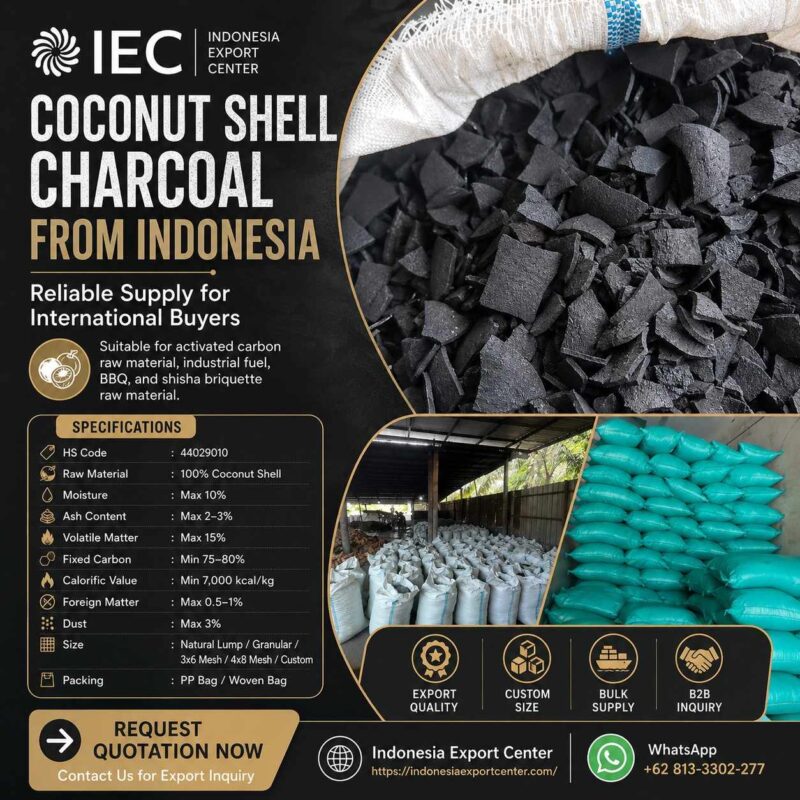
IEC | INDONESIA EXPORT CENTER
COCONUT SHELL CHARCOAL FROM INDONESIA
Reliable Supply for International Buyers
Looking for coconut shell charcoal export to India for activated carbon manufacturing, industrial processing, or bulk raw material procurement?
Indonesia Export Center (IEC) facilitates B2B sourcing and export inquiries for raw coconut shell charcoal from Indonesia, helping Indian manufacturers and importers communicate their technical specifications, quality requirements, purchasing volumes, and shipment preferences.
For activated carbon factories in India, raw charcoal procurement involves more than selecting a material with a high fixed carbon percentage.
Feedstock suitability also depends on ash content, moisture, volatile matter, particle size, mechanical characteristics, processing compatibility, and the results of activation trials.
IEC’s supplied raw coconut shell charcoal specifications include a grade-dependent minimum fixed carbon range of 75–80%, a grade-dependent maximum ash range of 2–3%, and maximum moisture of 10%.
Exact grade limits, laboratory results, sample availability, MOQ, production capacity, packaging, and commercial terms must be confirmed for each inquiry.
IEC welcomes sourcing inquiries from activated carbon manufacturers, industrial carbon processors, commodity traders, and raw material importers across India.
Export Quality • Custom Size • Bulk Supply • B2B Inquiry
Request Coconut Shell Charcoal Quotation for India:
https://wa.me/628133302277
Indonesian Coconut Shell Charcoal for Indian Industrial Buyers
Indonesia is a sourcing market for coconut-derived products, including raw coconut shell charcoal.
Indian industrial buyers may evaluate Indonesian raw charcoal for further processing and manufacturing.
Common Buyer Categories
- Activated carbon manufacturers
- Industrial carbon processors
- Raw material importers
- Commodity traders
- Charcoal briquette manufacturers
- Industrial fuel buyers
Important Clarification
IEC operates as a sourcing and export facilitation intermediary.
IEC is not represented as a confirmed charcoal manufacturer, contractual seller, or exporter of record.
Why Indian Activated Carbon Manufacturers Evaluate Coconut Shell Charcoal
Activated carbon manufacturers may use raw coconut shell charcoal as a carbonaceous feedstock.
Common Procurement Priorities
- Fixed carbon
- Ash
- Moisture
- Volatile matter
- Particle-size distribution
- Mechanical properties
- Supply consistency
- Laboratory documentation
- Activation compatibility
- Total landed cost
Buyer Recommendation
Evaluate the complete technical specification and conduct process-specific trials before committing to bulk procurement.
Raw Coconut Shell Charcoal vs. Finished Activated Carbon
These are different products.
Raw Coconut Shell Charcoal
Carbonized coconut shell material that may be used for further industrial processing.
Finished Activated Carbon
A separately processed material with specific adsorption and physical performance characteristics.
Important Clarification
IEC’s supplied product specifications describe raw coconut shell charcoal.
They do not establish the properties of finished activated carbon.
Coconut Shell Charcoal Specifications for India
IEC’s supplied raw coconut shell charcoal specifications are:
| Parameter | Specification |
|---|---|
| HS Code | 44029010 |
| Raw Material | 100% Coconut Shell |
| Moisture | Max 10% |
| Ash Content | Max 2–3% |
| Volatile Matter | Max 15% |
| Fixed Carbon | Min 75–80% |
| Calorific Value | Min 7,000 kcal/kg |
| Foreign Matter | Max 0.5–1% |
| Dust | Max 3% |
| Size | Natural Lump / Granular / 3×6 Mesh / 4×8 Mesh / Custom |
| Packing | PP Bag / Woven Bag |
Specification note: Ash, fixed carbon, and foreign matter values represent grade-dependent ranges of limits.
The exact applicable values must be confirmed for the offered grade.
The supplied HS code is a reference and must be verified against applicable Indonesian and Indian customs classifications before shipment.
Fixed Carbon Requirements for Indian Activated Carbon Factories
Fixed carbon is a proximate-analysis parameter.
IEC’s supplied reference is:
Fixed Carbon: Minimum 75–80%, Depending on Grade
Buyer Considerations
- Required minimum percentage
- Reporting basis
- Laboratory method
- Sampling procedure
- Batch consistency
Important Clarification
The specification does not guarantee that every available lot contains at least 80% fixed carbon.
Ash Content Requirements
Ash is the inorganic residue remaining after a defined laboratory ashing procedure.
IEC’s supplied reference is:
Ash: Maximum 2–3%, Depending on Grade
Buyer Considerations
- Maximum ash percentage
- Reporting basis
- Test method
- Laboratory documentation
- Batch acceptance
Important Clarification
Lower ash does not independently guarantee higher activation yield or better finished activated carbon performance.
Moisture Requirements
IEC’s supplied raw charcoal specification states:
Moisture: Maximum 10%
Why Moisture Matters
Moisture affects:
- As-received weight
- Analytical reporting
- Storage
- Handling
- Processing
Buyer Recommendation
Define the moisture test method and contractual inspection point.
Volatile Matter and Calorific Value
IEC’s supplied specifications include:
- Volatile Matter: Maximum 15%
- Calorific Value: Minimum 7,000 kcal/kg
Why These Matter
Both parameters contribute to raw charcoal characterization.
Buyer Recommendation
Request laboratory results using agreed analytical methods.
Natural Lump and Granular Charcoal for India
IEC’s supplied size categories include:
- Natural Lump
- Granular
- 3×6 Mesh
- 4×8 Mesh
- Custom Size
Natural Lump
May be evaluated by manufacturers requiring larger raw charcoal pieces.
Granular
May be relevant for factories with defined particle-size requirements.
Screened Mesh Grades
May be requested where particle-size distribution is important.
Important Clarification
Mesh standards, tolerances, and actual availability must be confirmed.
Particle Size and Activation Processing
Particle size can influence industrial handling and processing.
Important Parameters
- Minimum particle size
- Maximum particle size
- Oversize percentage
- Undersize percentage
- Dust percentage
- Screening method
Buyer Recommendation
Provide a detailed particle-size specification in the RFQ.
Dust and Foreign Matter Limits
IEC’s supplied raw charcoal specifications include:
- Dust: Maximum 3%
- Foreign Matter: Maximum 0.5–1%, Depending on Grade
Why These Matter
Dust and foreign matter may affect handling and processing.
Buyer Recommendation
Define measurement methods and acceptance criteria separately.
Fixed Carbon vs. Activation Yield
Fixed carbon is a raw material characterization parameter.
Activation yield is a process-dependent manufacturing result.
Important Clarification
Higher fixed carbon does not automatically guarantee higher activation yield.
Buyer Recommendation
Conduct activation trials under your factory’s operating conditions.
Iodine Number and BET Surface Area
Iodine number and BET surface area are commonly discussed in activated carbon applications.
Important Distinction
These are not guaranteed properties of raw coconut shell charcoal.
Buyer Recommendation
Test finished activated carbon produced from the candidate feedstock.
IEC has not supplied verified iodine number or BET surface area specifications for raw charcoal.
Mechanical Properties and Processing Suitability
Mechanical properties may matter for industrial handling and processing.
Buyer Considerations
- Particle strength
- Breakage
- Abrasion
- Dust generation
- Handling losses
Buyer Recommendation
Specify relevant tests where mechanical performance is important.
Laboratory Testing for India-Bound Shipments
Indian activated carbon manufacturers may request laboratory documentation before purchasing.
Common Testing Parameters
- Moisture
- Ash
- Volatile matter
- Fixed carbon
- Calorific value
- Particle size
- Dust
- Foreign matter
Laboratory Requirements
- Identified sample
- Test method
- Reporting basis
- Test date
- Laboratory identity
- Batch reference
No verified batch-specific laboratory results have been supplied.
Certificate of Analysis for Indian Buyers
A Certificate of Analysis (COA) may document test results for an identified sample or lot.
COA Checklist
- Product name
- Grade
- Sample ID
- Batch or lot number
- Sampling date
- Test date
- Laboratory identity
- Test methods
- Reporting basis
- Analytical results
Important Clarification
A historical COA should not be treated as proof that every future shipment meets the same specification.
Representative Sampling and Quality Inspection
Representative sampling helps buyers evaluate whether the offered lot meets technical requirements.
Suggested Sampling Workflow
- Define the lot.
- Agree on a sampling plan.
- Select sampling locations or packaging units.
- Collect samples.
- Prepare laboratory samples.
- Preserve sample identification.
- Conduct agreed testing.
- Compare results with acceptance criteria.
Buyer Recommendation
Define sampling and inspection requirements before shipment.
Sample Evaluation for Indian Activated Carbon Manufacturers
Sample testing may be an important step before bulk purchasing.
Suggested Evaluation Stages
- Review supplier specifications.
- Request a representative sample.
- Conduct laboratory proximate analysis.
- Evaluate particle size.
- Perform process-specific activation trials.
- Test the finished activated carbon.
- Compare results with internal acceptance criteria.
- Decide whether to proceed with bulk procurement.
Important Clarification
Sample availability and testing arrangements must be confirmed.
Supplier Verification for India Procurement
Indian importers should verify the relevant supplier and transaction parties.
Verification Checklist
- Legal business identity
- Manufacturing or sourcing role
- Product availability
- Quality documentation
- Packaging capability
- Commercial quotation
- Contracting party
- Exporter of record
- Payment instructions
Important Clarification
IEC facilitates sourcing inquiries but does not automatically certify or guarantee every potential supplier.
MOQ for Coconut Shell Charcoal Export to India
IEC has not supplied a fixed MOQ.
MOQ Considerations
- Product grade
- Particle size
- Packaging
- Order quantity
- Supplier capacity
- Shipping arrangements
Buyer Recommendation
State the required quantity in metric tons and request confirmation of the applicable MOQ.
Bulk Packaging for India-Bound Charcoal
IEC’s supplied raw charcoal packaging options include:
- PP Bags
- Woven Bags
Packaging Details to Confirm
- Net weight per bag
- Gross weight per bag
- Bag dimensions
- Closure method
- Labeling
- Lot identification
- Palletization
- Container loading arrangement
Exact bag weights and packaging configurations have not been supplied.
Container Loading for India
Container planning is important for bulk raw charcoal procurement.
Common Container Options
Buyers may request quotations based on 20-foot or 40-foot container arrangements, subject to suitability and carrier acceptance.
Important Loading Variables
- Product bulk density
- Bag dimensions
- Net weight per bag
- Gross weight per bag
- Container internal dimensions
- Payload limits
- Cargo securing
- Transport safety requirements
Important Clarification
IEC has not supplied verified container loading capacities.
A fixed number of metric tons per container should not be assumed.
20ft Container Planning
A 20-foot container may be evaluated for bulk raw charcoal shipments.
Buyer Questions
- What is the verified net cargo weight?
- How many bags can be loaded?
- What is the total gross weight?
- Is palletization required?
- What loading arrangement is proposed?
- Are the required transport safety conditions satisfied?
Buyer Recommendation
Request a supplier-specific loading plan.
40ft Container Planning
A 40-foot container may also be considered depending on the product and shipping arrangement.
Buyer Questions
- Is the product volume-limited or weight-limited?
- What is the actual container payload limit?
- How will bags be arranged?
- What is the proposed net cargo weight?
- What cargo securing measures are required?
Important Clarification
A 40-foot container does not automatically carry twice the weight of a 20-foot container.
Net Weight vs. Gross Weight
Indian importers should distinguish between net and gross weight.
Net Weight
Weight of the charcoal itself.
Gross Weight
Weight of the charcoal plus its packaging and other included shipping materials.
Buyer Recommendation
Request both values for container planning and documentation.
Export Shipping from Indonesia to India
Shipment arrangements depend on the origin location, destination port, carrier, and agreed Incoterm.
Commercial Information to Confirm
- Port of loading
- Destination port
- Container type
- Freight arrangement
- Transit schedule
- Carrier acceptance
- Shipping documents
No specific port of loading, shipping route, transit time, or freight rate is guaranteed.
Indian Destination Port Selection
Indian buyers should specify their preferred destination port.
Buyer Considerations
- Factory location
- Inland transportation
- Customs arrangements
- Freight availability
- Total landed cost
Important Clarification
Port selection should be based on actual logistics requirements and available carrier services.
FOB, CFR and CIF for India Procurement
International charcoal quotations may use different Incoterms.
FOB – Free On Board
Under FOB Incoterms 2020, the seller delivers goods on board the vessel at the named port of shipment.
Risk transfers when the goods are on board.
CFR – Cost and Freight
Under CFR, the seller arranges and pays for carriage to the named destination port, while risk generally transfers when the goods are on board at the shipment port.
CIF – Cost, Insurance and Freight
Under CIF, the seller arranges freight and the contractually required minimum cargo insurance, while risk generally transfers when the goods are on board at the shipment port.
Important Clarification
The named port, responsibilities, insurance coverage, and contract terms must be clearly agreed.
For containerized shipments handed to a carrier before loading on board, FCA or other appropriate Incoterms may be worth evaluating.
Export Documents for India-Bound Charcoal
Document requirements depend on the transaction and applicable regulations.
Documents Commonly Discussed
- Commercial invoice
- Packing list
- Bill of lading
- Certificate of origin, where applicable
- Customs documentation
- Laboratory reports, where required
- Transport safety documentation, where required
Important Clarification
This is not a guaranteed or exhaustive document list.
Indian import requirements must be verified for the actual product and shipment.
HS Code and Indian Customs Classification
IEC’s supplied raw charcoal reference is:
HS Code: 44029010
Important Clarification
Customs classification must be verified under the applicable Indonesian and Indian tariff schedules.
A supplied HS reference should not be treated as a binding customs ruling.
Buyer Recommendation
Confirm classification, duties, taxes, and any applicable import restrictions with a qualified customs professional or relevant authority.
India Import Compliance
Indian importers should verify current requirements before shipment.
Compliance Considerations
- Importer eligibility
- Importer Exporter Code (IEC), where required
- Product classification
- Customs declaration
- Required documents
- Inspection requirements
- Applicable duties and taxes
- Transport safety
Important Clarification
The Indian Importer Exporter Code (IEC) is a separate regulatory identifier and should not be confused with the Indonesia Export Center brand name.
Buyer Recommendation
Confirm requirements for the specific product, importer, and destination port.
Maritime Transport Safety for Charcoal
Charcoal may present self-heating and fire hazards.
Important Safety Considerations
- Product classification
- Applicable testing
- Packaging
- Container suitability
- Documentation
- Carrier acceptance
- Handling procedures
IMDG Code Requirements
The applicable classification and transport requirements under the current International Maritime Dangerous Goods (IMDG) Code must be verified.
Charcoal should not automatically be treated as unrestricted general cargo.
Moisture and Transit Handling
Moisture may change during storage and transportation.
Potential Factors
- Packaging condition
- Humidity
- Condensation
- Water ingress
- Transit conditions
Buyer Recommendation
Define moisture acceptance and inspection procedures in the purchase agreement.
Any packaging or container moisture-control measures must be compatible with the cargo’s safety requirements.
Pre-Shipment Inspection for Indian Buyers
Pre-shipment inspection may help confirm contract compliance.
Potential Inspection Scope
- Product identification
- Packaging
- Quantity
- Lot identification
- Sampling
- Laboratory testing
- Loading condition
- Documentation
Important Clarification
Inspection availability, scope, and cost must be agreed separately.
Pricing for Coconut Shell Charcoal to India
IEC has not supplied live wholesale prices or freight rates.
Pricing Factors
- Product grade
- Fixed carbon
- Ash
- Moisture
- Particle size
- Packaging
- Quantity
- Testing
- Inspection
- Incoterm
- Freight
Buyer Recommendation
Request a quotation with clearly defined product specifications and shipping terms.
Calculating Landed Cost in India
Indian importers should evaluate total landed cost.
Potential Cost Components
- Product price
- Packaging
- Inland transport
- Export handling
- Freight
- Insurance
- Import duties
- Taxes
- Customs clearance
- Destination handling
- Inland delivery
Important Clarification
Actual costs depend on the transaction and current regulations.
Payment Terms and Contracting
Payment arrangements should be agreed with the relevant contractual seller.
Buyer Considerations
- Contracting party
- Currency
- Payment schedule
- Bank details
- Inspection conditions
- Shipping documents
- Dispute resolution
Buyer Recommendation
Verify the recipient of payment and contractual responsibilities before transferring funds.
IEC’s Role in Indonesia-to-India Charcoal Sourcing
Indonesia Export Center operates as a sourcing and export facilitation intermediary.
IEC receives requirements from Indian industrial buyers and facilitates inquiries about potential raw coconut shell charcoal supply arrangements.
IEC is not represented as a confirmed manufacturer, contractual seller, or exporter of record.
Actual supplier identity, product availability, laboratory results, MOQ, packaging, container loading capacity, and commercial terms must be confirmed for each transaction.
How Indian Activated Carbon Manufacturers Can Request a Quotation
Step 1 – Identify the Application
Specify activated carbon manufacturing or another industrial use.
Step 2 – Define Product Specifications
State fixed carbon, ash, moisture, volatile matter, particle size, and dust requirements.
Step 3 – Confirm Testing Requirements
Include laboratory methods, sampling, and acceptance criteria.
Step 4 – Request Samples
Specify sample quantity and testing requirements.
Step 5 – Define Packaging and Container Requirements
State bag type, preferred net weight, container type, and requested quantity.
Step 6 – Provide Destination Port
Identify the port in India.
Step 7 – Select Commercial Terms
State the preferred Incoterm and payment requirements.
Step 8 – Request Quotation
Send the RFQ to IEC.
Coconut Shell Charcoal RFQ Template for India
Subject: RFQ – Coconut Shell Charcoal Export from Indonesia to India
Dear Indonesia Export Center Team,
We are an India-based company seeking raw coconut shell charcoal from Indonesia for activated carbon manufacturing or industrial processing.
Please advise whether the following requirements can be supported.
Company Name: [Company Name]
Company Location: [City, India]
Destination Port: [Port in India]
Intended Application: [Activated Carbon / Industrial Processing / Briquette Manufacturing / Trading]
Product: Raw Coconut Shell Charcoal
Required Minimum Fixed Carbon: [Percentage]
Maximum Ash: [Percentage]
Maximum Moisture: [Percentage]
Maximum Volatile Matter: [Percentage]
Minimum Calorific Value: [kcal/kg]
Required Particle Size: [Natural Lump / Granular / Mesh]
Maximum Dust: [Percentage]
Maximum Foreign Matter: [Percentage]
Required Laboratory Documentation: [Details]
Sampling and Acceptance Criteria: [Details]
Sample Quantity Required: [kg]
Required Quantity: [Metric Tons]
Preferred Container Type: [20ft / 40ft / Other]
Preferred Packaging: [PP Bag / Woven Bag / Other Request]
Requested Net Weight per Bag: [kg]
Preferred Incoterm: [FOB / CFR / CIF / FCA / Other]
Expected Shipment Date: [Date]
Please provide:
- Available raw charcoal grades
- Applicable product specifications
- Available laboratory reports
- Sample availability
- MOQ
- Wholesale pricing
- Packaging specifications
- Proposed net loading weight per container
- Proposed bag count per container
- Container loading plan
- Supply lead time
- Port of loading
- Freight quotation options
- Pre-shipment inspection options
- Export and transport safety documentation
- Contracting and payment arrangements
We look forward to receiving your quotation.
Best regards,
[Your Name]
[Company Name]
[Contact Information]
Send Your India Import RFQ via WhatsApp:
https://wa.me/628133302277
Frequently Asked Questions About Coconut Shell Charcoal Export to India
Can India import coconut shell charcoal from Indonesia?
Potential imports are subject to applicable Indian import requirements, product classification, documentation, and transport regulations.
Does IEC facilitate raw coconut shell charcoal sourcing for Indian activated carbon factories?
Yes. IEC facilitates B2B sourcing inquiries for raw coconut shell charcoal.
What is IEC’s fixed carbon specification?
IEC’s supplied reference is minimum 75–80%, depending on grade.
What is IEC’s ash specification?
IEC’s supplied reference is maximum 2–3%, depending on grade.
What is IEC’s moisture specification?
IEC’s supplied reference is maximum 10%.
Is raw coconut shell charcoal the same as activated carbon?
No. Activated carbon requires additional processing.
Does high fixed carbon guarantee higher activation yield?
No. Activation yield depends on feedstock characteristics and process conditions.
Can Indian manufacturers request samples?
Sample requirements may be included in the RFQ, subject to availability and commercial arrangements.
Can buyers request natural lump charcoal?
Yes. Natural lump is listed among IEC’s raw charcoal size categories, subject to availability.
Can buyers request granular charcoal?
Yes. Granular is listed as a size category, subject to availability.
Are 3×6 mesh and 4×8 mesh options listed?
Yes. Exact mesh standards and tolerances must be confirmed.
What packaging is listed?
PP bags and woven bags.
What is the MOQ for India?
No fixed MOQ has been supplied.
How many metric tons fit in a 20ft container?
The loading quantity depends on product density, packaging, container limits, and transport requirements.
How many metric tons fit in a 40ft container?
The loading quantity must be calculated for the actual product and shipment.
Can IEC provide laboratory test reports?
Buyers may request available laboratory documentation for the offered grade.
Can Indian importers request pre-shipment inspection?
Inspection requirements may be included in the RFQ, subject to commercial arrangements.
What is the HS code?
IEC’s supplied reference is 44029010, subject to customs verification.
Is charcoal unrestricted general cargo?
Not automatically. Applicable IMDG Code classification and transport requirements must be verified.
Does IEC manufacture coconut shell charcoal?
IEC is presented as a sourcing and export facilitation intermediary, not a confirmed manufacturer.
How can Indian buyers request a quotation?
Contact IEC through WhatsApp at +62 813-3302-277 with your specifications, sample requirements, quantity, container preferences, destination port, and preferred commercial terms.
Request Coconut Shell Charcoal Quotation for India
Looking for Indonesian raw coconut shell charcoal for activated carbon manufacturing or industrial procurement in India?
Indonesia Export Center (IEC) welcomes B2B sourcing inquiries from Indian activated carbon factories, industrial carbon processors, raw material traders, and bulk importers.
Sourcing Focus: Raw Coconut Shell Charcoal from Indonesia
Raw Material: 100% Coconut Shell
Technical Reference: Fixed Carbon • Ash • Moisture • Volatile Matter • Calorific Value
Applications: Activated Carbon Feedstock • Industrial Fuel • BBQ • Shisha Briquette Raw Material
Size Inquiries: Natural Lump • Granular • 3×6 Mesh • 4×8 Mesh • Custom
Packaging Reference: PP Bag • Woven Bag
Container Planning: 20ft / 40ft Subject to Confirmed Loading Specifications
Destination Market: India
Origin: Indonesia
Contact IEC to discuss available grades, laboratory documentation, sample evaluation, MOQ, packaging, container loading arrangements, shipping terms, and export quotations.
Indonesia Export Center (IEC)
Website: https://indonesiaexportcenter.com/
WhatsApp: +62 813-3302-277
Request Quotation via WhatsApp:
https://wa.me/628133302277
Please include your company name, location in India, destination port, intended industrial application, technical requirements, preferred particle size, sample requirements, purchasing quantity, container type, packaging requirements, and expected shipment date.
