

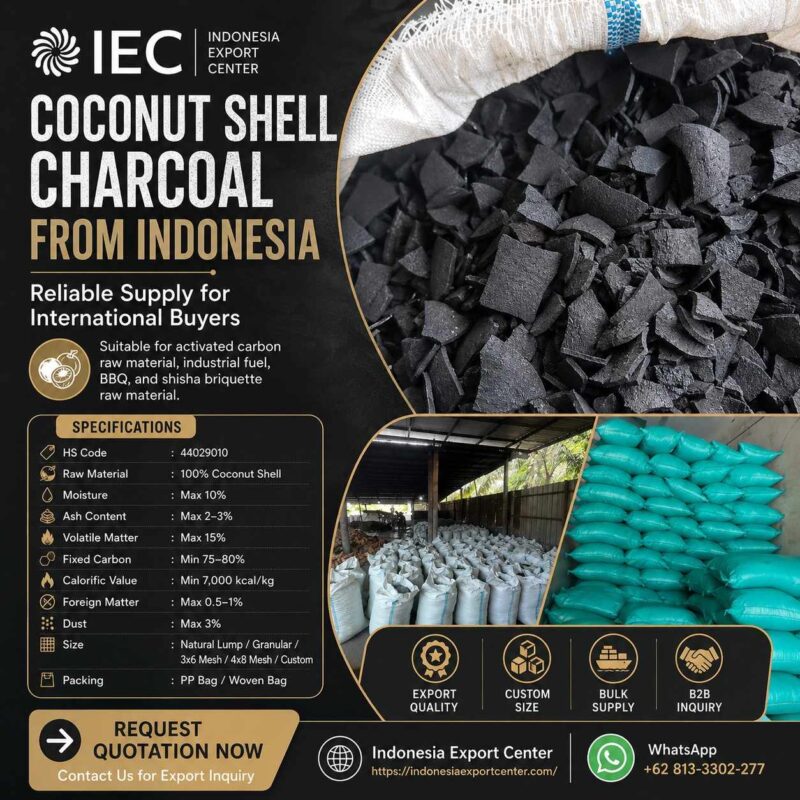
IEC | INDONESIA EXPORT CENTER
COCONUT SHELL CHARCOAL FROM INDONESIA
Reliable Supply for International Buyers
Choosing between coconut shell charcoal vs wood charcoal requires more than comparing the raw materials used to produce them.
For international importers, industrial procurement teams, activated carbon manufacturers, BBQ distributors, and charcoal product brands, the right choice depends on the intended application, product specifications, processing requirements, quality consistency, and total purchasing cost.
Both coconut shell charcoal and wood charcoal are carbonized biomass materials. However, their characteristics can vary depending on feedstock, carbonization conditions, particle size, moisture, ash content, volatile matter, and further processing.
Neither material should be considered universally superior.
Indonesia Export Center (IEC) facilitates B2B sourcing and export inquiries for raw coconut shell charcoal from Indonesia, with supplied technical specifications covering moisture, ash, fixed carbon, calorific value, particle size, and packaging.
This comparison guide explains the practical differences between coconut shell charcoal and wood charcoal, including how buyers can evaluate each material for industrial and commercial use.
Export Quality • Custom Size • Bulk Supply • B2B Inquiry
Request Coconut Shell Charcoal Quotation:
https://wa.me/628133302277
What Is Coconut Shell Charcoal?
Coconut shell charcoal is produced by carbonizing coconut shells under controlled conditions.
The raw material is the hard shell of the coconut.
Common Commercial Applications
- Activated carbon feedstock
- Industrial fuel
- Charcoal briquette manufacturing
- BBQ charcoal products
- Shisha charcoal briquette raw material
Product Forms
Raw coconut shell charcoal may be supplied as:
- Natural lumps
- Granular material
- Screened mesh grades
- Custom particle sizes
Important Clarification
Raw coconut shell charcoal is not the same as finished activated carbon or finished BBQ and shisha charcoal briquettes.
Those products require additional processing and separate quality specifications.
What Is Wood Charcoal?
Wood charcoal is produced by carbonizing wood or wood-derived biomass.
Its characteristics depend on factors such as:
- Wood species
- Feedstock condition
- Carbonization process
- Moisture
- Ash
- Volatile matter
- Particle size
Common Commercial Applications
- Cooking and grilling
- Industrial heating
- Metallurgical or process applications, where technically suitable
- Activated carbon feedstock, depending on material and process
- Charcoal briquette manufacturing
Important Clarification
Wood charcoal is not one uniform product.
Different wood species and production methods may produce substantially different results.
Coconut Shell Charcoal vs Wood Charcoal: Quick Comparison
| Comparison Factor | Coconut Shell Charcoal | Wood Charcoal |
|---|---|---|
| Primary Raw Material | Coconut shells | Wood or wood-derived biomass |
| Production Method | Carbonization | Carbonization |
| Physical Form | Lumps, granular, screened material, or processed products | Lumps, granular material, or processed products |
| Fixed Carbon | Depends on grade and carbonization | Depends on wood species and carbonization |
| Ash Content | Depends on feedstock and processing | Depends on feedstock and processing |
| Moisture | Depends on drying, storage, and handling | Depends on drying, storage, and handling |
| Calorific Value | Requires product-specific testing | Requires product-specific testing |
| Activated Carbon Feedstock | May be suitable after evaluation | May be suitable after evaluation |
| BBQ Applications | Raw or processed products may be used | Commonly supplied as lump charcoal or processed products |
| Briquette Manufacturing | May be used as raw material | May be used as raw material |
| Particle Size | Depends on crushing and screening | Depends on crushing and screening |
| Commercial Suitability | Application-dependent | Application-dependent |
Key takeaway: The material type alone does not establish which charcoal will perform better.
1. Raw Material Differences
The primary difference is the biomass feedstock.
Coconut Shell Charcoal
Produced from coconut shells, a material generated through coconut processing.
Wood Charcoal
Produced from wood or wood-derived biomass.
Buyer Consideration
Raw material origin can influence supply chain traceability, sustainability documentation, product characteristics, and commercial availability.
2. Carbonization Process
Both materials are produced through thermal conversion of biomass under oxygen-limited conditions.
Important Variables
- Feedstock condition
- Heating profile
- Carbonization temperature
- Residence time
- Process control
- Cooling conditions
Why This Matters
Different carbonization conditions can produce different moisture, volatile matter, fixed carbon, and other characteristics.
Buyer Recommendation
Evaluate the finished raw charcoal specification rather than assuming all coconut shell or wood charcoal is produced under identical conditions.
3. Fixed Carbon Comparison
Fixed carbon is a proximate-analysis parameter used to characterize charcoal.
Coconut Shell Charcoal
IEC’s supplied raw coconut shell charcoal specification includes a grade-dependent minimum fixed carbon range of 75–80%.
Wood Charcoal
Fixed carbon varies according to feedstock and processing.
No universal wood charcoal fixed carbon value is assumed.
Buyer Recommendation
Request comparable laboratory reports using the same analytical basis.
4. Ash Content Comparison
Ash is the inorganic residue remaining after a defined laboratory ashing procedure.
Coconut Shell Charcoal
IEC’s supplied raw charcoal specification includes a grade-dependent maximum ash range of 2–3%.
Wood Charcoal
Ash content varies according to wood species, production, and contamination.
Important Clarification
Coconut shell charcoal should not automatically be described as lower ash than every wood charcoal product.
The comparison requires actual test results.
5. Moisture Content Comparison
Moisture affects the as-received condition of charcoal.
Coconut Shell Charcoal
IEC’s supplied raw charcoal specification states maximum 10% moisture.
Wood Charcoal
Moisture depends on drying, storage, packaging, and transportation.
Buyer Recommendation
Compare moisture results using appropriate and consistent test methods.
6. Volatile Matter Comparison
Volatile matter is determined through a defined analytical procedure.
Coconut Shell Charcoal
IEC’s supplied raw charcoal specification states maximum 15% volatile matter.
Wood Charcoal
Volatile matter depends on carbonization conditions and the product grade.
Buyer Recommendation
Compare complete proximate-analysis results rather than a single value.
7. Calorific Value Comparison
Calorific value measures energy content under a specified testing procedure.
Coconut Shell Charcoal
IEC’s supplied raw charcoal specification states minimum 7,000 kcal/kg.
Wood Charcoal
Calorific value varies by product.
Important Clarification
No blanket claim is made that coconut shell charcoal always has a higher calorific value than wood charcoal.
8. Density and Physical Characteristics
Charcoal density and physical structure can vary by feedstock and production method.
Why Density Matters
Density may influence:
- Packaging
- Handling
- Container loading
- Material processing
- Product form
Buyer Recommendation
If density matters for your application, request product-specific measurements.
Do not assume a universal density value for either charcoal type.
9. Particle Size and Shape
Raw charcoal may be supplied in different physical forms.
Coconut Shell Charcoal
IEC’s supplied size categories include:
- Natural Lump
- Granular
- 3×6 Mesh
- 4×8 Mesh
- Custom Size
Wood Charcoal
May be supplied as lumps or processed into smaller size fractions.
Buyer Recommendation
Specify the required particle-size distribution, oversize, undersize, and dust limits.
10. Dust and Fines
Dust content may affect handling and processing.
Coconut Shell Charcoal
IEC’s supplied raw charcoal specification states maximum 3% dust.
Wood Charcoal
Dust levels depend on handling, processing, packaging, and transportation.
Buyer Recommendation
Compare measured dust content under an agreed method.
11. Mechanical Strength and Breakage
Charcoal pieces may break during handling and transport.
Important Factors
- Material structure
- Particle size
- Handling conditions
- Packaging
- Transportation
- Processing
Buyer Recommendation
Request suitable breakage or strength tests where required.
Neither material should be assumed to be universally stronger.
12. Coconut Shell Charcoal vs Wood Charcoal for Activated Carbon
Both materials may be evaluated as activated carbon feedstocks.
Coconut Shell Charcoal
May be suitable for activated carbon manufacturing, depending on feedstock properties and process requirements.
Wood Charcoal
May also be suitable for activated carbon manufacturing, depending on the intended activated carbon product and process.
Important Technical Considerations
- Ash
- Fixed carbon
- Moisture
- Particle size
- Mechanical properties
- Activation behavior
- Finished activated carbon performance
Key Principle
The preferred feedstock depends on the desired finished activated carbon characteristics.
13. Activation Yield Comparison
Activation yield depends on the feedstock and activation process.
Buyer Considerations
- Raw material properties
- Process conditions
- Target product characteristics
- Manufacturing losses
- Finished-product requirements
Important Clarification
Neither coconut shell charcoal nor wood charcoal should be assigned a universal activation yield without process-specific data.
14. Iodine Number and BET Surface Area
Iodine number and BET surface area are commonly discussed in activated carbon applications.
Important Distinction
Raw charcoal specifications are not the same as finished activated carbon specifications.
Buyer Recommendation
Conduct activation trials and test the resulting activated carbon.
Do not assume that raw coconut shell charcoal or raw wood charcoal automatically meets a particular iodine number or BET surface area.
15. Coconut Shell Charcoal vs Wood Charcoal for BBQ
Both charcoal types may be used in BBQ-related applications.
Coconut Shell Charcoal
May be processed into BBQ briquettes or evaluated for other grilling applications.
Wood Charcoal
Often supplied as lump charcoal or processed BBQ products.
Important Performance Factors
- Ignition behavior
- Heat output
- Burn duration
- Ash generation
- Smoke
- Odor
- Product size
- Packaging
Important Clarification
Actual grilling performance depends on the specific finished product.
16. Burning Duration Comparison
Burn duration depends on several factors.
Important Variables
- Product mass
- Density
- Shape
- Size
- Moisture
- Airflow
- Testing conditions
Buyer Recommendation
Use standardized side-by-side testing when comparing finished charcoal products.
Do not rely on unsupported claims that one raw material always burns longer.
17. Heat Output Comparison
Heat output is relevant to BBQ and industrial fuel buyers.
Important Variables
- Calorific value
- Moisture
- Airflow
- Product dimensions
- Burning conditions
Buyer Recommendation
Request calorific value reports and conduct application-specific performance tests.
18. Smoke and Odor Comparison
Smoke and odor are important for certain cooking and shisha applications.
Important Factors
- Carbonization quality
- Volatile matter
- Moisture
- Contamination
- Additives
- Finished-product processing
Important Clarification
Neither coconut shell charcoal nor wood charcoal should automatically be described as smoke-free or odor-free.
Performance must be verified for the actual product.
19. Coconut Shell Charcoal vs Wood Charcoal for Shisha Briquettes
Shisha briquettes are finished products manufactured to specific performance requirements.
Coconut Shell Charcoal
May be used as raw material for coconut-based shisha briquettes.
Wood Charcoal
May be used in certain processed charcoal products, subject to formulation and suitability.
Important Performance Factors
- Ash
- Ignition
- Burn duration
- Odor
- Smoke
- Mechanical strength
- Product dimensions
Important Clarification
IEC’s supplied raw coconut shell charcoal specifications do not represent guaranteed finished shisha briquette specifications.
20. Briquette Manufacturing Comparison
Both raw materials may be processed into briquettes.
Manufacturing Considerations
- Raw charcoal particle size
- Moisture
- Binder formulation
- Compression
- Drying
- Finished-product strength
- Burning performance
Buyer Recommendation
Evaluate the complete manufacturing process rather than selecting feedstock solely by origin.
21. Sustainability and Raw Material Origin
Raw material origin is relevant to environmental and sourcing assessments.
Coconut Shell Charcoal
Uses coconut shells generated through coconut processing.
Wood Charcoal
Uses wood or wood-derived biomass.
Important Clarification
Neither product is automatically sustainable or environmentally superior.
Environmental performance depends on sourcing practices, land use, energy consumption, production methods, transport, and other factors.
Buyer Recommendation
Request relevant origin and sustainability documentation where required.
22. Supply Chain Traceability
International buyers may require traceability information.
Important Questions
- What is the raw material source?
- Where is the charcoal produced?
- How are batches identified?
- What documentation is available?
- Are origin claims verifiable?
Buyer Recommendation
Define traceability requirements before placing orders.
23. Commercial Pricing Comparison
Coconut shell charcoal and wood charcoal prices depend on market and product conditions.
Pricing Factors
- Feedstock availability
- Carbonization costs
- Product grade
- Particle size
- Quality specifications
- Packaging
- Order quantity
- Freight
- Incoterms
Important Clarification
IEC has not supplied live market prices for either material.
No universal price advantage is claimed.
24. Comparing Landed Cost
International buyers should compare total landed cost rather than supplier unit price alone.
Potential Cost Components
- Product price
- Packaging
- Inland transport
- Export handling
- Freight
- Insurance
- Import duties
- Taxes
- Customs clearance
- Inspection
- Destination handling
Buyer Recommendation
Request quotations using clearly defined Incoterms and comparable shipment assumptions.
25. Container Loading and Packaging
Packaging affects shipment planning.
Coconut Shell Charcoal
IEC’s supplied raw charcoal packaging options include:
- PP Bags
- Woven Bags
Wood Charcoal
Packaging varies according to the supplier and product.
Important Clarification
Container loading capacity depends on bulk density, bag dimensions, weight limits, container type, and safety requirements.
No universal loading quantity is claimed for either material.
26. Shipping Safety Considerations
Both coconut shell charcoal and wood charcoal may present self-heating and fire hazards.
Important Requirements
- Appropriate transport classification
- Applicable testing
- Suitable packaging
- Required documentation
- Carrier acceptance
- Safe handling procedures
Maritime Transport Safety
The applicable requirements under the current International Maritime Dangerous Goods (IMDG) Code must be verified.
Neither charcoal type should automatically be treated as unrestricted general cargo.
27. Coconut Shell Charcoal Specifications from IEC
IEC’s supplied raw coconut shell charcoal specifications are:
| Parameter | Specification |
|---|---|
| HS Code | 44029010 |
| Raw Material | 100% Coconut Shell |
| Moisture | Max 10% |
| Ash Content | Max 2–3% |
| Volatile Matter | Max 15% |
| Fixed Carbon | Min 75–80% |
| Calorific Value | Min 7,000 kcal/kg |
| Foreign Matter | Max 0.5–1% |
| Dust | Max 3% |
| Size | Natural Lump / Granular / 3×6 Mesh / 4×8 Mesh / Custom |
| Packing | PP Bag / Woven Bag |
Specification note: Ash, fixed carbon, and foreign matter values represent grade-dependent ranges of limits.
The exact applicable limits must be confirmed for the selected grade.
The supplied HS code should be verified against the applicable customs classification requirements.
These specifications describe raw coconut shell charcoal only. They are not comparative specifications for wood charcoal.
28. How to Compare Charcoal Quality Reports
Buyers should compare equivalent analytical results.
Quality Comparison Checklist
- Same product form
- Same reporting basis
- Comparable test methods
- Representative sampling
- Identified batches
- Current laboratory reports
- Defined acceptance criteria
Buyer Recommendation
Avoid comparing laboratory results that use different methods or reporting bases without appropriate technical review.
29. Supplier Comparison Matrix
| Evaluation Factor | Coconut Shell Charcoal | Wood Charcoal |
|---|---|---|
| Raw Material Origin | [Supplier Information] | [Supplier Information] |
| Fixed Carbon | [Lab Result] | [Lab Result] |
| Ash | [Lab Result] | [Lab Result] |
| Moisture | [Lab Result] | [Lab Result] |
| Volatile Matter | [Lab Result] | [Lab Result] |
| Calorific Value | [Lab Result] | [Lab Result] |
| Particle Size | [Specification] | [Specification] |
| Dust | [Lab Result] | [Lab Result] |
| Packaging | [Details] | [Details] |
| MOQ | [Quantity] | [Quantity] |
| Unit Price | [Quotation] | [Quotation] |
| Incoterm | [Term] | [Term] |
| Lead Time | [Confirmed] | [Confirmed] |
This is a buyer evaluation template, not a list of confirmed IEC suppliers.
30. Which Charcoal Is Better for Your Application?
The answer depends on your technical and commercial requirements.
Activated Carbon Manufacturing
Compare feedstock analysis and activation trial results.
BBQ Distribution
Compare actual finished-product performance, packaging, and market requirements.
Industrial Fuel
Compare calorific value, moisture, ash, handling, and cost.
Briquette Manufacturing
Compare raw material suitability, processing requirements, and finished-product testing.
Bulk Trading
Compare specification consistency, documentation, price, and logistics.
Key Recommendation
Select the product that meets your application-specific acceptance criteria at an acceptable total cost.
31. Why Buyers Consider Indonesian Coconut Shell Charcoal
Indonesia is a sourcing market for coconut-derived products, including coconut shell charcoal.
Buyer Considerations
- Raw material type
- Available grades
- Particle-size requirements
- Quality documentation
- Packaging
- Commercial terms
- Export logistics
Important Clarification
Availability, quality, capacity, and pricing must be confirmed for each supplier and shipment.
32. IEC’s Role in Coconut Shell Charcoal Sourcing
Indonesia Export Center operates as a sourcing and export facilitation intermediary.
IEC receives international buyer requirements and facilitates inquiries about potential raw coconut shell charcoal supply arrangements.
IEC is not represented as a confirmed manufacturer of coconut shell charcoal or wood charcoal.
Actual grade availability, laboratory results, MOQ, packaging, production capacity, and commercial terms must be confirmed with the relevant supplier.
33. How to Request Coconut Shell Charcoal from Indonesia
Step 1 – Define Your Application
Specify activated carbon manufacturing, industrial fuel, BBQ, briquette production, or trading.
Step 2 – Set Technical Requirements
Include fixed carbon, ash, moisture, volatile matter, particle size, and dust.
Step 3 – Define Testing Requirements
Specify laboratory methods, sampling, and acceptance criteria.
Step 4 – Confirm Product Form
State whether you require raw charcoal or a finished processed product.
Step 5 – Provide Quantity and Destination
Include required metric tons, destination country, and port.
Step 6 – Request Quotation
Contact IEC with your technical and commercial requirements.
34. Coconut Shell Charcoal RFQ Template
Subject: RFQ – Raw Coconut Shell Charcoal from Indonesia
Dear Indonesia Export Center Team,
We are evaluating coconut shell charcoal for our industrial or commercial application.
Please advise whether the following requirements can be supported.
Company Name: [Company Name]
Destination Country: [Country]
Destination Port: [Port]
Intended Application: [Activated Carbon / Industrial Fuel / Briquette Manufacturing / Other]
Product: Raw Coconut Shell Charcoal
Required Minimum Fixed Carbon: [Percentage]
Maximum Ash: [Percentage]
Maximum Moisture: [Percentage]
Maximum Volatile Matter: [Percentage]
Minimum Calorific Value: [kcal/kg]
Required Particle Size: [Natural Lump / Granular / Mesh]
Maximum Dust: [Percentage]
Maximum Foreign Matter: [Percentage]
Required Laboratory Documentation: [Details]
Sampling and Acceptance Criteria: [Details]
Required Quantity: [Metric Tons]
Packaging: [PP Bag / Woven Bag / Other Request]
Preferred Incoterm: [Specify]
Expected Shipment Date: [Date]
Please provide:
- Available raw charcoal grades
- Applicable technical specifications
- Available laboratory reports
- Sample availability
- Particle-size information
- MOQ
- Wholesale pricing
- Packaging options
- Supply lead time
- Inspection options
- Export and shipping arrangements
We look forward to receiving your quotation.
Best regards,
[Your Name]
[Company Name]
[Contact Information]
Send Your Coconut Shell Charcoal RFQ via WhatsApp:
https://wa.me/628133302277
Frequently Asked Questions About Coconut Shell Charcoal vs Wood Charcoal
What is the main difference between coconut shell charcoal and wood charcoal?
The main difference is the raw material used for carbonization.
Is coconut shell charcoal better than wood charcoal?
Not universally. Suitability depends on the application, product grade, laboratory results, and commercial requirements.
Does coconut shell charcoal always have higher fixed carbon?
No. Fixed carbon depends on the specific product and production conditions.
Does coconut shell charcoal always have lower ash?
No. Ash must be compared using actual laboratory results.
Which charcoal is better for activated carbon?
Both may be suitable, depending on the desired activated carbon properties and processing requirements.
Does coconut shell charcoal guarantee a higher iodine number?
No. Iodine number is a finished activated carbon property requiring separate testing.
Which charcoal burns longer?
Burn duration depends on product form, mass, dimensions, airflow, and testing conditions.
Which charcoal produces more heat?
Heat performance depends on calorific value, moisture, product form, and combustion conditions.
Is coconut shell charcoal smokeless?
Not automatically. Smoke performance depends on the actual product and operating conditions.
Is wood charcoal suitable for BBQ?
Yes, suitable wood charcoal products are commonly used for grilling.
Can coconut shell charcoal be used for BBQ?
Yes, coconut shell charcoal may be used or processed into suitable BBQ products.
Can both materials be used for briquettes?
Yes, both may be used as briquette raw materials, subject to formulation and process requirements.
Is coconut shell charcoal more sustainable?
Not automatically. Sustainability depends on sourcing, production, and supply chain practices.
Which charcoal is cheaper?
Pricing varies by grade, market conditions, quantity, and logistics.
Can I compare coconut shell charcoal and wood charcoal using fixed carbon alone?
No. Buyers should evaluate the complete technical specification.
What is IEC’s coconut shell charcoal fixed carbon specification?
IEC’s supplied raw charcoal specification is minimum 75–80%, depending on grade.
What is IEC’s coconut shell charcoal ash specification?
IEC’s supplied raw charcoal specification is maximum 2–3%, depending on grade.
Does IEC supply finished activated carbon?
Finished activated carbon availability is not established by the supplied raw charcoal specifications.
Does IEC manufacture charcoal?
IEC is presented as a sourcing and export facilitation intermediary, not a confirmed manufacturer.
How do I request a coconut shell charcoal quotation?
Contact IEC through WhatsApp at +62 813-3302-277 with your product specifications, intended application, quantity, packaging, and destination.
Request Coconut Shell Charcoal Quotation from Indonesia
Comparing coconut shell charcoal vs wood charcoal for your next industrial or commercial purchase?
Indonesia Export Center (IEC) welcomes B2B sourcing inquiries from activated carbon manufacturers, industrial fuel buyers, charcoal briquette producers, BBQ distributors, commodity traders, and international importers.
Sourcing Focus: Raw Coconut Shell Charcoal from Indonesia
Raw Material: 100% Coconut Shell
Technical Reference: Fixed Carbon • Ash • Moisture • Volatile Matter • Calorific Value
Applications: Activated Carbon Feedstock • Industrial Fuel • BBQ • Shisha Briquette Raw Material
Size Inquiries: Natural Lump • Granular • 3×6 Mesh • 4×8 Mesh • Custom
Packaging Reference: PP Bag • Woven Bag
Origin: Indonesia
Contact IEC to discuss available grades, laboratory documentation, sample requirements, MOQ, packaging, and export quotations.
Indonesia Export Center (IEC)
Website: https://indonesiaexportcenter.com/
WhatsApp: +62 813-3302-277
Request Quotation via WhatsApp:
https://wa.me/628133302277
Please include your company name, destination country, intended application, technical requirements, particle size, purchasing quantity, and expected shipment date.
