

IEC | INDONESIA EXPORT CENTER
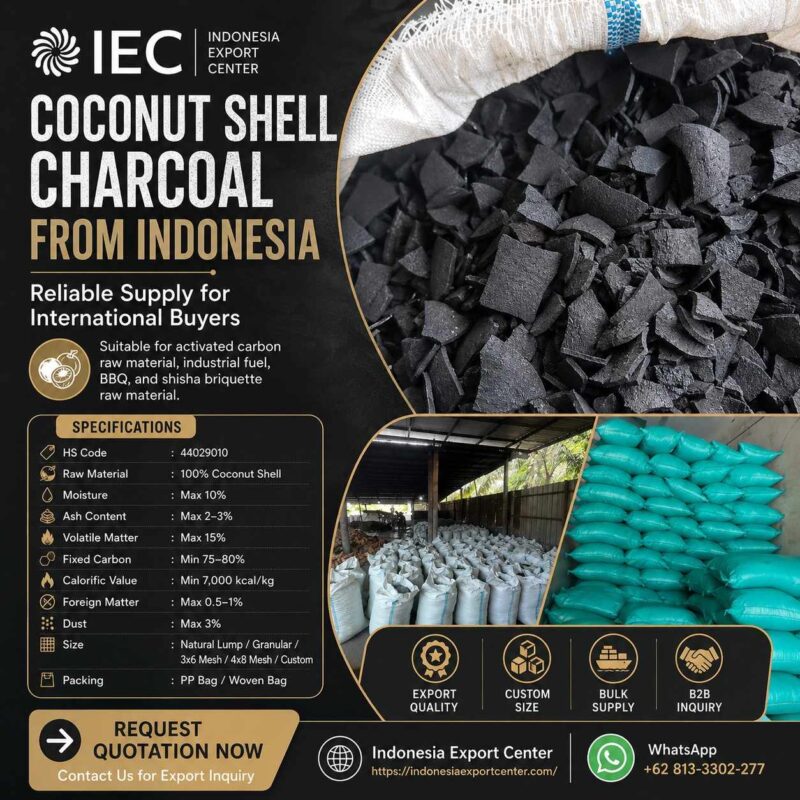
COCONUT SHELL CHARCOAL FROM INDONESIA
Reliable Supply for International Buyers
Planning to import coconut shell charcoal from Indonesia for industrial processing, activated carbon manufacturing, BBQ fuel applications, or shisha briquette production?
Indonesia Export Center (IEC) facilitates international B2B sourcing and export inquiries for coconut shell charcoal from Indonesia.
For procurement managers, importing charcoal requires more than finding a competitive product price. Buyers must also verify technical specifications, supplier identity, minimum order quantities, cargo classification, shipping arrangements, inspection procedures, and import requirements.
IEC’s listed product is made from 100% coconut shells and is available in natural lump, granular, 3×6 mesh, 4×8 mesh, and custom sizes subject to confirmation.
This guide explains the key steps involved in sourcing and importing coconut shell charcoal from Indonesia, helping international buyers prepare a structured purchasing inquiry.
Request Coconut Shell Charcoal Import Quotation:
https://wa.me/628133302277
Why Import Coconut Shell Charcoal from Indonesia?
Indonesia is a relevant sourcing origin for coconut-derived products, including coconut shell charcoal.
Coconut shell charcoal is produced through the carbonization of coconut shells and may be used in various industrial applications.
Common Applications
Activated Carbon Raw Material
Raw coconut shell charcoal can serve as feedstock for activated carbon production. It is not finished activated carbon.
Industrial Fuel
Certain charcoal grades may be considered for industrial fuel applications, depending on the buyer’s equipment and technical requirements.
BBQ Charcoal
Suitable grades may be used for BBQ fuel applications, subject to product-specific evaluation.
Shisha Briquette Manufacturing
Raw coconut shell charcoal may be processed further into finished shisha charcoal briquettes.
Why Buyers Need Grade-Specific Specifications
Not every coconut shell charcoal grade is suitable for every application.
Procurement managers should evaluate the actual product specifications against their manufacturing, distribution, or end-use requirements.
Coconut Shell Charcoal Specifications for Importers
IEC’s supplied technical specifications are:
| Parameter | Specification |
|---|---|
| HS Code | 44029010 |
| Raw Material | 100% Coconut Shell |
| Moisture | Max 10% |
| Ash Content | Max 2–3% |
| Volatile Matter | Max 15% |
| Fixed Carbon | Min 75–80% |
| Calorific Value | Min 7,000 kcal/kg |
| Foreign Matter | Max 0.5–1% |
| Dust | Max 3% |
| Size | Natural Lump / Granular / 3×6 Mesh / 4×8 Mesh / Custom |
| Packing | PP Bag / Woven Bag |
Important specification note: Ash content, fixed carbon, and foreign matter are stated as ranges of limits. Buyers must agree on the exact grade-specific maximum or minimum values before contracting.
The listed HS code is a supplied product reference and must be verified against the applicable customs tariff schedules.
Step 1 – Define Your Import Requirements
Before contacting a supplier, prepare a clear purchasing specification.
Product Requirements
Identify:
- Intended application
- Required charcoal size
- Moisture limit
- Ash content limit
- Fixed carbon requirement
- Volatile matter limit
- Calorific value requirement
- Dust limit
- Foreign matter limit
Quantity Requirements
Specify:
- Required quantity in metric tons
- Expected purchasing frequency
- One-time or recurring order
- Preferred shipment schedule
Packaging Requirements
IEC’s listed packaging options are:
- PP Bags
- Woven Bags
Buyers should confirm bag weight, dimensions, closure method, labeling, and loading arrangement.
Destination Requirements
Provide:
- Destination country
- Destination port
- Importer company details
- Preferred Incoterm
- Expected arrival period
Step 2 – Identify and Verify the Charcoal Supplier
Supplier verification is an important part of international procurement.
Before entering into a purchase agreement, buyers should confirm the identity and responsibilities of the actual supply parties.
Supplier Verification Checklist
- Legal company name
- Registered business address
- Business registration details
- Manufacturing or supply role
- Product availability
- Quality specifications
- Commercial quotation
- Payment beneficiary
- Exporter of record
- Shipment responsibilities
Manufacturer vs. Trader vs. Sourcing Intermediary
Manufacturer
Produces the charcoal.
Trading Company
May purchase and resell charcoal under its own commercial contracts.
Sourcing Intermediary
Facilitates buyer inquiries and supply coordination without necessarily being the manufacturer or contractual seller.
IEC’s Role
Indonesia Export Center operates as a sourcing and export facilitation intermediary.
IEC is not automatically the manufacturer, contractual seller, or exporter of record.
The identities and responsibilities of the relevant parties must be confirmed for each transaction.
Step 3 – Request a Detailed Commercial Quotation
A complete quotation should allow the buyer to compare different offers on a consistent basis.
Information to Include
- Product name
- Product grade
- Technical specifications
- Quantity
- Unit price
- Currency
- Packaging
- Incoterm
- Named port or place
- Production lead time
- Shipment schedule
- Payment terms
- Inspection requirements
- Quotation validity
Avoid Comparing Prices Without Matching Terms
Two quotations may have different values because of differences in:
- Product quality
- Packaging
- Shipment quantity
- Freight responsibility
- Insurance responsibility
- Inspection costs
- Payment terms
- Delivery location
Buyers should compare offers using equivalent product and commercial conditions.
Step 4 – Understand Incoterms for Coconut Shell Charcoal Imports
Incoterms define important responsibilities between the buyer and seller.
The selected Incoterm should be stated clearly in the purchase agreement.
FOB – Free on Board
Under FOB Incoterms 2020, the seller delivers the goods on board the buyer-nominated vessel at the named port of shipment.
The seller generally handles export clearance.
Risk transfers when the goods are on board the vessel.
The buyer generally arranges the main ocean freight.
CFR – Cost and Freight
Under CFR Incoterms 2020, the seller arranges and pays for ocean freight to the named destination port.
However, risk generally transfers to the buyer when the goods are loaded on board the vessel at the port of shipment.
The seller is not required to provide cargo insurance under CFR.
CIF – Cost, Insurance and Freight
Under CIF Incoterms 2020, the seller arranges and pays for ocean freight and the required cargo insurance to the named destination port.
Risk generally transfers when the goods are loaded on board the vessel at the port of shipment.
CIF requires the seller to provide the insurance coverage specified by the applicable Incoterms rule, which may be only minimum coverage.
FCA – Free Carrier
FCA may be appropriate for certain containerized cargo arrangements.
Under FCA Incoterms 2020, the seller delivers the goods to the carrier or another nominated party at the named place, with the precise delivery point determining the relevant responsibilities.
For containerized shipments handed to a carrier or terminal before vessel loading, FCA is often worth considering instead of FOB.
Incoterms Comparison
| Incoterm | Main Freight | Seller’s Insurance Obligation | General Risk Transfer |
|---|---|---|---|
| FOB | Buyer arranges | None under the rule | Goods on board vessel |
| CFR | Seller arranges and pays | None under the rule | Goods on board vessel |
| CIF | Seller arranges and pays | Required minimum coverage | Goods on board vessel |
| FCA | Buyer generally arranges onward carriage | None under the rule | Delivery to carrier at named place |
Important: Incoterms do not by themselves establish payment terms, transfer of ownership, or every contractual obligation.
The quotation should state the named location and Incoterms 2020.
Step 5 – Confirm Charcoal Quality and Inspection
Quality inspection helps buyers verify whether the proposed charcoal meets the agreed specifications.
Main Inspection Parameters
Moisture
IEC’s listed maximum is 10%.
Ash Content
IEC’s listed specification is maximum 2–3%, with the exact contractual limit to be confirmed.
Fixed Carbon
IEC’s listed specification is minimum 75–80%, with the exact contractual minimum to be confirmed.
Volatile Matter
IEC’s listed maximum is 15%.
Calorific Value
IEC’s listed minimum is 7,000 kcal/kg.
Dust
IEC’s listed maximum is 3%.
Foreign Matter
IEC’s listed maximum is 0.5–1%, with the exact limit to be confirmed.
Inspection Planning
Buyers should agree on:
- Sampling procedure
- Testing method
- Testing laboratory
- Inspection timing
- Product acceptance criteria
- Responsibility for inspection costs
- Procedure for nonconforming goods
Laboratory Reports
Buyers may request information about available Certificates of Analysis or laboratory test reports.
Availability and the scope of testing must be confirmed.
Step 6 – Confirm Product Size and Packaging
IEC’s listed product sizes include:
Natural Lump
Irregular pieces of carbonized coconut shell.
Granular
Smaller charcoal particles suitable for certain industrial processes.
3×6 Mesh
A listed screened charcoal size option.
4×8 Mesh
Another listed screened size option.
Custom Size
Subject to supplier confirmation.
Important Mesh Clarification
Buyers should specify the sieve standard and acceptable particle size distribution.
Mesh labels alone may not fully describe the required size distribution.
Packaging
The listed packaging options are PP bags and woven bags.
Exact bag weights, dimensions, and loading arrangements must be confirmed.
Step 7 – Plan Container Loading and Freight
International charcoal shipments require careful cargo planning.
Information Needed for Container Loading
- Container type
- Cargo net weight
- Cargo gross weight
- Bag dimensions
- Bag quantity
- Cargo density
- Container payload limit
- Loading configuration
- Applicable cargo safety requirements
20-Foot and 40-Foot Containers
Buyers may request loading plans for 20-foot or 40-foot containers.
However, no verified container loading capacity has been supplied.
Actual loading quantities depend on the cargo and transport requirements.
Freight Planning
Freight availability and cost may depend on:
- Origin port
- Destination port
- Cargo classification
- Shipping-line acceptance
- Container type
- Shipment timing
- Applicable surcharges
The exact loading port, freight rate, and shipping schedule must be confirmed during quotation.
Step 8 – Verify Charcoal Maritime Transport Safety
Charcoal can present self-heating and fire hazards during transportation.
Importers must not assume that charcoal can always be shipped as unrestricted general cargo.
Transport Compliance Requirements
The responsible parties should establish:
- Correct cargo classification
- Applicable UN number and proper shipping name
- Required test evidence
- Packaging requirements
- Dangerous-goods documentation, where applicable
- Container and stowage requirements
- Shipping-line acceptance
IMDG Code
Maritime shipments must comply with the applicable requirements of the current International Maritime Dangerous Goods (IMDG) Code and relevant carrier rules.
Why This Matters for Importers
Incorrect cargo classification or documentation can lead to:
- Booking rejection
- Shipment delays
- Additional costs
- Cargo safety incidents
- Regulatory consequences
Transport compliance should be confirmed before shipment.
Step 9 – Prepare Export and Import Documents
The documentation requirements depend on the transaction, shipment, and destination country.
Common Export Documents
Commercial Invoice
Records the seller, buyer, goods, price, and transaction details.
Packing List
Provides packaging and weight information.
Bill of Lading
Documents the ocean carriage arrangement.
Customs Export Declaration
Indonesian export shipments are subject to applicable customs procedures, including the export declaration commonly referred to as PEB.
Certificate of Origin
May be required for customs purposes or preferential tariff treatment, depending on the applicable rules.
Transport Safety Documentation
May be required depending on the cargo classification.
Destination-Country Import Documents
Buyers may need:
- Import permits or registrations
- Customs import declaration
- Product-related compliance documents
- Applicable certificates
- Tax and duty payment records
The exact requirements vary by importing country.
Step 10 – Confirm HS Code and Import Duties
IEC’s supplied product information lists:
HS Code: 44029010
However, tariff classification must be verified.
Why HS Code Verification Matters
The applicable tariff code can affect:
- Import duty
- Customs declaration
- Trade restrictions
- Documentary requirements
- Preferential tariff eligibility
Import Duty Calculation
Import duties and taxes depend on the destination country’s tariff rules and the applicable customs value.
Buyers should consult their customs broker or relevant customs authority.
No universal import duty rate is provided because rates vary by country and classification.
Step 11 – Arrange Customs Clearance and Delivery
After the cargo arrives, the importer or appointed customs broker generally coordinates import clearance.
Import Clearance Activities
- Submission of customs documents
- Tariff classification
- Customs valuation
- Duty and tax assessment
- Regulatory checks
- Cargo release
- Inland delivery arrangements
The responsible parties and procedures depend on the destination country and agreed commercial terms.
Step 12 – Establish a Repeat-Order Procurement Process
For procurement managers planning recurring purchases, consistency is important.
Recommended Repeat-Order Controls
- Approved product specifications
- Verified supplier information
- Agreed sampling procedure
- Inspection records
- Packaging standards
- Shipment documentation
- Delivery performance records
- Nonconformance procedures
- Periodic commercial review
A structured process can help buyers evaluate repeat shipments against consistent requirements.
Coconut Shell Charcoal Import Cost Checklist
A complete landed-cost estimate should consider the applicable costs rather than only the supplier’s unit price.
Potential Cost Components
| Cost Component | Description |
|---|---|
| Product Cost | Agreed charcoal price |
| Packaging | Included or separately charged, depending on quotation |
| Origin Handling | According to agreed commercial terms |
| Export Clearance | According to agreed commercial terms |
| Inspection | If required |
| Ocean Freight | According to selected Incoterm |
| Cargo Insurance | According to agreement |
| Destination Charges | Port and terminal charges |
| Customs Duty | Based on applicable tariff |
| Import Taxes | Based on destination rules |
| Customs Brokerage | If applicable |
| Inland Transport | Delivery from port to final destination |
Basic Landed-Cost Formula
Estimated Landed Cost = Product Cost + Applicable Freight + Insurance + Import Duties + Taxes + Handling + Other Import Expenses
The exact calculation depends on the Incoterm and the importing country’s customs valuation rules.
Common Mistakes When Importing Coconut Shell Charcoal
1. Purchasing Without Exact Specifications
Avoid vague quality requirements.
2. Assuming Raw Charcoal Is Finished Activated Carbon
Raw coconut shell charcoal requires further processing to become activated carbon.
3. Using Raw Charcoal Specifications for Finished Briquettes
Finished briquettes require separate product specifications.
4. Comparing FOB and CIF Prices Directly
Different Incoterms allocate costs differently.
5. Ignoring Cargo Classification
Charcoal transport safety requirements must be verified.
6. Assuming a Fixed Container Capacity
Loading quantity depends on cargo characteristics and applicable restrictions.
7. Skipping Supplier Verification
Verify the actual contractual parties before making payment.
8. Omitting Inspection Criteria
Agree on sampling, testing, and acceptance requirements before shipment.
IEC’s Role in Coconut Shell Charcoal Import Sourcing
Indonesia Export Center facilitates international B2B sourcing inquiries and export coordination discussions.
IEC is a sourcing and export facilitation intermediary, not automatically the charcoal manufacturer, contractual seller, or exporter of record.
For each proposed transaction, buyers should confirm:
- Actual supplier
- Contractual seller
- Payment beneficiary
- Exporter of record
- Freight responsibilities
- Inspection arrangements
- Commercial terms
IEC can receive buyer requirements and facilitate inquiries about potential supply arrangements.
Coconut Shell Charcoal Import RFQ Template
Subject: RFQ – Import Coconut Shell Charcoal from Indonesia
Dear Indonesia Export Center Team,
We are interested in importing coconut shell charcoal from Indonesia.
Please provide information and a commercial quotation based on the following requirements.
Company Name: [Company Name]
Destination Country: [Country]
Destination Port: [Port]
Intended Application: [Activated Carbon / Industrial Fuel / BBQ / Briquette Manufacturing]
Product: Raw Coconut Shell Charcoal
Required Size: [Natural Lump / Granular / 3×6 Mesh / 4×8 Mesh / Custom]
Required Quantity: [Metric Tons]
Maximum Moisture: [Specification]
Maximum Ash Content: [Specification]
Minimum Fixed Carbon: [Specification]
Maximum Volatile Matter: [Specification]
Minimum Calorific Value: [Specification]
Packaging: [PP Bag / Woven Bag / Preferred Bag Weight]
Preferred Incoterm: [FOB / CFR / CIF / FCA / Other]
Expected Shipment Date: [Date]
Please include:
- Product availability
- Minimum order quantity
- Technical specifications
- Unit price and total quotation
- Packaging details
- Available laboratory test reports
- Inspection options
- Estimated production lead time
- Loading and shipping arrangements
- Payment terms
- Export documentation requirements
- Cargo transport compliance information
We look forward to reviewing your quotation.
Best regards,
[Your Name]
[Company Name]
[Contact Information]
Send Your Import RFQ via WhatsApp:
https://wa.me/628133302277
Frequently Asked Questions About Importing Coconut Shell Charcoal from Indonesia
How can I import coconut shell charcoal from Indonesia?
Define your specifications, verify the supplier, request a quotation, agree on commercial terms, establish inspection procedures, confirm shipping compliance, and arrange import customs clearance.
What is the HS code for coconut shell charcoal?
IEC’s supplied reference is 44029010. The applicable customs classification must be verified.
What is the minimum order quantity?
A fixed MOQ has not been supplied. Contact IEC for confirmation.
Can I import coconut shell charcoal in containers?
Container-based shipments may be discussed, subject to loading feasibility, cargo classification, and shipping arrangements.
What are the available charcoal sizes?
Natural lump, granular, 3×6 mesh, 4×8 mesh, and custom sizes subject to confirmation.
What is the moisture specification?
Maximum 10%.
What is the ash content?
The supplied specification is maximum 2–3%, with the exact grade limit to be confirmed.
What is the fixed carbon specification?
The supplied specification is minimum 75–80%, with the exact grade limit to be confirmed.
Which Incoterm should I choose?
The appropriate Incoterm depends on your freight arrangements and risk allocation preferences. FOB, CFR, CIF, and FCA may be considered depending on the shipment.
Can I request FOB or CIF pricing?
Buyers may request these terms. Availability and the named ports must be confirmed.
Is coconut shell charcoal classified as dangerous goods?
Charcoal may present self-heating hazards. Its transport classification must be determined under applicable maritime regulations for the actual shipment.
What documents are required?
Common documents include a commercial invoice, packing list, bill of lading, customs declarations, and other documents required by the destination country or transport classification.
Does IEC manufacture the charcoal?
IEC is presented as a sourcing and export facilitation intermediary, not automatically the manufacturer.
How can I request a quotation?
Contact IEC through WhatsApp at +62 813-3302-277 with your product specifications, quantity, packaging, destination, and preferred Incoterm.
Request Coconut Shell Charcoal Import Quotation
Ready to import coconut shell charcoal from Indonesia?
Indonesia Export Center (IEC) welcomes inquiries from international procurement managers, industrial manufacturers, charcoal importers, and bulk commodity traders.
Product: Coconut Shell Charcoal
Raw Material: 100% Coconut Shell
Available Size Options: Natural Lump / Granular / 3×6 Mesh / 4×8 Mesh / Custom
Packaging: PP Bag / Woven Bag
Origin: Indonesia
Business Focus: Export Quality • Custom Size • Bulk Supply • B2B Inquiry
Contact IEC to discuss sourcing requirements, technical specifications, MOQ, inspection, Incoterms, and export quotations.
Indonesia Export Center (IEC)
Website: https://indonesiaexportcenter.com/
WhatsApp: +62 813-3302-277
Request Quotation via WhatsApp:
https://wa.me/628133302277
Please include your company name, destination country, required charcoal size, technical specifications, purchasing quantity, packaging, and preferred Incoterm.
