

IEC | INDONESIA EXPORT CENTER
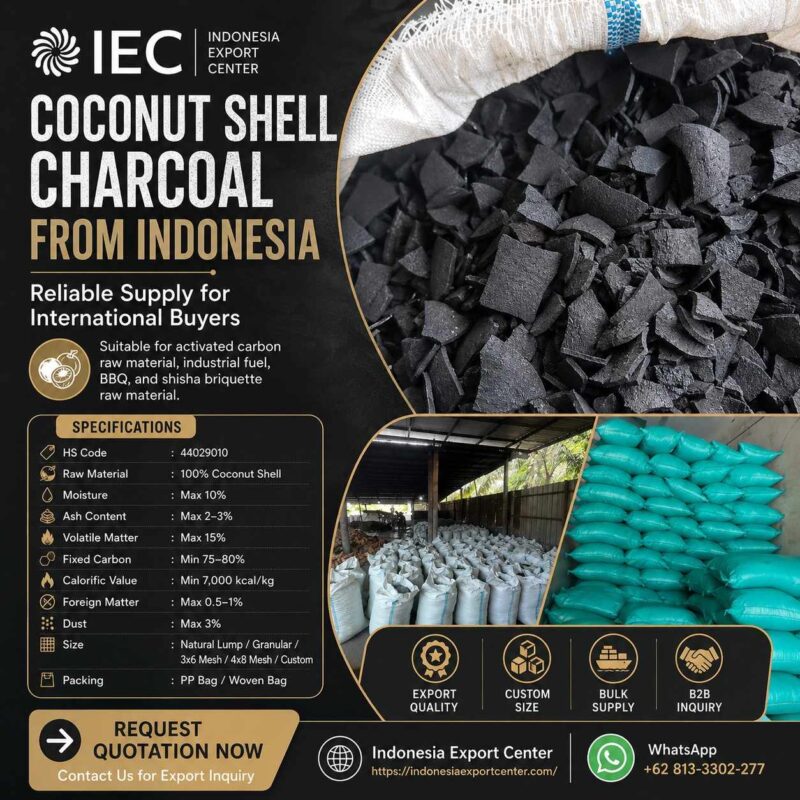
COCONUT SHELL CHARCOAL FROM INDONESIA
Raw Material Sourcing for Activated Carbon Manufacturers
Looking for coconut shell charcoal for activated carbon manufacturing?
Indonesia Export Center (IEC) facilitates international B2B sourcing inquiries for coconut shell charcoal from Indonesia, helping activated carbon producers explore raw material supply opportunities based on their technical specifications, particle size requirements, purchasing volume, and destination market.
Produced from 100% coconut shells, the listed charcoal product has moisture content of maximum 10%, ash content of maximum 2–3%, volatile matter of maximum 15%, and fixed carbon of minimum 75–80%.
Available forms include natural lump charcoal, granular charcoal, 3×6 mesh, 4×8 mesh, and custom sizes subject to confirmation.
IEC welcomes inquiries from activated carbon manufacturers and industrial carbon processors in China, India, Malaysia, and other international markets.
Important: This product is raw coconut shell charcoal used as a potential feedstock for activated carbon manufacturing. It is not finished activated carbon, and no activated carbon performance rating is claimed for the raw material.
Request Activated Carbon Feedstock Quotation:
https://wa.me/628133302277
Why Coconut Shell Charcoal Is Used for Activated Carbon Production
Coconut shell charcoal is a carbon-rich material produced through the carbonization of coconut shells.
It can serve as a precursor for activated carbon manufacturing, where additional processing develops the porous structure required for adsorption applications.
Activated carbon producers may evaluate coconut shell charcoal for use in manufacturing products intended for:
- Water treatment
- Air purification
- Gas treatment
- Industrial filtration
- Chemical processing
- Adsorption systems
The suitability of a specific charcoal grade depends on the manufacturer’s activation technology, raw material acceptance criteria, and intended finished activated carbon product.
Raw Coconut Shell Charcoal vs. Finished Activated Carbon
| Characteristic | Raw Coconut Shell Charcoal | Finished Activated Carbon |
|---|---|---|
| Production Stage | Carbonized coconut shell material | Material processed through activation |
| Main Role | Industrial carbon feedstock | Adsorbent material |
| Further Processing | Requires activation for activated carbon production | May require grading or finishing depending on application |
| Key Evaluation | Ash, moisture, fixed carbon, volatile matter, size | Adsorption performance, pore characteristics, hardness, ash, moisture, size |
| Iodine Number | Not specified for IEC raw charcoal | May be specified for certain activated carbon grades |
| Surface Area | Not specified for IEC raw charcoal | Commonly evaluated for activated carbon |
IEC supplies information for raw charcoal sourcing inquiries, not a verified finished activated carbon product specification.
Coconut Shell Charcoal Feedstock Specifications
IEC’s listed specifications for coconut shell charcoal are as follows.
| Parameter | Specification |
|---|---|
| HS Code | 44029010 |
| Raw Material | 100% Coconut Shell |
| Moisture | Max 10% |
| Ash Content | Max 2–3% |
| Volatile Matter | Max 15% |
| Fixed Carbon | Min 75–80% |
| Calorific Value | Min 7,000 kcal/kg |
| Foreign Matter | Max 0.5–1% |
| Dust | Max 3% |
| Size | Natural Lump / Granular / 3×6 Mesh / 4×8 Mesh / Custom |
| Packing | PP Bag / Woven Bag |
Specification clarification: The stated ash, fixed carbon, and foreign matter values are ranges of possible limits. The precise acceptance limits for the selected feedstock grade must be confirmed in the purchase agreement.
The listed HS code is a supplied reference and should be verified against the applicable customs tariff classification.
Ash Content: A Key Parameter for Activated Carbon Feedstock
Ash content is an important consideration when evaluating coconut shell charcoal for activation.
Ash is the inorganic residue remaining after combustion under defined laboratory conditions.
IEC Listed Ash Specification
Maximum 2–3%
The exact maximum must be confirmed for the product grade offered.
Why Ash Matters in Activation
Depending on the activation process, ash content may influence:
- Mineral residue in the raw material
- Activation processing conditions
- Subsequent washing requirements
- Finished-product ash content
- Certain adsorption characteristics
- Product quality consistency
Lower ash content may be desirable for some activated carbon production processes, but the acceptable limit depends on the manufacturer’s technology and finished-product requirements.
Ash Testing Requirements
Manufacturers should specify:
- Required maximum ash content
- Laboratory testing method
- Sample preparation procedure
- Analytical basis
- Batch acceptance criteria
Ash values should be compared only when the analytical methods and reporting bases are equivalent.
Fixed Carbon: Evaluating the Carbon-Rich Feedstock
Fixed carbon is commonly used to characterize charcoal composition.
It represents the solid carbonaceous residue remaining after accounting for moisture, volatile matter, and ash under the applicable analytical method.
IEC Listed Fixed Carbon Specification
Minimum 75–80%
The exact contractual minimum must be agreed upon.
Why Fixed Carbon Matters
Fixed carbon can help manufacturers evaluate:
- Charcoal composition
- Consistency between batches
- Raw material quality
- Suitability for further processing
However, fixed carbon is only one of several factors involved in feedstock evaluation.
Does Higher Fixed Carbon Guarantee Better Activated Carbon?
No.
A higher fixed carbon value does not automatically guarantee:
- Higher activation yield
- Higher iodine number
- Greater BET surface area
- Better pore distribution
- Higher adsorption capacity
- Improved mechanical strength
These characteristics depend on the raw material, activation method, processing conditions, and finishing steps.
Manufacturers should validate the feedstock through appropriate testing and production trials.
Moisture Content and Raw Material Handling
Moisture content affects charcoal handling and preparation before activation.
IEC Listed Moisture Specification
Maximum 10%
Why Moisture Matters
Moisture may influence:
- Incoming material weight
- Storage conditions
- Drying requirements
- Process energy consumption
- Material feeding consistency
Manufacturers should define the moisture measurement method and acceptance limit.
Volatile Matter and Carbonization Quality
Volatile matter is measured by heating charcoal under specified laboratory conditions.
IEC Listed Volatile Matter Specification
Maximum 15%
Volatile matter provides information about the material’s composition and carbonization characteristics.
For activated carbon manufacturers, it may be evaluated alongside fixed carbon, ash, moisture, and other process-specific parameters.
The listed volatile matter limit does not guarantee a particular activation yield or finished activated carbon grade.
Charcoal Particle Size for Activated Carbon Production
Particle size selection depends on the activation system and material handling equipment.
Natural Lump Charcoal
Natural lump charcoal consists of irregular pieces of carbonized coconut shell.
It may be suitable for manufacturers that crush and screen raw material internally.
Granular Charcoal
Granular charcoal provides smaller particles for buyers with specific feed preparation requirements.
3×6 Mesh Charcoal
A listed screened-size option for buyers requiring a defined granular fraction.
4×8 Mesh Charcoal
Another listed screened-size option for industrial feedstock requirements.
Custom Particle Sizes
Buyers may inquire about custom particle size requirements.
For mesh products, manufacturers should confirm the applicable sieve standard and acceptable oversize, undersize, and fines content.
Custom size availability must be confirmed before ordering.
Additional Feedstock Tests for Activated Carbon Manufacturers
The supplied IEC specifications cover important basic charcoal characteristics.
However, activated carbon factories may require additional evaluation before approving a feedstock.
Potential Additional Tests
| Test | Why Manufacturers May Request It |
|---|---|
| Bulk Density | Material handling and equipment loading |
| Particle Size Distribution | Feed preparation and process consistency |
| Sulfur Content | Process-specific impurity control |
| Chloride Content | Process-specific impurity control |
| Mineral Composition | Evaluation of inorganic constituents |
| Mechanical Durability | Handling and processing behavior |
| Pilot Activation Test | Evaluation under the manufacturer’s activation conditions |
| Activation Yield | Measurement of output under defined process conditions |
| Finished Carbon Adsorption Tests | Verification of the activated product |
These are potential buyer-specific requirements, not additional confirmed IEC product specifications.
Availability of laboratory reports and testing arrangements must be confirmed during the sourcing inquiry.
Evaluating Coconut Shell Charcoal for Steam Activation
Steam activation is one method used in activated carbon manufacturing.
Under controlled high-temperature conditions, steam reacts with carbonized material and contributes to pore development.
Feedstock Considerations
Manufacturers may evaluate:
- Raw material composition
- Ash content
- Particle size
- Moisture
- Mechanical behavior
- Carbonization characteristics
- Activation response
The optimal feedstock depends on the activation equipment and target product.
Can IEC Guarantee Steam Activation Performance?
No activation yield, iodine number, surface area, or pore structure specification has been provided.
Manufacturers should conduct suitable laboratory or production-scale trials before approving a feedstock for regular use.
Evaluating Coconut Shell Charcoal for Chemical Activation
Chemical activation is another processing approach used for certain activated carbon products.
Its suitability depends on the raw material and the manufacturer’s selected chemical treatment process.
Important Considerations
Manufacturers may assess:
- Raw material composition
- Impurity levels
- Particle size
- Process compatibility
- Washing requirements
- Finished-product performance
IEC does not claim that the listed charcoal has been validated for any specific chemical activation process.
Buyers should evaluate compatibility with their own manufacturing conditions.
Coconut Shell Charcoal Supply for Activated Carbon Factories in Asia
IEC welcomes industrial sourcing inquiries from activated carbon manufacturers and raw material importers across Asia.
China
Activated carbon producers in China can inquire about natural lump and granular coconut shell charcoal from Indonesia.
Buyers should specify their required quality parameters, quantity, packaging, and destination port.
India
Manufacturers in India can request information about raw coconut shell charcoal for activation processes.
Applicable import requirements, customs classifications, and shipment conditions should be verified before purchasing.
Malaysia
Activated carbon factories and industrial processors in Malaysia can submit inquiries based on their production requirements and purchasing volumes.
Other Markets
IEC also welcomes international B2B inquiries from activated carbon manufacturers in other countries.
Availability and export arrangements must be confirmed for each transaction.
Bulk Supply, MOQ, and Packaging
Industrial manufacturers may require container-based or recurring raw material procurement.
However, IEC’s supplied product information does not establish a fixed MOQ, production capacity, or guaranteed monthly supply volume.
Bulk Purchasing Information to Confirm
- Minimum order quantity
- Available charcoal grade
- Product size
- Current supply quantity
- Production lead time
- Packaging format
- Shipment schedule
- Inspection requirements
Packaging Options
IEC’s listed packaging formats are:
- PP Bags
- Woven Bags
Bag weights, dimensions, palletization, and loading arrangements must be confirmed.
Quality Inspection Before Import
Activated carbon factories should establish quality acceptance procedures before confirming an order.
Recommended Inspection Checklist
- Confirm raw material identity
- Verify moisture content
- Verify ash content
- Verify fixed carbon
- Verify volatile matter
- Confirm particle size distribution
- Check dust and foreign matter
- Inspect packaging
- Verify shipment quantity
- Review laboratory results against agreed limits
Laboratory and Sampling Requirements
Buyers should specify:
- Sampling method
- Testing method
- Analytical basis
- Laboratory qualifications
- Acceptance criteria
- Inspection responsibility
- Procedure for nonconforming cargo
Independent inspection and laboratory testing availability should be confirmed during commercial discussions.
Exporting Raw Coconut Shell Charcoal from Indonesia
International shipment requires coordination among the supplier, contractual seller, exporter of record, freight providers, and importer.
Export Documentation
Depending on the transaction and destination, documents may include:
- Commercial Invoice
- Packing List
- Bill of Lading
- Customs Export Declaration
- Certificate of Origin, where applicable
- Transport safety documentation
- Additional import documents required by the destination country
Maritime Transport Safety
Charcoal can present self-heating hazards.
The applicable classification, packaging, testing, loading, and documentation requirements must be verified under the current International Maritime Dangerous Goods (IMDG) Code and shipping-line requirements.
No specific container loading capacity or shipping schedule is guaranteed in the supplied information.
IEC’s Role in Industrial Charcoal Sourcing
Indonesia Export Center operates as a sourcing and export facilitation intermediary.
IEC helps international buyers communicate their requirements and explore potential supply arrangements from Indonesia.
IEC is not represented as the charcoal manufacturer or automatically as the exporter of record.
Before purchasing, manufacturers should verify the identity of the actual supplier, contractual seller, payment beneficiary, and parties responsible for export and freight arrangements.
How to Request Coconut Shell Charcoal for Activated Carbon Manufacturing
Step 1 – Define Your Activation Feedstock Requirements
Specify your required ash, fixed carbon, moisture, volatile matter, and particle size.
Step 2 – Select the Product Form
Choose natural lump, granular, 3×6 mesh, 4×8 mesh, or inquire about custom sizing.
Step 3 – Provide Your Purchasing Quantity
State the required quantity in metric tons.
Step 4 – Identify Additional Testing Requirements
Mention any required laboratory analysis, sampling, or pilot activation evaluation.
Step 5 – Specify Packaging and Destination
Provide your preferred packaging, destination country, and port.
Step 6 – Request a Quotation
Contact IEC to discuss available supply, MOQ, commercial terms, and export requirements.
Activated Carbon Feedstock RFQ Template
Subject: RFQ – Coconut Shell Charcoal for Activated Carbon Production
Dear Indonesia Export Center Team,
We are an activated carbon manufacturer seeking coconut shell charcoal from Indonesia as an industrial raw material.
Please provide a quotation based on the following requirements:
Company Name: [Company Name]
Country: [China / India / Malaysia / Other]
Destination Port: [Port]
Product: Raw Coconut Shell Charcoal
Application: Activated Carbon Manufacturing
Required Size: [Natural Lump / Granular / 3×6 Mesh / 4×8 Mesh / Custom]
Required Quantity: [Metric Tons]
Maximum Ash Content: [Specification]
Minimum Fixed Carbon: [Specification]
Maximum Moisture: [Specification]
Maximum Volatile Matter: [Specification]
Maximum Dust: [Specification]
Additional Testing Requirements: [If Any]
Packaging: [PP Bag / Woven Bag / Preferred Bag Weight]
Preferred Incoterm: [Specify]
Expected Shipment Date: [Date]
Please provide:
- Available product specifications
- Minimum order quantity
- Commercial quotation
- Available supply quantity
- Packaging information
- Estimated production lead time
- Available laboratory test reports
- Sampling and inspection options
- Export documentation requirements
- Payment and shipping terms
Thank you. We look forward to receiving your response.
Best regards,
[Your Name]
[Company Name]
[Contact Information]
Send Your RFQ via WhatsApp:
https://wa.me/628133302277
Frequently Asked Questions About Coconut Shell Charcoal for Activated Carbon
Is coconut shell charcoal suitable for activated carbon production?
Coconut shell charcoal can serve as a precursor for activated carbon manufacturing. Suitability depends on its properties and the manufacturer’s activation process.
Is IEC’s product finished activated carbon?
No. The listed product is coconut shell charcoal, not finished activated carbon.
What is the ash content?
The supplied specification is maximum 2–3%. The exact maximum should be confirmed for the selected grade.
What is the fixed carbon content?
The listed specification is minimum 75–80%. The precise contractual minimum should be agreed upon.
What is the moisture content?
The listed maximum is 10%.
What is the volatile matter content?
The listed maximum is 15%.
Does higher fixed carbon guarantee higher activated carbon yield?
No. Activation yield depends on the raw material and processing conditions, not fixed carbon alone.
Does the raw charcoal have a guaranteed iodine number?
No iodine number specification has been supplied for the raw charcoal.
Does the raw charcoal have a guaranteed BET surface area?
No BET surface area specification has been supplied.
Can factories request natural lump charcoal?
Natural lump charcoal is a listed size option. Availability should be confirmed.
Can manufacturers in China, India, and Malaysia request quotations?
Yes. IEC welcomes industrial sourcing inquiries from these markets.
What is the MOQ?
A specific MOQ has not been supplied. Contact IEC for confirmation.
Can buyers request laboratory testing?
Buyers may discuss available test reports, sampling, and inspection requirements during quotation.
Does IEC manufacture the charcoal?
IEC is presented as a sourcing and export facilitation intermediary, not the manufacturer.
How do I request a quotation?
Contact IEC through WhatsApp at +62 813-3302-277 with your technical specifications, required quantity, and destination port.
Request Coconut Shell Charcoal for Activated Carbon Production
Looking for coconut shell charcoal feedstock from Indonesia?
Indonesia Export Center (IEC) welcomes inquiries from activated carbon manufacturers, industrial carbon processors, and raw material importers in China, India, Malaysia, and other international markets.
Product: Raw Coconut Shell Charcoal
Raw Material: 100% Coconut Shell
Ash Content: Max 2–3%
Fixed Carbon: Min 75–80%
Moisture: Max 10%
Volatile Matter: Max 15%
Calorific Value: Min 7,000 kcal/kg
Size Options: Natural Lump / Granular / 3×6 Mesh / 4×8 Mesh / Custom
Packaging: PP Bag / Woven Bag
Origin: Indonesia
Contact IEC to discuss your activation feedstock requirements, available product grades, MOQ, packaging, and export quotation.
Indonesia Export Center (IEC)
Website: https://indonesiaexportcenter.com/
WhatsApp: +62 813-3302-277
Request Quotation via WhatsApp:
https://wa.me/628133302277
Please include your company name, destination country, required charcoal size, ash and fixed carbon specifications, order quantity, and expected shipment schedule when submitting your inquiry.
