

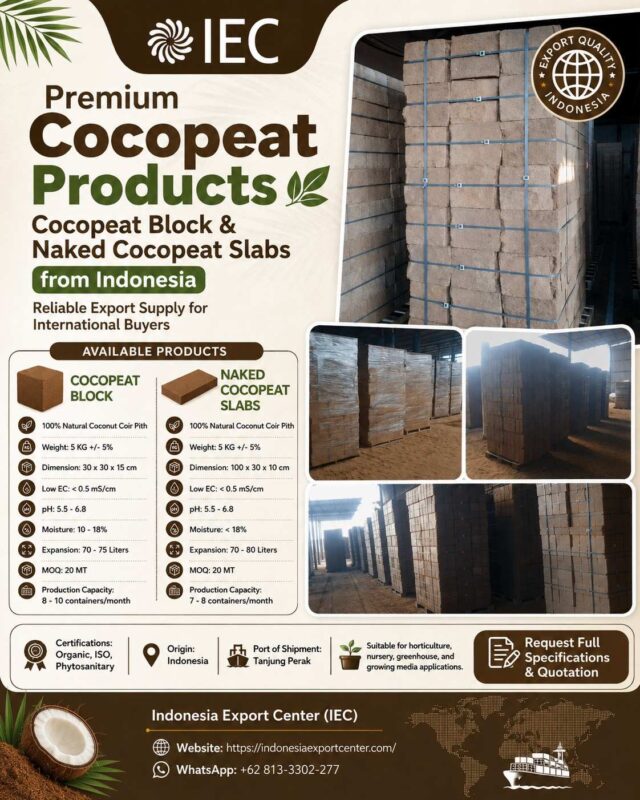
Premium Cocopeat Products
Cocopeat Blocks & Naked Cocopeat Slabs from Indonesia
Reliable Export Supply for International Buyers
Understanding cocopeat export documentation is an essential part of importing coconut coir growing media from Indonesia.
For international importers, customs brokers, and compliance teams, preparing the correct documents can help reduce customs clearance delays, avoid shipment discrepancies, and support compliance with destination-country import regulations.
Cocopeat is a plant-derived agricultural material commonly used in horticulture, nurseries, greenhouses, and commercial growing media production. Depending on the destination country, its importation may involve customs documentation, plant-health requirements, and additional regulatory checks.
Indonesia Export Center (IEC) supplies premium 5 KG cocopeat blocks and naked cocopeat slabs made from 100% natural coconut coir pith for international wholesale inquiries.
Our products have specified Low EC levels below 0.5 mS/cm, a pH range of 5.5–6.8, and a minimum order quantity of 20 metric tons.
This guide explains the key documents, certification considerations, and compliance checks involved in exporting cocopeat from Indonesia.
Request Cocopeat Export Documentation Information & Quotation:
https://wa.me/628133302277
What Documents Are Required to Export Cocopeat from Indonesia?
The documents required for an international cocopeat shipment depend on the destination country, applicable trade regulations, shipment arrangements, and agreed commercial terms.
Common export and import documentation may include:
- Commercial Invoice
- Packing List
- Bill of Lading
- Certificate of Origin, where applicable
- Phytosanitary Certificate, where required
- Customs Export Declaration
- Import Permit or Import Authorization, where required
- Organic or ISO Certification Documents, where applicable
- Laboratory Test Reports, where requested or required
- Additional destination-country compliance documents
Not every document is mandatory for every shipment.
Importers should verify the applicable requirements with their customs broker, freight forwarder, and relevant government authorities before confirming an order.
1. Commercial Invoice for Cocopeat Export
A commercial invoice is one of the main documents used in international trade.
It provides information about the commercial transaction between the exporter and importer.
Common Information Included in a Commercial Invoice
- Exporter name and address
- Importer name and address
- Invoice number and date
- Product description
- Product quantity
- Unit price
- Total invoice value
- Transaction currency
- Country of origin
- Agreed Incoterms
- Relevant shipping information
Why It Matters
Customs authorities may use the commercial invoice to evaluate the declared transaction value and other information relevant to customs processing.
Import compliance teams should verify that the commercial invoice is consistent with the purchase agreement and other shipment documents.
2. Packing List for Cocopeat Shipments
A packing list describes the physical contents of a shipment.
For bulk cocopeat exports, it helps customs officials, freight forwarders, warehouse operators, and importers identify the shipped products.
Common Packing List Details
- Product name
- Number of packages or units
- Packaging type
- Net weight
- Gross weight
- Package dimensions
- Shipment identification
- Container details, where available
IEC Cocopeat Product Formats
Cocopeat Block
- Nominal weight: 5 KG ± 5%
- Dimensions: 30 × 30 × 15 cm
Naked Cocopeat Slabs
- Nominal weight: 5 KG ± 5%
- Dimensions: 100 × 30 × 10 cm
Actual package counts, weights, and loading details must be confirmed for the specific shipment.
3. Bill of Lading for Cocopeat Export
A Bill of Lading (B/L) is an important shipping document for ocean freight.
Depending on its form, it can serve as evidence of the contract of carriage, a receipt for goods, and potentially a document of title.
Common Bill of Lading Information
- Shipper
- Consignee
- Notify party
- Port of loading
- Port of discharge
- Vessel and voyage information
- Cargo description
- Package quantity
- Gross cargo weight
- Container and seal numbers
IEC Port of Shipment
Tanjung Perak, Indonesia
Importers should ensure that the Bill of Lading details match the agreed shipping instructions and other commercial documents.
4. Phytosanitary Certificate for Cocopeat
What Is a Phytosanitary Certificate?
A phytosanitary certificate is an official document issued by the competent plant protection authority to certify that a regulated consignment meets specified plant-health requirements.
Because cocopeat is derived from coconut husks, some importing countries may impose phytosanitary conditions on its entry.
Is a Phytosanitary Certificate Required for Cocopeat?
Requirements vary by destination country.
Depending on the importing jurisdiction, authorities may require:
- A phytosanitary certificate
- Specific declarations or treatments
- Inspection before export
- Import permits
- Additional plant-health documentation
A phytosanitary certificate should not be assumed to be mandatory in every market or sufficient by itself to authorize importation.
What Importers Should Verify
Before shipping, confirm:
- Whether cocopeat is regulated in the destination country.
- Whether a phytosanitary certificate is required.
- Whether additional declarations must appear on the certificate.
- Whether treatment or inspection is required.
- Whether import authorization must be obtained in advance.
IEC lists phytosanitary documentation among its supplied certification information. Availability and shipment-specific requirements should be confirmed during the quotation process.
5. Certificate of Origin for Cocopeat from Indonesia
A Certificate of Origin (COO) identifies the origin of goods in international trade.
It may be used for customs purposes or to support eligibility for preferential tariff treatment under an applicable trade agreement.
Why a Certificate of Origin May Be Needed
A Certificate of Origin can help importers:
- Establish the declared country of origin
- Meet destination-country documentation requirements
- Support eligible preferential tariff claims
- Complete customs procedures
IEC Product Origin
Country of Origin: Indonesia
Buyers should confirm whether a Certificate of Origin is required and which format applies to their destination market.
Preferential tariff eligibility depends on the relevant trade agreement and its rules of origin.
6. Customs Export Declaration in Indonesia
Commercial exports from Indonesia generally involve customs export formalities.
A customs export declaration records information required by the relevant customs authority.
In Indonesia, the export declaration process is commonly associated with the Pemberitahuan Ekspor Barang (PEB).
Typical Export Declaration Information
- Exporter identification
- Product description
- Declared quantity and value
- Commodity classification
- Destination country
- Shipping details
- Supporting commercial documents
The applicable filing procedures, exemptions, and supporting requirements depend on current Indonesian customs regulations and the shipment.
Exporters and their appointed customs representatives should confirm the current requirements with the relevant authority.
7. Import Permits and Destination-Country Requirements
One of the most important responsibilities for international importers is verifying the rules that apply in their destination country.
Cocopeat may be subject to agricultural, environmental, biosecurity, or customs controls depending on the market.
Import Compliance Questions to Ask
- Is cocopeat permitted for import?
- Is an import permit required?
- Does the product require phytosanitary certification?
- Are there treatment or inspection conditions?
- Is the product subject to quarantine inspection?
- What commodity classification applies?
- Are there labeling or packaging requirements?
- What customs duties and taxes apply?
These requirements should be confirmed before cargo is shipped.
Important Compliance Note
Export documentation issued in Indonesia does not automatically replace import permits or regulatory approvals required by the destination country.
The importer should verify its obligations with the appropriate local authorities.
8. Organic and ISO Certification for Cocopeat
The supplied IEC product information identifies the following certification categories:
- Organic
- ISO
- Phytosanitary
However, each serves a different purpose.
Organic Certification
Organic certification may relate to specific production, processing, or product requirements under a defined certification scheme.
Importers should confirm the applicable standard, issuing body, certificate validity, product coverage, and recognition in the destination market.
ISO Certification
ISO certification generally relates to conformity with a particular management-system or other ISO standard.
The relevant ISO standard and certification scope must be identified before making a compliance claim.
Phytosanitary Documentation
Phytosanitary certificates address applicable plant-health requirements for regulated consignments.
They do not establish that a cocopeat product is organically certified or meets a particular ISO standard.
Certification Verification Checklist
Before relying on a certificate, confirm:
- Certificate number
- Issuing authority or certification body
- Applicable standard
- Validity period
- Certified company or facility
- Product or activity scope
- Destination-country recognition, where relevant
Important: The exact IEC certification numbers, issuing bodies, standards, validity periods, and scope have not been supplied. These details should be verified before certificates are described as independently confirmed.
9. Laboratory Test Reports and Cocopeat Quality Documents
In addition to customs paperwork, commercial buyers may request technical documentation to verify product quality.
Common Cocopeat Quality Parameters
- Electrical Conductivity (EC)
- pH
- Moisture content
- Expansion volume
- Unit weight
- Physical dimensions
- Material composition
IEC Cocopeat Quality Specifications
| Quality Parameter | Cocopeat Block | Naked Cocopeat Slabs |
|---|---|---|
| Material | 100% Natural Coconut Coir Pith | 100% Natural Coconut Coir Pith |
| Weight | 5 KG ± 5% | 5 KG ± 5% |
| Dimensions | 30 × 30 × 15 cm | 100 × 30 × 10 cm |
| Low EC | < 0.5 mS/cm | < 0.5 mS/cm |
| pH | 5.5–6.8 | 5.5–6.8 |
| Moisture | 10–18% | < 18% |
| Expansion | 70–75 Liters | 70–80 Liters |
Why Testing Methods Matter
EC, pH, moisture, and expansion measurements depend on the testing procedures used.
Importers should confirm:
- Sampling method
- Test method
- Measurement conditions
- Laboratory identification
- Report date
- Batch or lot identification
- Agreed acceptance criteria
Laboratory report availability should be confirmed directly with IEC.
10. Cocopeat Commodity Classification and HS Codes
Cocopeat imports require an appropriate customs commodity classification.
The Harmonized System (HS) provides an international framework for classifying traded goods.
However, the applicable classification can depend on the product’s characteristics, processing, intended use, and national tariff rules.
Why HS Classification Matters
The correct classification affects:
- Customs declarations
- Import duties
- Regulatory requirements
- Trade statistics
- Eligibility for certain tariff preferences
How to Confirm the Correct HS Code
Importers should consult their customs broker or the destination-country customs authority.
Do not rely solely on a supplier’s suggested HS code without verifying its suitability for the specific product and importing jurisdiction.
IEC’s supplied product information does not specify an HS code, so no classification is asserted here.
11. Export Documentation Checklist for Cocopeat Importers
Use the following checklist before arranging a shipment.
| Document / Requirement | Purpose | Verification |
|---|---|---|
| Commercial Invoice | Commercial transaction and customs valuation | Confirm invoice details |
| Packing List | Shipment quantities, weights, and packaging | Match actual cargo |
| Bill of Lading | Ocean carriage documentation | Match shipping instructions |
| Certificate of Origin | Origin verification, where applicable | Confirm required format |
| Phytosanitary Certificate | Plant-health compliance, where required | Confirm destination conditions |
| Export Declaration | Indonesian customs export formalities | Confirm applicable filing |
| Import Permit | Destination-country authorization, where required | Obtain before shipment if necessary |
| Organic / ISO Documents | Specific certification verification | Check standard, scope, and validity |
| Laboratory Reports | Product quality verification | Confirm availability and test methods |
| Additional Import Documents | Destination-specific compliance | Verify with local authorities |
This checklist is a general planning reference rather than a universal list of mandatory documents.
12. Common Cocopeat Export Documentation Mistakes to Avoid
Inconsistent Product Descriptions
Different descriptions across the invoice, packing list, and shipping documents can create questions during customs processing.
Use consistent product identification wherever required.
Incorrect Cargo Weight or Quantity
Shipment documents should reflect the actual cargo rather than only preliminary order estimates.
Missing Import Authorization
Some destinations require import permits or other approvals before the shipment departs.
Unverified Phytosanitary Requirements
Importers should not assume that plant-health requirements are identical across countries.
Incorrect Commodity Classification
An unsuitable HS classification may affect duties, documentation, and regulatory compliance.
Unverified Certification Claims
Organic, ISO, and phytosanitary documentation should be evaluated separately according to their actual purpose and scope.
Late Document Review
Reviewing documentation before shipment helps identify discrepancies while corrections may still be possible.
13. Cocopeat Export Supply from Indonesia Export Center
Indonesia Export Center offers two compressed cocopeat products for international wholesale inquiries.
Cocopeat Block – 5 KG
- Material: 100% Natural Coconut Coir Pith
- Weight: 5 KG ± 5%
- Dimensions: 30 × 30 × 15 cm
- Low EC: < 0.5 mS/cm
- pH: 5.5–6.8
- Moisture: 10–18%
- Expansion: 70–75 Liters
- MOQ: 20 MT
- Production Capacity: 8–10 containers/month
Naked Cocopeat Slabs – 5 KG
- Material: 100% Natural Coconut Coir Pith
- Weight: 5 KG ± 5%
- Dimensions: 100 × 30 × 10 cm
- Low EC: < 0.5 mS/cm
- pH: 5.5–6.8
- Moisture: < 18%
- Expansion: 70–80 Liters
- MOQ: 20 MT
- Production Capacity: 7–8 containers/month
Export Information
Supplier: Indonesia Export Center (IEC)
Origin: Indonesia
Port of Shipment: Tanjung Perak
Applications: Horticulture, nurseries, greenhouses, and growing media production.
Listed Certifications / Documentation: Organic, ISO, Phytosanitary.
The availability of particular certificates, laboratory reports, and shipping documents should be confirmed for each transaction.
Frequently Asked Questions About Cocopeat Export Documentation
What documents are needed to export cocopeat from Indonesia?
Common documents include a commercial invoice, packing list, Bill of Lading, and applicable customs documentation. Certificates of Origin, phytosanitary certificates, permits, and other documents may be required depending on the destination.
Is a phytosanitary certificate mandatory for cocopeat?
Not universally. The requirement depends on the importing country’s plant-health regulations and the specific product.
Does cocopeat require an import permit?
Some destinations may require import permits or agricultural authorizations. Buyers should check with their local authorities before shipping.
What is the purpose of a Certificate of Origin?
It identifies the origin of the goods and may support customs requirements or eligible preferential tariff claims.
Does ISO certification replace a phytosanitary certificate?
No. ISO certification and phytosanitary certification address different requirements.
Can an organic certificate be used for customs clearance?
An organic certificate may be relevant to specific product or market requirements, but it does not replace mandatory customs or plant-health documentation.
What HS code should be used for cocopeat?
The appropriate HS classification should be confirmed with the relevant customs authority or a qualified customs broker. No specific HS code is asserted for IEC products here.
Can buyers request cocopeat laboratory test reports?
Buyers can inquire about available reports and testing methods. Availability should be confirmed with IEC before ordering.
What is the minimum order quantity for IEC cocopeat?
The MOQ is 20 MT for both cocopeat blocks and naked cocopeat slabs.
Which Indonesian port is used for shipment?
The specified port of shipment is Tanjung Perak, Indonesia.
Request Cocopeat Export Documentation Details & Wholesale Quotation
Preparing to import cocopeat from Indonesia?
Indonesia Export Center (IEC) welcomes inquiries from international importers, customs compliance teams, freight forwarders, agricultural distributors, and wholesale growing media buyers.
Our 5 KG cocopeat blocks and naked cocopeat slabs are available for wholesale export inquiries with a minimum order quantity of 20 MT.
Contact IEC to discuss product specifications, export documentation, certification information, shipping requirements, and commercial quotations.
Available Products: Cocopeat Blocks & Naked Cocopeat Slabs
Minimum Order Quantity: 20 MT
Country of Origin: Indonesia
Port of Shipment: Tanjung Perak
Indonesia Export Center (IEC)
Website: https://indonesiaexportcenter.com/
WhatsApp: +62 813-3302-277
Request Full Specifications & Quotation:
https://wa.me/628133302277
Please include your company name, destination country, destination port, required cocopeat product, order quantity, and any specific import documentation requirements when submitting an inquiry.
