

Industrial RBD Coconut Oil RFQ Checklist – Complete Procurement Guide for Global Buyers
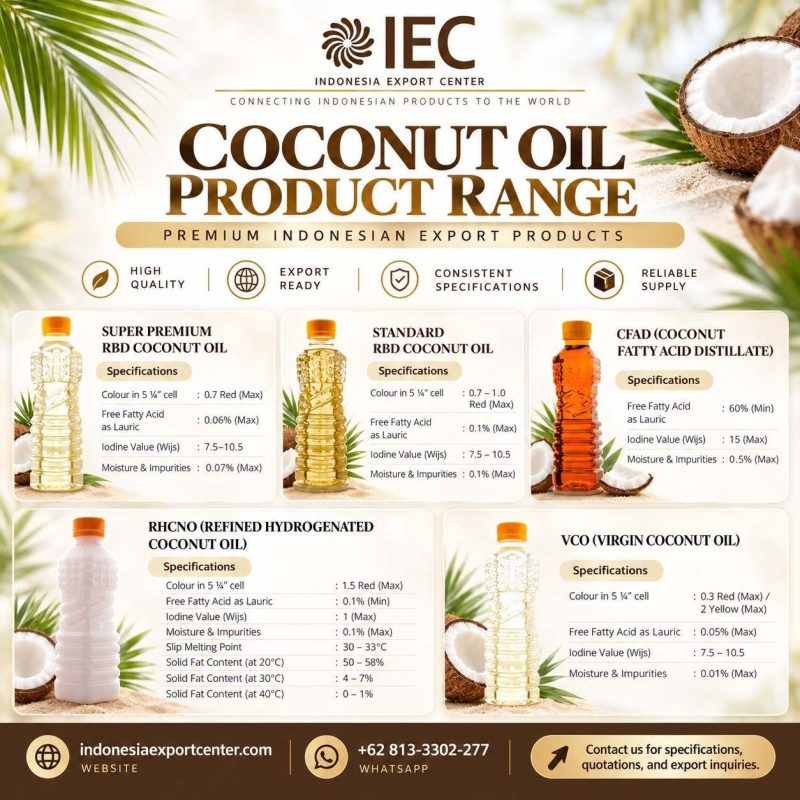
IEC | INDONESIA EXPORT CENTER
CONNECTING INDONESIAN PRODUCTS TO THE WORLD
COCONUT OIL PRODUCT RANGE
PREMIUM INDONESIAN EXPORT PRODUCTS
HIGH QUALITY | EXPORT-ORIENTED SOURCING | CONSISTENT SPECIFICATION TARGETS | INTERNATIONAL PROCUREMENT SUPPORT
Industrial RBD Coconut Oil RFQ Checklist for International Buyers
Purchasing industrial RBD coconut oil in bulk requires more than requesting a price per metric ton. Corporate procurement departments, manufacturing companies, international distributors, and industrial ingredient buyers need clear product specifications, shipment quantities, packaging requirements, destination details, and commercial conditions before comparing supplier quotations.
A properly prepared RBD Coconut Oil Request for Quotation (RFQ) helps buyers communicate purchasing requirements accurately, evaluate comparable offers, and reduce misunderstandings during international transactions.
Indonesia Export Center (IEC) supports international buyers by facilitating connections with Indonesian product suppliers and coordinating commercial inquiries for bulk coconut oil sourcing.
Whether your company requires Standard RBD Coconut Oil for industrial processing, manufacturing, food applications, or distribution, this procurement checklist provides a practical framework for preparing a complete quotation request.
Request RBD Coconut Oil Specifications and Quotations
Website: https://indonesiaexportcenter.com/
WhatsApp: https://wa.me/628133302277
1. What Is an Industrial RBD Coconut Oil RFQ?
An RFQ, or Request for Quotation, is a formal purchasing document used by procurement departments to obtain commercial offers from potential suppliers.
For industrial RBD coconut oil, an effective RFQ communicates the technical specifications, quantity, packaging, destination, shipment schedule, and transaction terms required by the buyer.
RBD stands for Refined, Bleached, and Deodorized, describing the refining process used to produce coconut oil with controlled quality characteristics suitable for various manufacturing applications.
Industrial buyers may use RBD coconut oil in:
- Food ingredient manufacturing
- Bakery and confectionery production
- Edible oil processing and blending
- Soap and detergent manufacturing
- Oleochemical processing
- Cosmetics and personal care manufacturing
- Industrial formulation and ingredient distribution
Suitability for a particular application depends on the purchased grade, technical specifications, regulatory requirements, and intended processing conditions.
A structured procurement checklist allows manufacturers and purchasing teams to identify technical and commercial requirements before entering supplier negotiations.
2. Industrial RBD Coconut Oil RFQ Checklist
Before contacting a potential supplier, procurement departments should prepare the following information.
| RFQ Component | Information Required |
|---|---|
| Product Name | Standard RBD Coconut Oil |
| Product Origin | Indonesia |
| Product Grade | Standard RBD or requested alternative |
| Technical Specifications | FFA, iodine value, colour, moisture and impurities |
| Intended Application | Food manufacturing, oleochemical, cosmetic, or other industrial use |
| Purchase Quantity | Required volume in metric tons |
| Order Frequency | One-time, monthly, quarterly, or annual |
| Packaging | Bulk, drums, IBC, or other available formats |
| Delivery Location | Destination port and country |
| Trade Terms | FOB, CFR, CIF, or another agreed Incoterm |
| Shipment Schedule | Required shipment date or delivery window |
| Documentation | COA, commercial documents, and destination-specific certificates |
| Inspection | Buyer-required sampling and independent inspection |
| Payment Terms | Proposed payment method and conditions |
| Company Information | Buyer name, country, and contact details |
| Quotation Validity | Requested validity period for the commercial offer |
Providing these details improves the likelihood of receiving a relevant quotation and helps avoid unnecessary revisions during the purchasing process.
3. Confirm Standard RBD Coconut Oil Technical Specifications
Product specifications are among the most important elements of an industrial coconut oil RFQ.
Different production facilities may require different maximum free fatty acid levels, moisture limits, colour characteristics, and iodine values.
IEC’s reference specifications for Standard RBD Coconut Oil are presented below.
Standard RBD Coconut Oil Specifications
| Specification | Value |
|---|---|
| Colour in 5¼” Cell | 0.7–1.0 Red (Max) |
| Free Fatty Acid as Lauric | 0.1% (Max) |
| Iodine Value (Wijs) | 7.5–10.5 |
| Moisture & Impurities | 0.1% (Max) |
| Product Origin | Indonesia |
| Product Type | Refined, Bleached and Deodorized Coconut Oil |
Important: These figures are reference product specifications. Buyers should request the applicable Technical Data Sheet (TDS) and batch-specific Certificate of Analysis (COA) to confirm the offered material against their purchasing requirements.
Why Technical Parameters Matter
Free Fatty Acid (FFA)
FFA is an important quality parameter that helps purchasing teams assess the acid content of the oil and its suitability for the intended manufacturing process.
Iodine Value
The iodine value indicates the degree of unsaturation in the oil and is a useful parameter for identifying and assessing coconut oil characteristics.
Colour
Colour specifications help ensure the supplied oil falls within the buyer’s desired appearance range.
Moisture and Impurities
Moisture and impurities are important quality control parameters, particularly for industrial storage, processing, and downstream product formulation.
Procurement teams should identify which specifications are mandatory and whether any technical tolerances are acceptable.
4. Specify Purchase Quantity and Monthly Volume Requirements
The requested purchasing volume is a key factor in preparing an industrial RBD coconut oil quotation.
Buyers should specify whether the procurement requirement is intended for a single shipment or a recurring supply arrangement.
Example Purchasing Requirements
| Procurement Type | Example RFQ Requirement |
|---|---|
| Trial Order | Subject to supplier MOQ |
| Initial Commercial Order | 20 MT, subject to confirmation |
| Monthly Supply | 100 MT per month |
| Quarterly Procurement | 300 MT per quarter |
| Annual Contract | 1,200 MT over 12 months |
| Custom Industrial Procurement | Volume according to buyer requirements |
The quantities above are illustrative RFQ examples and do not represent confirmed supplier minimum order quantities or available production capacity.
For recurring procurement, buyers should specify:
- Estimated monthly consumption
- Required minimum and maximum monthly shipment quantities
- Contract duration
- Forecasting and order release procedures
- Shipment scheduling flexibility
- Acceptable quantity tolerance
- Additional demand during peak production periods
Procurement Tip: State the preferred quantity unit clearly, normally metric tons (MT), and distinguish total contract volume from the quantity required per shipment.
5. Choose the Appropriate Packaging and Shipment Format
Packaging selection can influence handling costs, transport efficiency, contamination risk, and storage requirements.
Depending on supplier capability and product requirements, industrial RBD coconut oil may be considered for different bulk packing formats.
| Packaging Option | Typical Procurement Consideration |
|---|---|
| Bulk Tank or Tank Container | Larger industrial shipments and bulk unloading |
| Flexitank | Containerized bulk liquid transport where suitable and approved |
| Steel Drums | Smaller industrial batches and controlled handling |
| IBC Tanks | Intermediate bulk storage and handling |
| Customized Packaging | Subject to supplier capability and commercial agreement |
All packaging options, food-contact suitability where applicable, transport compatibility, and loading arrangements must be confirmed with the supplier.
The RFQ should also indicate whether the buyer requires:
- Food-grade packaging where applicable
- Tamper-evident seals
- Batch identification
- Product traceability
- Packaging weight information
- Palletized delivery
- Specific container loading procedures
- Temperature management when necessary
Because coconut oil can solidify under cooler conditions, bulk buyers should also clarify suitable handling, heating, unloading, and receiving arrangements.
6. Identify Destination Port and Delivery Terms
Accurate destination information is necessary for suppliers to prepare realistic export quotations.
International industrial buyers should include both the destination country and the specific receiving port.
Example Destination Ports
| Destination Market | Example Destination Port |
|---|---|
| United States | Los Angeles or New York |
| China | Shanghai or Ningbo |
| India | Nhava Sheva (JNPT) or Chennai |
| Malaysia | Port Klang |
| United Arab Emirates | Jebel Ali |
| Netherlands | Rotterdam |
| Japan | Yokohama or Kobe |
| South Korea | Busan |
| Australia | Melbourne or Sydney |
| Germany | Hamburg |
These destinations are examples for preparing RFQs, not statements of confirmed shipping routes or supplier service coverage.
Common International Trade Terms
FOB – Free On Board
The seller delivers the goods on board the vessel at the agreed Indonesian port. The buyer generally arranges main carriage and insurance.
CFR – Cost and Freight
The seller pays the cost and freight to the named destination port, while transit risk transfers according to the applicable Incoterms rule.
CIF – Cost, Insurance and Freight
The seller pays the cost, freight, and required insurance to the named destination port under the applicable Incoterms rule.
Buyers should specify the named port and use the current agreed edition of Incoterms, such as Incoterms 2020, in their RFQ.
For example:
Product: Standard RBD Coconut Oil
Quantity: 100 MT
Delivery Term: CIF Rotterdam, Incoterms 2020
Destination Country: Netherlands
Shipment Window: As mutually agreed
This information provides a practical starting point for obtaining quotations based on comparable logistics requirements.
7. Define Shipment Lead Time and Delivery Schedule
Industrial manufacturers frequently depend on predictable raw material arrivals to maintain production continuity.
For that reason, every RBD coconut oil RFQ should include the required delivery schedule.
Procurement teams should clarify:
- Expected first shipment date
- Estimated supplier preparation or production lead time
- Number of shipments per month
- Quantity per shipment
- Allowed shipment tolerance
- Partial shipment requirements
- Transshipment restrictions, if applicable
- Documentation submission deadlines
For long-term supply contracts, buyers should establish a clear forecast and shipment confirmation procedure.
Actual lead times depend on stock availability, supplier capacity, packaging preparation, shipping arrangements, and export documentation.
8. Request Product Documentation and Quality Assurance
Corporate procurement departments often require technical and commercial documents before approving a new supplier.
Documentation requirements should be included in the initial RFQ.
Recommended Document Checklist
| Document | Purpose |
|---|---|
| Technical Data Sheet (TDS) | Defines product specifications |
| Certificate of Analysis (COA) | Confirms tested quality parameters for the relevant batch |
| Commercial Invoice | Records transaction details |
| Packing List | Describes shipment quantities and packaging |
| Bill of Lading | Serves as the applicable ocean transport document |
| Certificate of Origin | Establishes declared origin where required |
| Safety Data Sheet (SDS), if applicable | Supports handling and hazard communication requirements |
| Inspection Certificate, if required | Documents agreed inspection results |
| Halal Certificate, if required | Supports buyer-specific religious certification requirements |
| Other Market-Specific Documents | Supports applicable destination-country import requirements |
Document availability, issuing authority, and required certification depend on the producing supplier, destination market, and transaction.
Independent Inspection
For selected transactions, buyers may request independent quality or quantity inspection through mutually approved inspection agencies.
Inspection arrangements may include:
- Pre-shipment sampling
- Quantity verification
- Packaging inspection
- Container condition checks
- Batch identification
- Laboratory testing
- Verification of contractual specifications
Inspection responsibility, cost allocation, sampling methods, and acceptance criteria should be agreed upon before shipment.
9. Include Payment Terms in the RFQ
Payment terms are an essential part of international procurement negotiations.
Buyers should indicate the proposed payment structure and request confirmation of acceptable arrangements.
Potential payment methods include:
- Telegraphic Transfer (T/T)
- Documentary Letter of Credit (L/C)
- Other mutually negotiated payment arrangements
The final payment method depends on the transaction value, counterparty evaluation, banking requirements, and commercial agreement.
Where documentary credits are used, buyers and sellers should confirm that the required documents, presentation deadlines, and payment conditions are feasible.
IEC encourages buyers to confirm supplier credentials, beneficiary banking details, and contractual responsibilities before transferring funds.
10. Additional Technical Requirements for Corporate Procurement
Larger manufacturers may require technical information beyond the basic RBD coconut oil specifications.
Depending on their application, procurement and quality assurance teams may request:
Identity and composition
- Fatty acid composition
- Product identification and origin
- Additional physicochemical properties
Food-related quality requirements
- Peroxide value
- Relevant food safety documentation
- Applicable contaminant testing
- Allergen statements where required
- Traceability and manufacturing information
Industrial processing requirements
- Melting and solidification behavior
- Handling and storage conditions
- Batch consistency
- Compatibility with downstream processing
Supplier qualification
- Company registration information
- Relevant manufacturing certifications
- Quality management arrangements
- Production and supply capability
- Export transaction experience
- Complaint and corrective action procedures
Not every parameter or document is routinely available for every grade. Requirements should be identified before quotation, and compliance should be verified with the actual supplying facility.
11. Standard vs. Super Premium RBD Coconut Oil
Some procurement teams may need tighter technical limits than those offered under Standard RBD Coconut Oil.
IEC can facilitate inquiries concerning different coconut oil grades, subject to supplier availability.
Product Specification Comparison
| Specification | Standard RBD Coconut Oil | Super Premium RBD Coconut Oil |
|---|---|---|
| Colour in 5¼” Cell | 0.7–1.0 Red (Max) | 0.7 Red (Max) |
| Free Fatty Acid as Lauric | 0.1% (Max) | 0.06% (Max) |
| Iodine Value (Wijs) | 7.5–10.5 | 7.5–10.5 |
| Moisture & Impurities | 0.1% (Max) | 0.07% (Max) |
The Super Premium grade has tighter listed limits for certain quality parameters.
The appropriate selection depends on the buyer’s end-use requirements, technical tolerances, purchasing budget, and qualified supplier offerings.
Request a comparison quotation when evaluating multiple grades for industrial procurement.
12. Other Coconut Oil Products Available for Sourcing Inquiries
Indonesia Export Center also facilitates commercial inquiries for other coconut-derived oil products.
CFAD – Coconut Fatty Acid Distillate
| Specification | Value |
|---|---|
| Free Fatty Acid as Lauric | 60% (Min) |
| Iodine Value (Wijs) | 15 (Max) |
| Moisture & Impurities | 0.5% (Max) |
CFAD may be considered by industrial buyers sourcing fatty acid-rich feedstocks for suitable oleochemical and downstream applications.
RHCNO – Refined Hydrogenated Coconut Oil
| Specification | Value |
|---|---|
| Colour in 5¼” Cell | 1.5 Red (Max) |
| Free Fatty Acid as Lauric | 0.1% (Min) – subject to supplier verification |
| Iodine Value (Wijs) | 1 (Max) |
| Moisture & Impurities | 0.1% (Max) |
| Slip Melting Point | 30–33°C |
| Solid Fat Content at 20°C | 50–58% |
| Solid Fat Content at 30°C | 4–7% |
| Solid Fat Content at 40°C | 0–1% |
RHCNO may be evaluated for specialized food fat, personal care, and industrial formulation applications depending on the final product specification.
Technical note: The supplied RHCNO FFA figure is expressed as a minimum. This should be verified against the supplier’s current Technical Data Sheet before use as a contractual acceptance criterion.
VCO – Virgin Coconut Oil
| Specification | Value |
|---|---|
| Colour in 5¼” Cell | 0.3 Red (Max) / 2 Yellow (Max) |
| Free Fatty Acid as Lauric | 0.05% (Max) |
| Iodine Value (Wijs) | 7.5–10.5 |
| Moisture & Impurities | 0.01% (Max) |
Virgin Coconut Oil is processed differently from RBD coconut oil and may be considered for selected food, cosmetic, and specialty ingredient applications.
Each product has distinct characteristics and should be evaluated against the intended manufacturing process.
13. Sample Industrial RBD Coconut Oil RFQ Template
International procurement officers can use the following sample when contacting Indonesia Export Center.
REQUEST FOR QUOTATION – STANDARD RBD COCONUT OIL
Buyer Information
Company Name: [Company Name]
Country: [Country]
Contact Person: [Full Name]
Email / WhatsApp: [Contact Details]
Product Requirements
Product: Standard RBD Coconut Oil
Origin: Indonesia
Required Grade: [Standard / Super Premium]
Application: [Food / Oleochemical / Cosmetics / Industrial]
Required FFA: [Maximum %]
Required Iodine Value: [Range]
Required Colour: [Maximum]
Required Moisture & Impurities: [Maximum %]
Other Technical Requirements: [Details]
Purchasing Requirements
Trial Order Quantity: [MT]
Regular Order Quantity: [MT]
Monthly Consumption: [MT]
Contract Duration: [Months]
Quantity Tolerance: [Percentage]
Packaging and Delivery
Preferred Packaging: [Bulk / Drum / IBC / Other]
Destination Port: [Port Name]
Destination Country: [Country]
Required Incoterm: [FOB / CFR / CIF / Other]
Expected First Shipment: [Date]
Shipment Frequency: [Monthly / Quarterly / One-Time]
Quality and Documentation
COA Required: [Yes / No]
TDS Required: [Yes / No]
Inspection Required: [Yes / No]
Additional Certificates: [Details]
Commercial Requirements
Target Price, if applicable: [Currency / MT]
Preferred Payment Terms: [Details]
Quotation Currency: [USD / Other]
Requested Quotation Validity: [Number of Days]
Additional Notes: [Details]
Please provide your commercial quotation, available product specifications, packaging options, minimum order quantity, estimated lead time, and proposed payment terms.
Send your RFQ to Indonesia Export Center:
WhatsApp: +62 813-3302-277
14. How Indonesia Export Center Supports Industrial Coconut Oil Procurement
Indonesia Export Center operates as a B2B sourcing and business connection platform, helping international buyers identify suitable Indonesian product suppliers and coordinate procurement inquiries.
Our role focuses on facilitating communication between qualified buyers and potential supply partners.
Our Procurement Facilitation Process
Step 1 – Submit Your RFQ
Provide product specifications, quantity, packaging, destination port, and preferred commercial terms.
Step 2 – Supplier Matching
IEC reviews the inquiry and seeks suitable supplier options based on the requested requirements.
Step 3 – Technical Clarification
The buyer and potential supplier clarify product grade, quality parameters, required documents, and intended applications.
Step 4 – Commercial Quotation
Subject to supplier confirmation, a commercial offer can be arranged covering pricing, quantity, shipment conditions, and payment arrangements.
Step 5 – Buyer Due Diligence
The buyer reviews supplier credentials, product documentation, contractual responsibilities, and applicable import requirements.
Step 6 – Transaction Coordination
The contracting parties agree on their commercial arrangements, while IEC may assist with communication and coordination according to its agreed role.
Supplier selection, production commitments, export responsibilities, and contractual obligations are subject to the final agreement between the relevant parties.
15. Why Source Industrial RBD Coconut Oil from Indonesia?
Indonesia is a major coconut-producing country with established coconut processing activities and commercial opportunities across various coconut-derived products.
International buyers seeking industrial RBD coconut oil from Indonesia may benefit from evaluating:
- Coconut-based ingredient supply opportunities
- Standard and specialty coconut oil grades
- Potential bulk procurement arrangements
- Flexible inquiry structures for different industrial applications
- Access to Indonesian manufacturing and trading networks
- Opportunities for repeat purchasing relationships
However, export availability, pricing, certification status, and production capacity must be verified for each supplier and transaction.
Indonesia Export Center supports the supplier discovery and quotation coordination process for international buyers interested in Indonesian coconut oil products.
16. Frequently Asked Questions – Industrial RBD Coconut Oil RFQ
What information should I include in an RBD coconut oil RFQ?
A complete RFQ should include the product grade, technical specifications, purchase quantity, packaging type, destination port, delivery term, shipment schedule, required documents, and proposed payment conditions.
What is the standard FFA specification for RBD coconut oil?
The IEC reference specification for Standard RBD Coconut Oil lists Free Fatty Acid as Lauric at a maximum of 0.1%. Actual acceptance specifications should be confirmed against the selected supplier’s TDS and COA.
Can I request a quotation for monthly RBD coconut oil shipments?
Yes. Buyers can submit inquiries for monthly or recurring procurement. Supplier capacity, available quantity, minimum orders, delivery frequency, and contract terms require confirmation.
What is the minimum order quantity for bulk RBD coconut oil?
The minimum order quantity varies according to supplier, packaging configuration, production availability, and shipment requirements. Buyers should specify their intended purchase quantity when requesting an offer.
Can I request CIF pricing for RBD coconut oil?
Yes. Buyers can request CIF quotations by specifying the named destination port, shipment quantity, packaging type, and other relevant transaction details. Supplier acceptance and shipping terms must be confirmed.
Is a Certificate of Analysis available for RBD coconut oil?
Buyers can request a COA as part of supplier qualification. The availability and scope of testing should be confirmed with the actual supplier.
Can industrial buyers request different coconut oil grades?
Yes. IEC can facilitate inquiries for Standard RBD Coconut Oil, Super Premium RBD Coconut Oil, CFAD, RHCNO, and Virgin Coconut Oil, subject to the respective supplier’s product portfolio and availability.
Does Indonesia Export Center manufacture RBD coconut oil?
Indonesia Export Center operates as a B2B sourcing and business facilitation platform. IEC connects international buyers with potential Indonesian suppliers rather than representing itself as the direct manufacturer of the products.
What payment methods are commonly considered for international coconut oil procurement?
International commercial transactions may use T/T, documentary L/C, or other agreed payment arrangements. The final structure depends on the supplier, buyer, transaction value, and banking conditions.
How can I submit an industrial RBD coconut oil RFQ?
You can contact Indonesia Export Center through its website or WhatsApp and provide the purchasing requirements outlined in this checklist.
17. Request an Industrial RBD Coconut Oil Quotation from Indonesia
Looking for a reliable sourcing channel for industrial RBD coconut oil from Indonesia?
Prepare your procurement requirements using this RFQ checklist and contact Indonesia Export Center to discuss suitable supplier options.
Our B2B sourcing coordination can assist corporate procurement teams, manufacturers, ingredient distributors, and international importers with the initial stages of Indonesian coconut oil supplier inquiries.
For faster quotation assessment, please include:
- Required product grade and specifications
- Purchasing quantity in metric tons
- Packaging requirements
- Destination port and country
- Preferred Incoterm
- Required shipment schedule
- Preferred payment terms
- Required certificates or inspection conditions
Contact Indonesia Export Center
IEC | INDONESIA EXPORT CENTER
CONNECTING INDONESIAN PRODUCTS TO THE WORLD
Website: https://indonesiaexportcenter.com/
WhatsApp: +62 813-3302-277
Direct WhatsApp Inquiry: https://wa.me/628133302277
Contact us for specifications, quotations, supplier coordination, and export-related procurement inquiries.
All product specifications are reference information and should be confirmed through current supplier documentation. Product availability, pricing, minimum order quantities, logistics arrangements, and commercial conditions are subject to supplier confirmation and mutual agreement.
INDONESIA EXPORT CENTER – CONNECTING INTERNATIONAL BUYERS WITH INDONESIAN PRODUCT SOURCING OPPORTUNITIES.
