

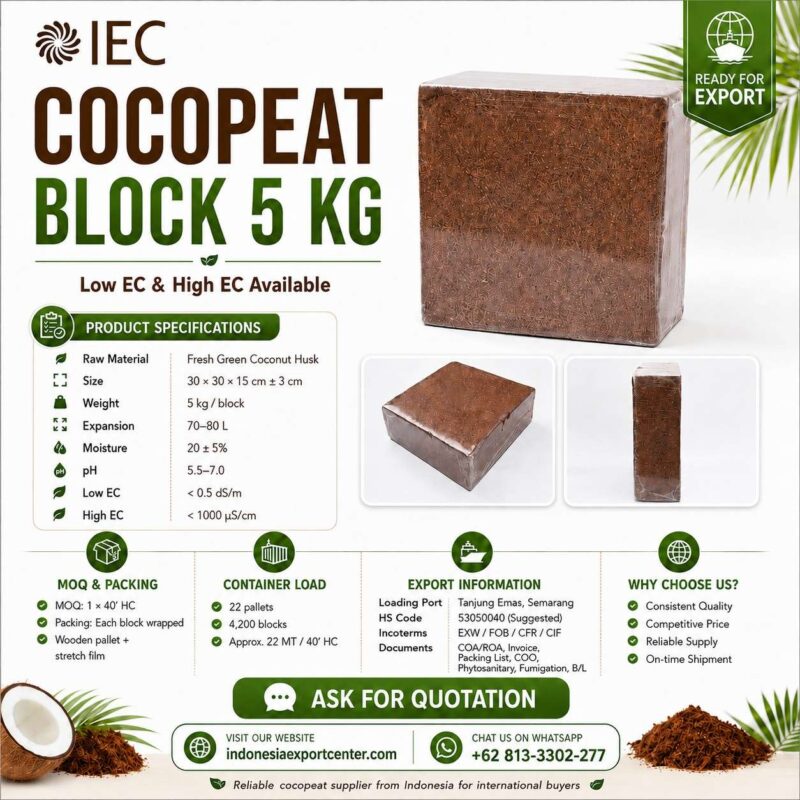
Indonesian Cocopeat Supply for Australian Nurseries and Growing Media Businesses
Looking for a reliable cocopeat supplier in Australia for your nursery or horticultural business? Indonesia Export Center (IEC) helps connect international buyers with Indonesian suppliers of cocopeat, also known as coco coir pith, for commercial growing media and horticultural applications.
Made from processed coconut husks, cocopeat is used in growing media for nurseries, propagation, potting mixes, and other plant-growing applications. It can also be considered as a component of growing media formulations developed to reduce or replace peat, depending on the requirements of the final product.
IEC facilitates sourcing inquiries for Australian nursery suppliers, horticultural distributors, growing media manufacturers, and commercial buyers interested in Indonesian cocopeat.
Looking to source cocopeat from Indonesia for Australia? Contact IEC to discuss your product specifications, order volume, and supply requirements.
Why Consider Indonesian Cocopeat?
For Australian horticultural businesses, choosing a growing media ingredient involves evaluating product consistency, suitability for the intended application, and reliable supply arrangements.
Indonesian cocopeat may be worth considering for businesses looking to diversify their sourcing options. The suitability of a particular product depends on its processing method, grade, quality parameters, and the requirements of the buyer.
Potential sourcing considerations include:
- Horticultural applications: Cocopeat may be suitable for nursery production, propagation, potting mixes, and selected growing media formulations.
- Different product grades: Buyers can inquire about available grades based on texture, particle size, and intended use.
- Compressed product formats: Compressed cocopeat may help reduce shipping and storage volume compared with loose material.
- Specification-based purchasing: Buyers can communicate target moisture content, pH, electrical conductivity (EC), fibre content, and other technical requirements.
- Supplier sourcing support: IEC facilitates connections with Indonesian suppliers so buyers can discuss product availability and commercial requirements.
Product options, quality specifications, supply capacity, and shipment arrangements are subject to confirmation by the relevant supplier.
Cocopeat Products for Australian Nursery Suppliers
Different nursery operations require different growing media characteristics. When sourcing cocopeat, Australian buyers should identify the product format and quality parameters that best match their production systems.
1. Cocopeat for Nursery Growing Media
Nurseries may use cocopeat as a component of growing media for container-grown plants and other horticultural applications. The appropriate grade depends on plant requirements, container size, irrigation practices, drainage needs, and the other ingredients in the growing mix.
2. Cocopeat for Seedling and Propagation Media
Propagation businesses may require finer and more uniform material for seed sowing, plug production, and young plant establishment. Buyers should evaluate particle size, moisture behaviour, EC, pH, and consistency before selecting a product.
3. Cocopeat for Potting Mix Manufacturers
Commercial potting mix producers may need defined physical characteristics to maintain consistency between production batches. Requirements may include a specific particle-size distribution, fibre content, moisture range, and compatibility with other substrate ingredients.
4. Compressed Cocopeat Blocks and Bricks
Compressed cocopeat blocks or bricks may be an option for buyers prioritising compact storage and shipping. Before ordering, confirm the available product dimensions, net weight, packaging, rehydration instructions, and expansion characteristics with the supplier.
5. Loose Cocopeat for Bulk Processing
Manufacturers that process or blend growing media may wish to inquire about loose cocopeat for further processing. Availability, transport suitability, loading arrangements, and minimum order quantities must be confirmed for each supply offer.
Cocopeat Specifications to Confirm Before Ordering
Australian nursery suppliers should establish their product specifications before requesting a quotation. This helps the supplier assess whether the material can meet the buyer’s intended use and quality requirements.
| Specification | What buyers should confirm |
|---|---|
| Product type | Cocopeat, coir pith, or a defined coco coir blend |
| Grade | Fine, medium, coarse, or custom grade |
| Particle size | Required particle-size distribution or sieve range |
| Fibre content | Target or maximum acceptable fibre content |
| Moisture content | Required moisture range at dispatch |
| pH | Acceptable pH range and test method |
| Electrical conductivity (EC) | Target EC and agreed measurement method |
| Washing status | Whether washed material is required |
| Buffering | Whether buffered cocopeat is required |
| Product format | Loose material, compressed blocks, bricks, or bales |
| Packaging | Required bag, bale, or bulk packaging format |
| Order quantity | Required volume or weight per order |
| Quality documentation | Available product specification, test reports, and supporting documents |
The values required for these parameters depend on the buyer’s application. IEC does not represent any particular EC, pH, moisture level, expansion ratio, certification, or product grade as guaranteed without supplier confirmation.
Importing Cocopeat into Australia
Australia has specific biosecurity requirements for imported goods, including coir peat used as a horticultural growing medium. Before placing an order, importers should check the current requirements for their exact product, intended use, processing status, and country of origin.
The Australian Department of Agriculture, Fisheries and Forestry provides the Biosecurity Import Conditions system (BICON), which buyers can use to check whether a commodity is permitted and what import conditions, supporting documents, treatments, or permits may apply.
Official resources:
- BICON import conditions: https://bicon.agriculture.gov.au/
- Australian Government guidance before importing goods: https://www.agriculture.gov.au/biosecurity-trade/import/before
Before shipment, Australian buyers should:
- Check the applicable BICON case for coir peat or cocopeat.
- Confirm any applicable phytosanitary, inspection, testing, or other documentation requirements.
- Verify whether the product’s additives, processing, or formulation change its import conditions.
- Confirm that the consignment and its packaging meet the applicable biosecurity requirements.
- Coordinate with the supplier to prepare the required documentation before dispatch.
Import conditions can change and may differ between product categories. Do not assume that all cocopeat products follow the same import pathway. The Australian importer should verify the current conditions for the exact product before committing to shipment.
Who Can Source Cocopeat Through IEC?
IEC welcomes inquiries from Australian businesses involved in horticulture and growing media, including:
- Nursery suppliers and wholesale nursery businesses.
- Commercial plant nurseries.
- Growing media and potting mix manufacturers.
- Horticultural product importers and distributors.
- Seedling and propagation businesses.
- Greenhouse supply companies.
- Bulk growing media processors and blenders.
Whether you need cocopeat for nursery production, propagation, or manufacturing, sharing your technical requirements and purchasing plans helps establish whether an available supply option may suit your business.
How to Source Cocopeat from Indonesia
Step 1: Send Your Product Requirements
Contact IEC with your intended application, preferred cocopeat grade, required specifications, packaging preferences, estimated quantity, and delivery destination in Australia.
Step 2: Review Available Supply Options
IEC facilitates connections with Indonesian suppliers. The relevant supplier must confirm product availability, production capability, specifications, and supporting documentation.
Step 3: Request a Quotation
Discuss pricing, minimum order quantity, packaging, payment conditions, shipping arrangements, and applicable trade terms directly with the supplier.
Step 4: Verify Australian Import Conditions
Check the applicable BICON requirements for the specific product before finalising the order. Confirm the necessary documents and any applicable treatments or inspection requirements.
Step 5: Confirm the Shipment
Once product specifications, commercial terms, import conditions, and shipment documentation have been agreed upon, the buyer and supplier can proceed with order confirmation.
Frequently Asked Questions
Where can Australian businesses find an Indonesian cocopeat supplier?
Australian businesses can contact Indonesia Export Center to initiate a sourcing inquiry and explore connections with Indonesian cocopeat suppliers. The availability and suitability of specific products must be confirmed with the relevant supplier.
Is Indonesian cocopeat suitable for Australian nurseries?
Cocopeat may be suitable for nursery and propagation growing media, depending on the product’s physical and chemical characteristics and the needs of the plants being grown. Buyers should evaluate the material against their application requirements before purchasing.
What cocopeat formats can I request?
You can inquire about loose cocopeat, compressed blocks, bricks, bales, and other available formats. The actual range depends on the supplier’s product offering and production capabilities.
Can I request specific EC and pH levels?
Yes. Provide your target EC and pH values and specify the testing method you require. The supplier must confirm whether those parameters can be met and whether supporting test results are available.
Can cocopeat be imported into Australia?
Coir peat is covered by Australian biosecurity import conditions. Importers should check the current BICON requirements for their specific product, intended use, and circumstances before arranging shipment.
What documents are needed to import cocopeat into Australia?
The documents required depend on the applicable import conditions and the product’s characteristics. Check the relevant BICON case to establish the current requirements for certificates, declarations, testing, permits, or other supporting documentation.
What is the minimum order quantity?
Minimum order quantities vary by supplier, product format, packaging, and shipment arrangements. Contact IEC with your target quantity to discuss potential sourcing options.
Does IEC manufacture cocopeat directly?
IEC facilitates connections between international buyers and Indonesian suppliers. Product manufacturing, availability, technical specifications, documentation, pricing, and final commercial arrangements are subject to confirmation by the relevant supplier.
Contact Indonesia Export Center for Cocopeat Supply to Australia
If you are looking for a cocopeat supplier for Australia, contact Indonesia Export Center to discuss your requirements and explore potential sourcing connections with Indonesian suppliers.
To help with your inquiry, please include:
- Your required cocopeat grade and intended application.
- Target particle size, EC, pH, moisture content, and other specifications.
- Preferred product format and packaging.
- Estimated order quantity.
- Australian delivery destination.
- Any specific import documentation or quality requirements.
Indonesia Export Center (IEC)
Website: https://indonesiaexportcenter.com/
WhatsApp: +62 813-3302-277
Direct WhatsApp inquiry: https://wa.me/628133302277
Indonesia Export Center — Connecting Global Buyers with Indonesian Suppliers.
Product availability, specifications, documentation, minimum order quantities, pricing, and commercial terms are subject to supplier confirmation.
