

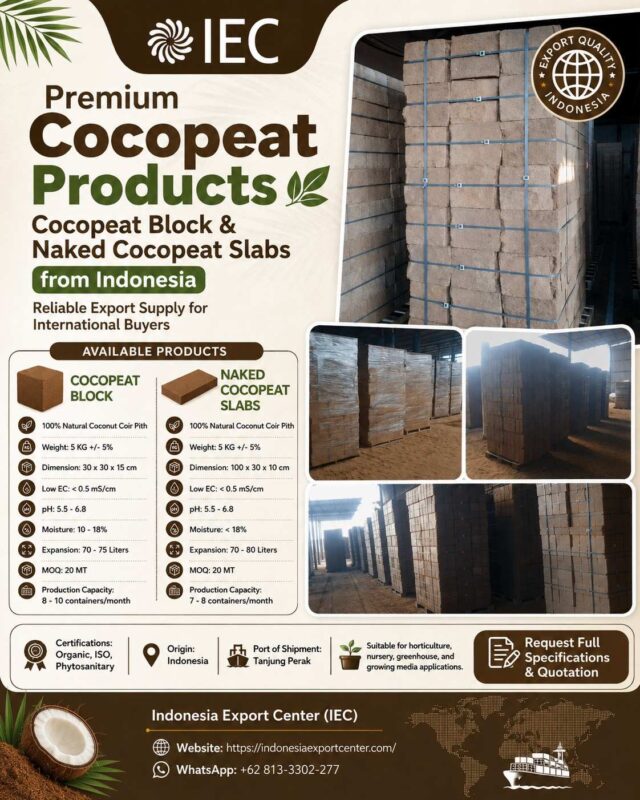
Indonesian Cocopeat and Coco Chips Mix for Growing Media Manufacturers
Indonesia Export Center (IEC) facilitates connections between international buyers and Indonesian suppliers of cocopeat and coco chips mix for commercial growing media applications. This blended coconut-based material combines the water-retention properties of cocopeat with the coarser structure of coco chips, making it a potential component for customized horticultural substrates.
For substrate blenders, growing media manufacturers, and horticultural supply businesses, selecting the right cocopeat and coco chips blend is an important step in developing products for different cultivation systems. The appropriate mixture depends on the required balance of moisture retention, aeration, drainage, particle size, and growing conditions.
Contact Indonesia Export Center to discuss your sourcing requirements and explore suitable supply options from Indonesia.
Why Choose a Cocopeat and Coco Chips Mix?
Cocopeat and coco chips serve complementary functions in growing media formulations. Their combination can help substrate manufacturers develop blends tailored to particular crops, containers, and cultivation methods.
1. Balanced Moisture Retention and Aeration
Cocopeat can retain moisture around plant roots, while the larger particles of coco chips can help create air spaces within a growing medium. The overall performance depends on the blend ratio, particle characteristics, and preparation process.
2. Flexible Blend Formulations
Different applications may require different proportions of fine cocopeat and coarse coco chips. Substrate blenders can specify their preferred blend ratio and particle distribution to support their own product formulations.
3. Suitable for Commercial Growing Media Production
Cocopeat and coco chips mix can be considered for growing media products intended for nurseries, greenhouse cultivation, container planting, and other horticultural applications, subject to the blend’s tested characteristics and suitability for the intended use.
4. Coconut-Based Growing Media Component
Cocopeat and coco chips are derived from coconut husk processing. They can be used as components in growing media formulations, either on their own in suitable applications or alongside other substrate ingredients.
Product Overview and Specifications
The exact specifications of cocopeat and coco chips mix should be confirmed with the supplier before an order is placed. Buyers can provide their target parameters to help identify a suitable product.
| Specification | Details |
|---|---|
| Product | Cocopeat and Coco Chips Mix |
| Product origin | Indonesia, subject to supplier confirmation |
| Composition | Cocopeat blended with coconut husk chips |
| Blend ratio | To be confirmed based on buyer requirements |
| Particle size | To be specified and confirmed with the supplier |
| Moisture content | To be confirmed |
| Electrical conductivity (EC) | To be tested and confirmed |
| pH level | To be tested and confirmed |
| Washing or buffering | Availability to be confirmed |
| Packaging | Options to be confirmed with the supplier |
| Order quantity | Subject to supplier availability and confirmation |
| Shipping and trade terms | To be agreed with the supplier |
Buyers should confirm whether the product is supplied loose, in compressed form, or in another packaging format. The final specification should be agreed upon before commercial production or shipment.
Applications of Cocopeat Coco Chips Mix
Commercial Substrate Blending
Growing media manufacturers can evaluate the mix as a base ingredient for customized substrate formulations. The blend ratio and particle characteristics should be selected according to the intended product performance.
Greenhouse and Hydroponic Growing Media
Depending on its physical and chemical properties, a cocopeat and coco chips blend may be suitable for selected greenhouse or soilless cultivation systems. Buyers should verify drainage, aeration, EC, pH, and moisture characteristics before use.
Nursery and Seedling Media
The blend may be considered for nursery applications where a combination of water retention and pore space is required. The suitable chip size and cocopeat proportion depend on the crop, container size, and irrigation method.
Container Gardening and Horticultural Products
Growing media producers may also evaluate the mix for container plants and other horticultural products. Suitability should be assessed through sample testing and, where necessary, cultivation trials.
What Substrate Blenders Should Check Before Ordering
Before sourcing a cocopeat and coco chips mix, commercial buyers should evaluate several key parameters.
- Blend ratio: Confirm the proportion of cocopeat to coco chips and whether a custom ratio is available.
- Particle size distribution: Check the proportion of fine, medium, and coarse particles against the requirements of the final growing media.
- Moisture content: Confirm the condition of the product upon packing and shipment.
- EC and pH: Request available test results and determine whether the material meets the intended growing media requirements.
- Washing and buffering: Confirm whether the product has been washed or buffered and request supporting information when relevant.
- Fiber and foreign material: Establish acceptable limits for long fibers, dust, and unwanted materials.
- Packaging and logistics: Discuss packaging format, shipment volume, destination, and trade terms.
- Quality documentation: Request available product specifications, test reports, and other relevant documents before confirming the order.
These checks help buyers compare offers and determine whether the product is suitable for their blending process.
Source Cocopeat Coco Chips Mix from Indonesia
Indonesia Export Center connects international buyers with Indonesian suppliers for product sourcing discussions and commercial inquiries. Buyers can share their technical requirements to help clarify the appropriate product configuration.
How the Sourcing Process Works
Step 1: Submit your requirements
Provide your required blend ratio, particle size, target EC and pH, moisture limits, packaging preference, and estimated order quantity.
Step 2: Review product suitability
Discuss the requested parameters and ask the supplier to confirm which specifications can be met. Samples or test reports may be requested where available.
Step 3: Confirm commercial details
Review the quotation, packaging, order quantity, lead time, documentation, payment terms, and shipping arrangements directly with the supplier.
Step 4: Finalize the order
Proceed once the product specifications and commercial conditions have been agreed upon by the relevant parties.
Product availability, technical specifications, minimum order quantity, documentation, and commercial terms are subject to supplier confirmation.
Frequently Asked Questions
What is a cocopeat and coco chips mix?
It is a growing media component made by blending fine coconut coir pith, commonly called cocopeat, with larger pieces of coconut husk known as coco chips. The proportions can affect the blend’s moisture retention, aeration, and drainage characteristics.
What is the recommended cocopeat to coco chips ratio?
There is no single ratio suitable for every application. The preferred proportion depends on crop requirements, container dimensions, irrigation practices, and the desired physical properties of the final substrate. Buyers should specify their target ratio and confirm availability with the supplier.
Can I request a specific particle size?
Buyers can communicate their target particle sizes and distribution when making an inquiry. Whether a supplier can meet those requirements must be confirmed before ordering.
Is the mix washed or buffered?
Washing and buffering availability depends on the specific product and supplier. Buyers should request confirmation of the processing method and any relevant test results.
Can international buyers source this product through IEC?
Indonesia Export Center facilitates connections between international buyers and Indonesian suppliers. Buyers can submit their requirements through IEC to discuss potential sourcing options.
What information should I provide for a quotation?
Include your preferred blend ratio, particle size, EC and pH requirements, moisture limits, packaging format, estimated quantity, destination country, and preferred shipping terms. These details help clarify the product and commercial requirements for supplier review.
Request a Cocopeat Coco Chips Mix Supply Inquiry
Looking for a cocopeat coco chips mix supplier in Indonesia for your growing media production business?
Contact Indonesia Export Center to share your technical specifications, target blend ratio, packaging requirements, and estimated order volume. IEC can facilitate sourcing discussions with Indonesian suppliers, with final product details and commercial conditions confirmed by the relevant supplier.
Indonesia Export Center (IEC)
Website: https://indonesiaexportcenter.com/
WhatsApp: +62 813-3302-277
Direct inquiry: https://wa.me/628133302277
Indonesia Export Center — Connecting Global Buyers with Indonesian Suppliers.
