

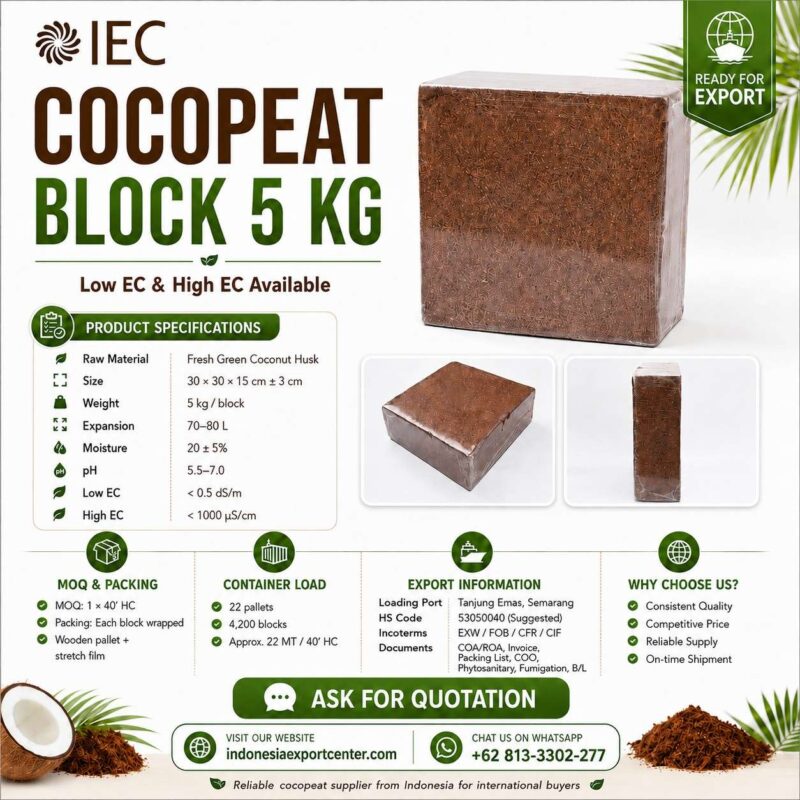
Looking for a reliable coir pith supplier in Indonesia for your growing media manufacturing business? Indonesia Export Center (IEC) connects international buyers with Indonesian suppliers to facilitate sourcing inquiries for coir pith and other Indonesian products.
Coir pith, also known as coco peat or cocopeat, is a coconut-derived material obtained from coconut husks during coir fiber processing. It is widely used in horticulture, nursery production, greenhouse cultivation, hydroponics, and the manufacture of growing media blends.
For growing media manufacturers, sourcing suitable coir pith involves evaluating product consistency, moisture content, particle size, electrical conductivity (EC), pH, and other parameters relevant to the final product.
Indonesia Export Center welcomes inquiries from international manufacturers, importers, distributors, and commercial buyers seeking Indonesian coir pith for industrial and horticultural applications.
Source Coir Pith from Indonesia
Indonesia is a coconut-producing country, creating opportunities for businesses interested in sourcing coconut-based materials. International buyers can explore potential coir pith sourcing opportunities through Indonesia Export Center, subject to supplier availability and confirmation.
For manufacturers, the suitability of coir pith depends on the intended application, processing requirements, and quality specifications of the finished growing medium.
Whether you produce horticultural substrates, nursery growing media, hydroponic products, or customized soil-free growing blends, communicating your technical requirements is an important step in evaluating potential suppliers.
Coir Pith Products for Growing Media Manufacturers
Depending on supplier capabilities, buyers may inquire about different coir pith formats for processing, blending, and distribution.
1. Raw Coir Pith
Raw coir pith is the fine, spongy material separated from coconut husks during coir fiber extraction. It may serve as a raw material for manufacturers producing growing media and related horticultural products.
Buyers should confirm the material’s particle-size distribution, fiber content, moisture level, and processing condition.
2. Screened Coir Pith
Screened coir pith is processed to separate material according to particle size or other physical characteristics.
For manufacturers with specific formulation requirements, screening specifications and consistency between shipments should be discussed with the supplier.
3. Compressed Coir Pith Blocks
Compressed coir pith blocks are compacted products designed to reduce storage and transportation volume. Depending on their characteristics, they may be suitable for manufacturers requiring coir pith for rehydration, processing, or blending.
Relevant specifications may include block dimensions, net weight, compression, moisture content, and expansion ratio.
4. Coir Pith for Growing Media Blends
Coir pith can be incorporated into growing media formulations for nurseries, greenhouse cultivation, hydroponics, and other horticultural applications.
Manufacturers should establish target specifications based on the requirements of their finished products and intended customers.
Product formats, processing options, and availability must be confirmed with the relevant supplier.
Technical Specifications for Coir Pith
For growing media manufacturers, technical specifications help determine whether a material is appropriate for a particular formulation or production process.
The following parameters may be relevant when evaluating Indonesian coir pith.
| Specification | Details to Confirm |
|---|---|
| Product type | Raw coir pith, screened coir pith, or compressed material |
| Particle size | Required grading and particle-size distribution |
| Moisture content | Target moisture percentage |
| pH level | Acceptable pH range |
| Electrical conductivity (EC) | Target EC and measurement method |
| Fiber content | Required fiber proportion, where applicable |
| Compression | Block dimensions, density, and compression characteristics |
| Expansion ratio | Expected expansion after hydration, where applicable |
| Processing condition | Screened, washed, buffered, or untreated, as required |
| Packaging | Bag type, net weight, and bulk packaging options |
| Quality documentation | Available laboratory reports and supporting records |
Not every parameter applies to every product. For example, washed or buffered coir pith should only be requested when the intended application requires those treatments and the supplier can provide them.
Buyers should also confirm how EC and pH are measured because results can vary with the testing method and sample preparation.
Applications in Growing Media Manufacturing
Coir pith is used in various horticultural and agricultural applications, depending on its physical and chemical properties.
Growing Media Production
Manufacturers may incorporate coir pith into formulated substrates designed for specific crops, cultivation systems, or customer requirements.
Nursery Substrates
Coir pith can be used in growing media for seedlings, propagation, and nursery production.
Greenhouse Cultivation
Manufacturers may supply coir-based substrates for greenhouse growers, subject to the crop’s requirements and the product’s technical characteristics.
Hydroponic Growing Media
Coir pith may form part of growing media products used in hydroponic and other soil-free cultivation systems.
Horticultural Product Distribution
Processors and distributors may source coir pith as an input for finished growing media products or for resale to horticultural businesses.
The suitability of a particular coir pith product depends on its verified specifications and the requirements of the intended application.
Why Growing Media Manufacturers Need Consistent Specifications
When sourcing coir pith for manufacturing, consistency between shipments can be important for maintaining product quality and production efficiency.
Before establishing a supply arrangement, buyers should consider:
- Particle-size consistency: Confirm the required grading and acceptable variation between batches.
- Moisture control: Establish moisture specifications relevant to storage, processing, and transportation.
- pH and EC requirements: Specify acceptable ranges and the testing methods used to verify them.
- Fiber and material composition: Identify the physical characteristics needed for the intended formulation.
- Processing requirements: Confirm whether the material needs washing, buffering, screening, or another treatment.
- Batch documentation: Ask whether product test reports or other quality records are available.
- Supply capacity: Verify production capacity, order quantities, and the ability to support planned purchasing schedules.
These requirements should be agreed with the supplier before a commercial order is finalized.
Bulk Packaging and Export Arrangements
International manufacturers should assess packaging and shipping arrangements alongside product specifications.
Depending on the supplier and product format, buyers may inquire about:
- Bags or other packaging formats suitable for the intended material.
- Compressed block dimensions and net weights.
- Bulk shipment and container-loading arrangements.
- Available production and shipment lead times.
- Export documentation and supporting quality reports.
- Shipping options and applicable trade terms.
- Destination-country import requirements.
Packaging availability, shipping costs, lead times, and trade terms are subject to supplier confirmation. Buyers should confirm the agreed shipping responsibilities, named ports, and applicable Incoterms before entering into a contract.
How to Source Coir Pith from Indonesia
Indonesia Export Center welcomes commercial inquiries from manufacturers interested in evaluating Indonesian coir pith sourcing opportunities.
To help facilitate your inquiry, provide the following information.
Step 1: Identify the Required Material
Specify whether you need raw coir pith, screened material, compressed blocks, or a particular processed product.
Step 2: Share Your Technical Specifications
Include your target particle size, moisture content, pH, EC, fiber content, and any washing or buffering requirements.
Step 3: Explain Your Intended Application
Describe whether the material will be used for growing media manufacturing, nursery substrates, hydroponic products, or another application.
Step 4: Specify Your Purchasing Volume
Provide your required quantity per shipment, estimated annual demand if available, and anticipated order frequency.
Step 5: Confirm Packaging and Destination
State your preferred packaging format, destination country, destination port, and expected delivery schedule.
Step 6: Review Supplier Information
Product availability, technical specifications, production capacity, pricing, documentation, and commercial terms must be confirmed with the relevant supplier.
Why Contact Indonesia Export Center?
Indonesia Export Center connects international buyers with Indonesian suppliers and facilitates initial sourcing inquiries.
For growing media manufacturers, this provides a point of contact for communicating technical requirements, commercial quantities, and potential supply needs.
When contacting IEC, buyers can outline their requirements for:
- Coir pith type and processing condition.
- Technical specifications and quality parameters.
- Bulk purchasing quantities and recurring supply needs.
- Packaging and shipment arrangements.
- Available quality documentation.
- Destination-specific import requirements.
All supplier connections and commercial arrangements are subject to confirmation. Buyers should evaluate product samples and supporting documentation where appropriate before approving material for production.
Frequently Asked Questions About Indonesian Coir Pith Suppliers
1. What is coir pith?
Coir pith is the fine, spongy material derived from coconut husks during coir fiber processing. It is also commonly called coco peat or cocopeat and is used in horticulture and growing media production.
2. Can I source coir pith from Indonesia for manufacturing?
You can contact Indonesia Export Center to explore potential sourcing opportunities with Indonesian suppliers. Product availability, technical specifications, and supplier capabilities must be confirmed.
3. What is the difference between coir pith and coco peat?
The terms are commonly used interchangeably to describe the pith-like material derived from coconut husks. Product terminology and processing characteristics may vary between suppliers, so buyers should confirm the actual material being offered.
4. Can I request specific particle sizes and moisture levels?
Yes. Manufacturers can communicate their required particle-size distribution, moisture content, pH, EC, and other relevant parameters. The supplier must confirm whether these requirements can be met.
5. Is washed or buffered coir pith available?
Availability depends on supplier processing capabilities. Buyers requiring washed or buffered material should specify the treatment and relevant quality criteria in their inquiry.
6. Can I purchase coir pith in bulk?
International manufacturers and commercial buyers can submit bulk purchasing inquiries. Minimum order quantities, production capacity, packaging, and shipment arrangements must be confirmed with the supplier.
7. How do I request a quotation for Indonesian coir pith?
Contact Indonesia Export Center through its website or WhatsApp. Include your material requirements, technical specifications, order volume, destination country, and preferred packaging and shipping arrangements.
Contact Indonesia Export Center for Coir Pith Sourcing
Are you looking for an Indonesian coir pith supplier for growing media manufacturing, horticultural substrate production, or commercial distribution?
Indonesia Export Center welcomes inquiries from international manufacturers, importers, distributors, and bulk buyers interested in exploring coir pith sourcing opportunities from Indonesia.
Contact us to communicate your technical and purchasing requirements and discuss potential supplier connections.
Website: https://indonesiaexportcenter.com/
WhatsApp: +62 813-3302-277
When contacting us, please include the material type, technical specifications, required quantity, intended application, destination country, and preferred shipping arrangements.
Indonesia Export Center – Connecting Global Buyers with Indonesian Suppliers.
