

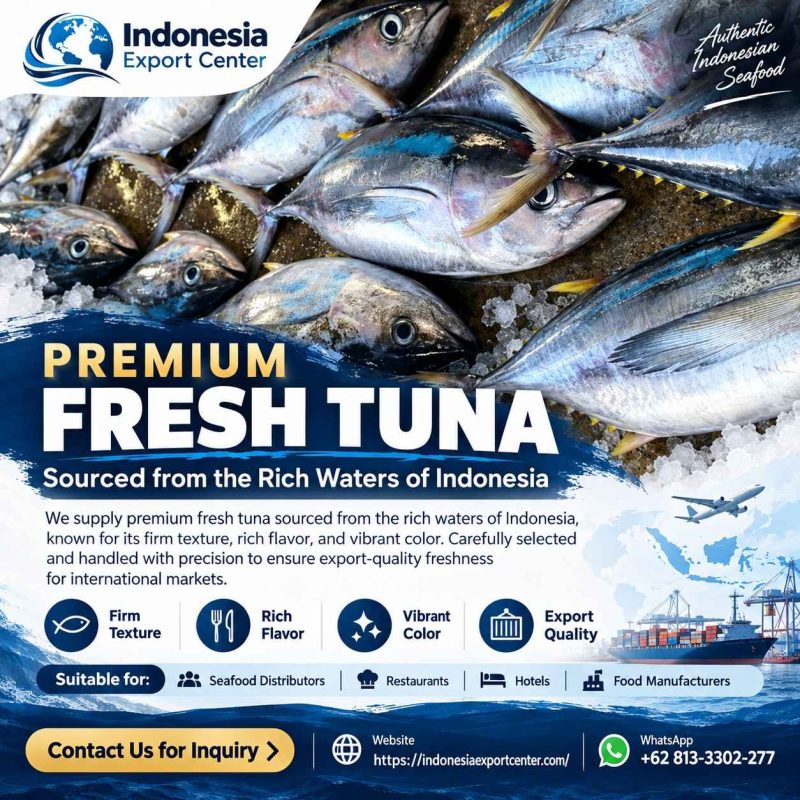
Connect with Indonesian Tuna Suppliers for International Wholesale and Export Requirements
Are you looking for a reliable Indonesian tuna exporter to support your international seafood sourcing needs?
Indonesia Export Center (IEC) helps international seafood importers, distributors, wholesalers, food manufacturers, and procurement businesses explore tuna sourcing opportunities in Indonesia.
Indonesia is one of the world’s important tuna-producing countries, benefiting from extensive fishing waters, commercially valuable tuna species, and established seafood trading activities.
As an Indonesian sourcing intermediary, Indonesia Export Center facilitates communication between overseas buyers and potential Indonesian suppliers and exporters.
We assist with product inquiries, supplier coordination, export requirements, commercial quotations, and documentation discussions, subject to supplier confirmation.
Whether you require fresh tuna, chilled tuna, frozen tuna, or processed tuna products, we welcome your inquiry and can explore suitable sourcing options.
REQUEST AN INDONESIAN TUNA EXPORT QUOTATION
Website: https://indonesiaexportcenter.com/
WhatsApp: +62 813-3302-277
Direct Inquiry: https://wa.me/628133302277
Why Indonesia Is an Important Source of Tuna for Global Markets
Indonesia’s strategic position between the Indian Ocean and Pacific Ocean provides access to productive marine fisheries.
The country participates in international tuna supply chains serving food processing, hospitality, seafood distribution, and retail markets.
1. Strategic Marine Location
Indonesia has extensive tuna fishing grounds across its surrounding waters, supporting commercial tuna harvesting and seafood trading.
2. Diverse Commercial Tuna Species
Indonesia’s tuna industry handles several internationally traded species, including yellowfin tuna, bigeye tuna, and skipjack tuna.
3. Established Seafood Industry
Indonesia has fisheries landing sites, processing facilities, cold-storage businesses, and seafood exporters supporting domestic and international markets.
4. Different Product Forms
Depending on supplier capabilities, Indonesian tuna may be offered in whole-fish, gutted, loin, steak, and other commercially specified forms.
5. International Trade Opportunities
Indonesian tuna products can be considered for various overseas markets, subject to importer regulations, supplier approvals, and applicable export requirements.
Indonesian Tuna Products for Export Sourcing
Indonesia Export Center welcomes inquiries for commercially traded Indonesian tuna varieties.
Yellowfin Tuna Export from Indonesia
Scientific Name: Thunnus albacares
Yellowfin tuna is commercially important for fresh, chilled, and frozen seafood markets.
Common applications include:
- Seafood wholesalers
- Restaurants and hotels
- Tuna processing companies
- Retail seafood distributors
- Foodservice businesses
Potential product forms include whole tuna, gutted tuna, loins, and steaks, depending on supplier availability and processing capabilities.
Target Keyword: Indonesian yellowfin tuna exporter
Bigeye Tuna Export from Indonesia
Scientific Name: Thunnus obesus
Bigeye tuna is valued in international seafood markets, including specialty seafood and higher-value foodservice segments.
Buyers may inquire about whole fish and processed products based on their required grade, size, handling conditions, and destination market.
Target Keyword: Bigeye tuna exporter Indonesia
Skipjack Tuna Export from Indonesia
Scientific Name: Katsuwonus pelamis
Skipjack tuna is widely used in international seafood processing, particularly canned tuna production and other industrial applications.
Commercial buyers may request sourcing information for suitable product forms and processing requirements.
Target Keyword: Indonesian skipjack tuna supplier
Product availability, export eligibility, grades, and quantities must be verified with the relevant supplier before a commercial offer is issued.
Indonesian Tuna Export Product Specifications
International tuna importers frequently require detailed technical specifications before approving a supplier.
The following table outlines common inquiry parameters.
| Specification | Details |
|---|---|
| Product | Indonesian Tuna |
| Country of Origin | Indonesia |
| Species | Yellowfin, Bigeye, Skipjack, subject to availability |
| Product Condition | Fresh, chilled, or frozen, depending on supplier |
| Product Form | Whole, gutted, headed and gutted, loins, steaks |
| Size and Weight | According to buyer specification |
| Product Grade | Supplier-specific, subject to inspection |
| Packaging | Food-grade packaging appropriate to product condition |
| Storage Temperature | Based on validated product handling requirements |
| Shelf Life | To be confirmed against product and handling specifications |
| Minimum Order Quantity | Subject to supplier quotation |
| Order Type | Trial or recurring B2B orders, subject to acceptance |
| Export Documents | According to shipment and destination requirements |
| Delivery Terms | To be agreed between contracting parties |
Buyers are encouraged to submit detailed specifications to receive more accurate sourcing information.
Indonesian Tuna Export Sourcing Workflow
Indonesia Export Center provides sourcing coordination to assist international buyers in identifying and communicating with potential Indonesian tuna suppliers.
Step 1 – Buyer Sends an Inquiry
The international buyer provides information about the required tuna species, product form, quality standards, purchase volume, and destination.
Step 2 – Product Requirement Review
We review the buyer’s commercial and technical requirements to understand the sourcing request.
Key details may include:
- Product species
- Fresh or frozen condition
- Whole fish or processed form
- Required weight range
- Packaging preferences
- Estimated order quantity
- Required certifications
- Destination country
- Target shipment schedule
Step 3 – Supplier Sourcing and Coordination
Indonesia Export Center explores suitable sourcing opportunities and coordinates discussions with potential Indonesian suppliers.
The supplier’s product availability, capabilities, documentation, and proposed commercial terms must be confirmed.
Step 4 – Product Specification and Quotation
Subject to supplier confirmation, the buyer may receive information covering:
- Product description
- Technical specifications
- Available grade and size
- Minimum order quantity
- Packaging arrangement
- Indicative or firm pricing
- Lead time
- Proposed delivery terms
- Relevant documentation
Step 5 – Supplier and Documentation Verification
Before proceeding, the buyer should verify the exporting company, facility requirements, product documentation, import eligibility, and other compliance matters.
Step 6 – Commercial Negotiation
The buyer and contracted seller negotiate pricing, Incoterms, payment terms, quality criteria, and shipment conditions.
Step 7 – Order Confirmation and Export Coordination
Following commercial agreement and required compliance checks, the responsible parties coordinate production or preparation, inspection, packaging, and shipment.
Indonesia Export Center serves as a sourcing intermediary; actual supply and export commitments depend on the contracted supplier or exporter.
Indonesian Tuna Export Capabilities and Supply Arrangements
International tuna buyers often need clarity regarding supply capacity, logistics, and commercial order conditions.
These capabilities vary by supplier and should be confirmed individually.
Fresh and Chilled Tuna Sourcing
Fresh tuna shipments require appropriate handling and temperature-controlled logistics.
Air freight may be considered where transit time and market requirements make it suitable.
Frozen Tuna Sourcing
Frozen tuna sourcing inquiries may involve whole fish, loins, steaks, or industrial processing forms.
Frozen product temperatures and handling conditions must meet applicable specifications and market requirements.
Wholesale and Bulk Tuna Orders
Wholesale supply arrangements depend on supplier capacity, species availability, seasonal conditions, and processing requirements.
Regular Supply Agreements
Buyers interested in recurring purchases may discuss planned order schedules and long-term sourcing arrangements with potential suppliers.
Customized Product Specifications
Suppliers may be asked to evaluate buyer-specific requirements covering product form, fish size, packaging, labeling, inspection, and other technical conditions.
No particular processing capacity, monthly tonnage, or delivery lead time is guaranteed without direct supplier confirmation.
Indonesian Tuna Export Documents and Certifications
Export documentation is a critical consideration for international seafood trade.
The exact requirements depend on the destination country, product category, exporting establishment, and applicable regulations.
Commonly relevant documents may include:
1. Commercial Invoice
Identifies the commercial transaction, including products, quantities, pricing, buyer, seller, and payment details.
2. Packing List
Provides shipment information such as product descriptions, packaging details, and net or gross weights.
3. Bill of Lading or Air Waybill
Documents the transportation arrangement for sea or air freight.
4. Health Certificate
A health certificate may be required by the importing country and must be issued through the appropriate authorized process.
5. Certificate of Origin
A certificate of origin may be needed for customs purposes or applicable preferential trade arrangements.
6. HACCP-Related Documentation
HACCP-based food safety controls and supporting documentation may be required depending on the supplier, product, and destination market.
7. Catch Documentation and Traceability
Certain tuna shipments may require catch-related records, traceability information, or documentation associated with applicable fisheries management and import controls.
8. Destination-Specific Regulatory Documents
Additional requirements may include establishment approvals, inspection records, food safety registrations, or laboratory reports.
Important: Documentation availability and certification validity must be verified for the specific exporting supplier and destination. Indonesia Export Center does not claim that every potential supplier holds all listed certificates.
Tuna Quality Control and Cold Chain Management
Product quality and safe handling are essential for international tuna shipments.
Appropriate quality assurance measures may include:
Species Identification
Confirming that the supplied tuna corresponds with the contracted species.
Freshness and Physical Inspection
Assessing appearance, odor, texture, and other relevant product characteristics.
Temperature Control
Maintaining suitable temperatures during storage, preparation, handling, and transportation.
Food Safety Management
Applying appropriate hygiene and hazard-control measures throughout the supply chain.
Histamine Control
Tuna is susceptible to histamine formation when temperature abuse occurs. Appropriate handling and validated food safety controls are essential.
Packaging and Logistics
Using product-appropriate packaging to help maintain condition during transportation.
Traceability
Maintaining relevant records to support product identification and supply chain verification.
Buyer acceptance criteria should be specified clearly in the purchase contract.
Indonesian Tuna Export Markets
International demand for tuna comes from seafood processors, wholesalers, restaurants, retailers, and specialty importers.
Indonesia Export Center welcomes sourcing inquiries from buyers in eligible international markets.
Japan
Japan is an important market for tuna products, with product-specific requirements relating to quality, handling, and distribution.
United States
US seafood importers operate under applicable FDA and seafood safety regulations, including relevant importer obligations.
European Union
EU imports of fishery products are subject to applicable sanitary rules, establishment eligibility, traceability requirements, and fisheries documentation.
Singapore
Singapore is a regional seafood trading and consumption market with established import requirements.
Middle Eastern Markets
Countries such as the United Arab Emirates and Saudi Arabia represent potential markets for seafood sourcing inquiries.
Other International Markets
We also welcome inquiries from eligible buyers in South Korea, Hong Kong, Malaysia, and other countries.
Export access is not automatic. Each transaction depends on destination regulations, exporting supplier approvals, product requirements, and available logistics.
Fresh Tuna vs Frozen Tuna for International Importers
Importers should evaluate product type according to intended applications, distribution infrastructure, and customer requirements.
| Comparison | Fresh / Chilled Tuna | Frozen Tuna |
|---|---|---|
| Product Condition | Chilled, not intentionally frozen | Frozen under controlled conditions |
| Typical Market | Fresh seafood distribution, foodservice | Processing, distribution, foodservice |
| Logistics | Time-sensitive temperature-controlled delivery | Frozen cold-chain transportation |
| Storage Life | Generally shorter | Generally longer under appropriate conditions |
| Packaging | Product-specific chilled packaging | Frozen product packaging |
| Order Planning | Highly dependent on harvest and transit timing | Dependent on inventory and cold-chain capacity |
Both categories require appropriate quality control, traceability, and food safety management.
Minimum Order Quantity for Indonesian Tuna Export
MOQ for Indonesian tuna exports is determined by the supplier and the transaction requirements.
Factors may include:
- Tuna species
- Product condition
- Whole or processed form
- Available stock
- Packaging configuration
- Freight requirements
- Export destination
- Supplier commercial policy
A fixed MOQ should not be assumed.
International buyers can request quotations for trial orders, wholesale purchases, or recurring supply contracts.
Indonesian Tuna Export Prices and Commercial Terms
Tuna export prices can vary significantly according to market conditions and product specifications.
Important pricing variables include species, fish size, grade, condition, processing form, packaging, quantity, origin, and shipping arrangements.
Buyers should identify their preferred Incoterms when submitting an inquiry.
Possible arrangements may include:
FOB – Free on Board
Suitable for agreed ocean freight transactions where the buyer arranges main carriage under the applicable Incoterms.
CIF – Cost, Insurance and Freight
An arrangement for applicable sea freight transactions where the seller contracts carriage and insurance under the agreed Incoterms.
CPT – Carriage Paid To
A potential arrangement for shipments using different transport modes, subject to negotiation.
CIP – Carriage and Insurance Paid To
A potential arrangement including contracted carriage and insurance to the agreed destination.
The appropriate Incoterm, named place, transport method, and division of responsibilities must be established in the sales contract.
Why Choose Indonesia Export Center as Your Tuna Sourcing Partner?
Indonesian Market Access
We facilitate introductions and communication between overseas buyers and potential Indonesian suppliers.
Commercial Sourcing Focus
Our approach emphasizes product requirements, quotation coordination, and commercially relevant supplier discussions.
Export-Oriented Communication
We understand that international buyers need clear specifications, supplier documentation, and delivery arrangements.
Multiple Sourcing Categories
Buyers may inquire about various Indonesian seafood and commodity products through a single sourcing platform.
Transparent Intermediary Role
Indonesia Export Center coordinates sourcing opportunities rather than claiming ownership of all listed inventory, processing facilities, or export operations.
Our goal is to support clear and productive communication between international buyers and qualified Indonesian supply partners.
Frequently Asked Questions About Indonesian Tuna Exporters
1. How can I find an Indonesian tuna exporter?
International buyers can contact Indonesia Export Center to explore potential Indonesian tuna sourcing and exporting partners based on product specifications and commercial requirements.
2. What types of tuna does Indonesia export?
Indonesia trades several tuna species, including yellowfin tuna, bigeye tuna, and skipjack tuna. The availability of specific products depends on the exporter and current supply conditions.
3. Can I purchase fresh tuna from Indonesia?
Fresh tuna sourcing opportunities may be available. Export feasibility depends on supplier capability, handling standards, transit arrangements, and destination import rules.
4. Does Indonesia export frozen tuna?
Yes. Frozen tuna is an important category of Indonesian seafood trade. Specific forms, quantities, and pricing must be confirmed with suppliers.
5. What is the MOQ for Indonesian tuna exporters?
There is no single MOQ applicable to all exporters. Each supplier establishes its own order requirements.
6. What documents are needed to import tuna from Indonesia?
Requirements may include a commercial invoice, packing list, transport document, health certificate, origin documents, and relevant fisheries or food safety documentation, depending on the importing country.
7. Can Indonesian tuna exporters provide HACCP documentation?
Some exporting facilities operate under HACCP-based food safety systems. Buyers should request current supplier-specific documentation and verify its applicability.
8. Can Indonesian tuna be exported to the United States or European Union?
Tuna shipments may enter these markets when the product, exporter, facility, documentation, and importing arrangements comply with applicable requirements.
9. How can I request an Indonesian tuna export price?
Submit your target species, product form, grade, required volume, destination, delivery schedule, and preferred trade terms.
10. What is Indonesia Export Center’s role in tuna exports?
Indonesia Export Center acts as a sourcing intermediary, assisting buyer-supplier communication and export-related inquiries. The actual seller, exporter of record, and contractual responsibilities are confirmed for each transaction.
Request for Quotation – Indonesian Tuna Export Supply
International Seafood Buyers – Send Your Tuna Sourcing Requirements
To help us coordinate a relevant supplier inquiry, please provide the following details.
Buyer and Company Information
- Company Name:
- Contact Person:
- Country:
- Business Email:
- WhatsApp Number:
- Company Website:
Tuna Product Requirements
- Tuna Species:
- Fresh / Chilled / Frozen:
- Whole Fish / Gutted / Loins / Steaks:
- Required Grade:
- Required Size or Weight:
- Quantity per Order:
- Estimated Monthly Demand:
- Packaging Requirements:
- Required Certifications:
- Destination Country and Port:
- Preferred Incoterms:
- Target Delivery Date:
- Additional Technical Requirements:
Providing detailed information helps us evaluate suitable sourcing options and coordinate discussions with potential Indonesian suppliers.
Contact Indonesia Export Center – Indonesian Tuna Export Sourcing
Looking for an Indonesian Tuna Exporter for Your Business?
Indonesia Export Center welcomes inquiries from international seafood importers, distributors, wholesalers, food manufacturers, restaurant suppliers, and procurement companies.
Contact us to discuss tuna sourcing opportunities, product specifications, potential supply arrangements, and export requirements.
INDONESIA EXPORT CENTER (IEC)
Bridging Indonesian Excellence to the World
Website: https://indonesiaexportcenter.com/
Landing Page: https://indonesiaexportcenter.com/indonesian-tuna-exporter/
WhatsApp: +62 813-3302-277
Direct WhatsApp: https://wa.me/628133302277
SEND YOUR TUNA EXPORT INQUIRY TODAY
Explore Indonesian tuna sourcing opportunities and connect with potential export suppliers through Indonesia Export Center.
All product offers, availability, export capabilities, certifications, pricing, payment terms, and shipping arrangements are subject to verification and agreement with the relevant supplier or exporter.
