

Washed vs Buffered Cocopeat: What International Buyers Need to Know
Cocopeat has become an important growing medium for hydroponic farms, greenhouse operations, commercial nurseries, potting-mix manufacturers, and horticultural projects worldwide. It offers useful water-retention properties, root-zone aeration, and a relatively stable physical structure when properly processed.
However, international buyers frequently encounter several technical terms when comparing cocopeat products, including raw cocopeat, washed cocopeat, low-EC cocopeat, and buffered cocopeat.
These terms are related, but they do not describe exactly the same product.
The most common misunderstanding is assuming that washed cocopeat and buffered cocopeat are interchangeable. Another frequent mistake is believing that every product labeled “Low EC” has automatically undergone a complete buffering treatment.
In reality:
Washing primarily removes water-soluble salts, while buffering changes the cation balance on the cocopeat’s exchange sites.
Understanding this distinction is essential because the processing method can influence the initial nutrient balance, fertilizer program, crop response, and suitability of cocopeat for precision hydroponic cultivation.
What Is Cocopeat?
Cocopeat, also called coir pith or coir dust, is the fine material produced during the processing of coconut husks. After separation from longer coir fibers, the pith can be aged, screened, washed, dried, and compressed into products such as 5 kg blocks, briquettes, slabs, or grow bags.
Cocopeat is widely used as a soilless growing medium because it can retain water while maintaining pore spaces that support root-zone aeration. Its physical and chemical properties nevertheless vary according to coconut origin, husk-processing practices, aging, particle-size distribution, washing quality, water quality, and subsequent chemical treatment.
Untreated cocopeat may contain elevated concentrations of potassium, sodium, chloride, and other soluble ions. Research has shown that the levels of potassium, sodium, and electrical conductivity can differ considerably depending on the cocopeat source and processing conditions.
For this reason, buyers should not evaluate cocopeat based only on its appearance, block weight, or expansion volume. Chemical preparation is equally important.
What Is Washed Cocopeat?
Washed cocopeat is cocopeat that has been treated with water to remove soluble salts and other water-extractable compounds.
During washing, water moves through the cocopeat and carries away dissolved ions. Depending on the raw material and the washing process, these may include:
- Sodium
- Chloride
- Part of the soluble potassium
- Residual processing salts
- Fine suspended particles
- Other water-soluble compounds
The main objective is usually to reduce the product’s electrical conductivity.
Electrical conductivity, commonly abbreviated as EC, is an indirect indication of the concentration of dissolved ions in an extract. High EC can indicate excessive salinity, which may interfere with water uptake, seed germination, root development, or fertilizer management.
However, washing mainly affects ions that are already dissolved or readily soluble. It does not necessarily remove all potassium and sodium held on the negatively charged exchange sites of the cocopeat.
This distinction is the main reason why washed cocopeat is not automatically the same as buffered cocopeat.
What Washing Can Achieve
A properly managed washing process can:
- Lower soluble salt concentrations
- Reduce the initial EC
- Remove a substantial part of sodium and chloride
- Improve suitability for horticultural use
- Prepare the material for subsequent buffering
- Reduce the amount of unwanted soluble material entering the buyer’s irrigation system
The effectiveness of washing depends heavily on the quality and quantity of water used. Cocopeat washed with saline water may not reach the same chemical quality as cocopeat washed with clean, low-EC water.
The number of washing cycles alone is therefore not a sufficient quality indicator. Buyers should focus on the test results of the finished product.
What Is Buffered Cocopeat?
Buffered cocopeat has undergone a chemical conditioning process intended to improve the balance of cations held by the cocopeat.
In cocopeat terminology, buffering does not simply mean adjusting the pH. It normally refers to a cation-exchange treatment.
Cocopeat contains negatively charged exchange sites that can attract positively charged ions. These positively charged nutrients and salts are called cations. Important examples include:
- Potassium: K⁺
- Sodium: Na⁺
- Calcium: Ca²⁺
- Magnesium: Mg²⁺
Untreated cocopeat may have a significant proportion of its exchange sites occupied by potassium and sodium. During buffering, the expanded material is commonly exposed to a calcium-based solution, frequently calcium nitrate. Some commercial protocols may also incorporate magnesium, depending on the required specification.
Because calcium carries two positive charges, it can displace part of the monovalent potassium and sodium from the cocopeat’s exchange complex. The displaced ions then enter the solution and must be removed through drainage and final washing.
A scientific study by Gbollie, Mwonga, and Kibe found an inverse relationship between calcium treatment and the potassium and sodium remaining in treated cocopeat. Increasing calcium nitrate treatment promoted calcium adsorption while reducing potassium and sodium. The researchers also emphasized that washing after soaking was necessary for complete removal of the displaced ions.
The same study reported that, under its experimental conditions, treatment using calcium nitrate and a 36-hour soaking period substantially reduced potassium and sodium while increasing calcium and nitrogen in the cocopeat. These results demonstrate the chemical-exchange principle behind commercial buffering, although production protocols should always be validated for each factory, water source, raw material, and target specification.
Washing and Buffering Are Different Processes
The easiest way to understand the difference is to consider where the unwanted ions are located.
In washed cocopeat, the main target is the pool of soluble salts in the pore water.
In buffered cocopeat, the main target is the pool of exchangeable ions attached to the cocopeat’s cation-exchange sites.
| Technical factor | Washed cocopeat | Buffered cocopeat |
|---|---|---|
| Main treatment | Leaching with water | Treatment with a calcium-based solution, followed by leaching |
| Primary purpose | Remove soluble salts and lower EC | Replace exchangeable sodium and potassium with calcium |
| Effect on EC | Can substantially reduce EC | EC may rise during treatment but should fall after final washing |
| Effect on sodium | Removes soluble sodium | Helps displace both soluble and exchangeable sodium |
| Effect on potassium | Removes part of soluble potassium | More effectively reduces exchangeable potassium |
| Calcium saturation | Not specifically controlled | Increased through cation exchange |
| Buyer preparation | May require additional conditioning | Usually requires less initial conditioning |
| Typical application | Potting mixes, soil amendment, nurseries, general horticulture | Precision hydroponics, greenhouse crops, sensitive seedlings and high-value crops |
Therefore, a product may be:
- Washed but not buffered
- Washed and buffered
- Low EC but not fully buffered
- Buffered but inadequately rinsed after treatment
- Raw or only lightly washed
The final laboratory results are more reliable than processing terminology alone.
Why Buffered Cocopeat Can Be Important in Hydroponics
Cocopeat has a meaningful cation-exchange capacity. This can be beneficial because the medium can retain positively charged nutrients. However, it also means that untreated or insufficiently buffered cocopeat may initially interact with the nutrient solution.
When a grower begins fertigating unbuffered cocopeat, calcium and magnesium from the nutrient solution may be adsorbed by available exchange sites. At the same time, potassium or sodium already held by the cocopeat may be released into the root-zone solution.
This can create an initial nutrient imbalance, particularly in systems using tightly controlled fertilizer formulations.
A review of soilless growing media explains that buffering is used to replace excess sodium and potassium bound to coir with calcium, helping reduce the risk of calcium and magnesium problems during crop production. The effectiveness of the process depends on factors such as the buffering salts, contact time, and subsequent leaching.
Potential symptoms of an unsuitable initial cation balance may include:
- Unexpectedly high potassium in the drainage
- Reduced calcium availability
- Reduced magnesium uptake
- Difficulty stabilizing the nutrient solution
- Variation between irrigation and drainage EC
- Additional fertilizer correction during crop establishment
These risks do not mean that every washed cocopeat product will cause crop failure. They mean that growers using non-buffered cocopeat may need to perform their own conditioning or adjust the initial fertigation program.
For professional hydroponic farms, ready-buffered cocopeat can offer greater predictability during crop establishment.
Is Low-EC Cocopeat Automatically Buffered?
No.
A low EC result mainly indicates a low concentration of soluble electrolytes under a particular extraction method. It does not provide complete information about which ions occupy the cation-exchange sites.
A manufacturer can sometimes achieve a low EC through repeated freshwater washing without performing a full calcium-buffering treatment.
Conversely, cocopeat that has just been exposed to calcium nitrate may temporarily show a relatively high EC because the solution contains dissolved calcium, nitrate, potassium, and sodium. The EC should decrease after adequate final washing.
This is why buyers should never use EC as the only evidence of buffering.
The analytical method must also be stated. Different ratios of cocopeat to water can produce different EC readings. RHP notes that both 1:5 volume extraction and 1:1.5 extraction methods are used for growing-media analysis, but the results from the two methods are not directly interchangeable.
A specification stating only “EC below 0.5 mS/cm” is incomplete unless the testing protocol is also known.
Buyers should ask:
- Was EC tested using a 1:1.5, 1:2, or 1:5 extraction?
- Was the sample taken before or after compression?
- Was distilled water or another water source used?
- Was the result measured on a representative production batch?
- Are sodium, chloride, potassium, calcium, and magnesium included in the analysis?
Which Type Should Buyers Choose?
The correct choice depends on how the cocopeat will be used.
Choose Washed Cocopeat When:
Washed cocopeat may be suitable when the buyer:
- Produces potting-soil blends
- Mixes cocopeat with compost, peat, bark, perlite, or other materials
- Uses the product as a soil amendment
- Has its own buffering facility
- Has experience adjusting calcium and magnesium during fertigation
- Is growing crops with less demanding root-zone specifications
- Needs an economical input for large-volume substrate production
In these applications, washed low-EC cocopeat can be a practical raw material, provided the chemical and physical specifications meet the buyer’s requirements.
Choose Buffered Cocopeat When:
Buffered cocopeat may be preferable when the buyer:
- Operates a commercial hydroponic greenhouse
- Requires precise nutrient control
- Grows high-value vegetables, fruits, flowers, or medicinal plants
- Uses reverse-osmosis or very low-mineral irrigation water
- Wants to reduce on-site substrate preparation
- Requires more predictable drainage chemistry
- Is concerned about sodium, potassium, calcium, and magnesium balance
- Needs ready-to-use grow bags or slabs
Buffered cocopeat is generally positioned as a more highly conditioned growing medium rather than merely a low-salt product.
Technical Questions Buyers Should Ask Suppliers
Before ordering cocopeat, buyers should request a complete specification instead of relying only on the words “washed,” “buffered,” or “Low EC.”
Important questions include:
1. What is the EC value and testing method?
The ratio and extraction procedure should be clearly stated.
2. Was the product washed with fresh, low-EC water?
The quality of washing water affects the finished product.
3. Was calcium buffering performed?
The supplier should distinguish between freshwater washing and chemical buffering.
4. Which buffering material was used?
Common treatments are calcium-based, but the exact input and process may vary.
5. Was the cocopeat washed after buffering?
The final rinse is necessary to remove displaced potassium, sodium, and excess treatment salts.
6. Are individual ion results available?
A professional analysis may include sodium, chloride, potassium, calcium, and magnesium.
7. What are the physical properties?
Buyers should also confirm:
- Particle-size distribution
- Fiber percentage
- Expansion volume
- Moisture content
- Bulk density
- Water-holding capacity
- Air-filled porosity
- Compression ratio
- Presence of sand or foreign matter
8. Is the certificate batch-specific?
A general product sheet should not replace a Certificate of Analysis for the actual production batch.
Washed and Buffered Cocopeat from Indonesia
Indonesia has abundant coconut resources and a growing coir-processing sector capable of supplying compressed cocopeat products for international horticultural markets.
Indonesia Export Center supports international buyers seeking Indonesian cocopeat through supplier coordination, specification matching, export packing discussions, documentation preparation, and shipment arrangements.
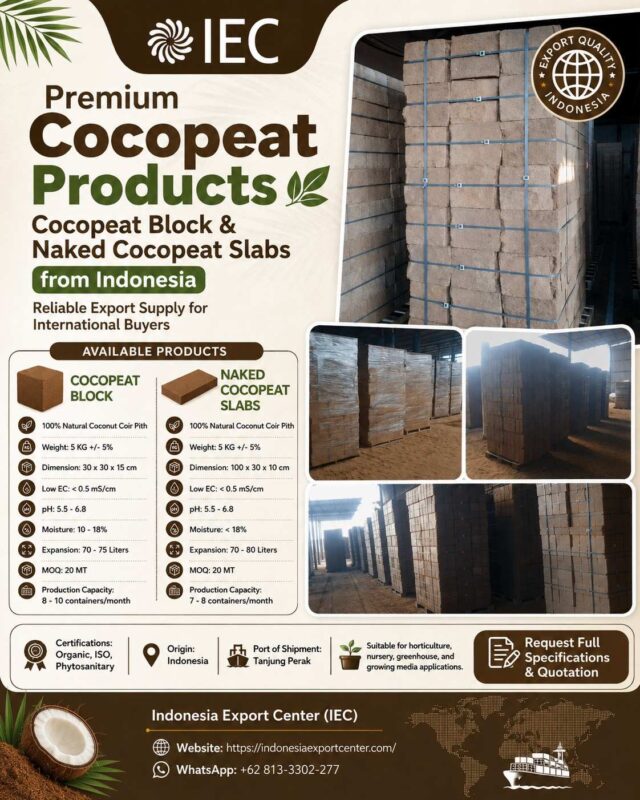
The current product range displayed by Indonesia Export Center includes:
- Cocopeat Block 5 kg
- Naked Cocopeat Slabs
- Low-EC specification below 0.5 mS/cm
- pH specification of 5.5–6.8
- 5:1 compression ratio
- MOQ of 20 metric tons
- Shipment through Tanjung Perak Port, Surabaya, Indonesia
The 5 kg cocopeat blocks are specified to expand to approximately 70–75 liters, while the naked slabs are specified to expand to approximately 70–80 liters. Final specifications, certificates, packing arrangements, and production availability must be reconfirmed for each order.
Importantly, buyers requiring buffered cocopeat should state this as a separate technical requirement. A request for “Low EC cocopeat” should not automatically be interpreted as a request for a fully calcium-buffered product.
The inquiry should clearly identify whether the buyer needs:
- Washed Low-EC Cocopeat
- Calcium-Buffered Cocopeat
- Calcium-and-Magnesium-Buffered Cocopeat
- Buyer-specific Na, K, Ca, Mg, and chloride limits
- A specified EC extraction method
- Batch-specific laboratory analysis
- Cocopeat Block 5 kg
- Naked Cocopeat Slabs
- Customized particle size or fiber content
- Private-label or buyer-specific packing
Availability remains subject to producer capability, production schedule, raw-material condition, order quantity, and final technical approval.
Recommended Buyer Specification
A clear purchasing request may use wording such as:
We require Low-EC washed and buffered cocopeat suitable for commercial hydroponic cultivation. Please confirm the EC testing method, pH, moisture, expansion volume, particle-size distribution, sodium, potassium, chloride, calcium and magnesium levels, buffering material, post-buffer washing process, packing, monthly capacity, and batch-specific Certificate of Analysis.
This wording is much more precise than asking only for “premium cocopeat” or “Low EC cocopeat.”
Conclusion
Washed cocopeat and buffered cocopeat are not identical products.
Washing reduces soluble salts and helps lower electrical conductivity. Buffering goes further by using calcium-based treatment to displace exchangeable sodium and potassium from the cocopeat. The material must then be properly washed to remove the displaced ions and excess treatment solution.
For soil amendment, potting-mix production, and buyers with their own substrate-conditioning systems, washed low-EC cocopeat may be sufficient.
For commercial hydroponics, greenhouse cultivation, high-value crops, and precision fertigation, properly washed and buffered cocopeat may provide a more predictable starting medium.
The best purchasing decision should be based on:
- Intended crop and growing system
- Irrigation-water quality
- Fertilizer strategy
- EC testing method
- Sodium and chloride limits
- Potassium, calcium, and magnesium balance
- Physical properties
- Verified batch analysis
International buyers looking for Indonesian cocopeat blocks or naked cocopeat slabs can submit their complete technical and commercial requirements to Indonesia Export Center.
Request a Cocopeat Quotation
Indonesia Export Center
🌐 Website: https://indonesiaexportcenter.com/
📱 WhatsApp: +62 813-3302-277
✉️ Email: info@indonesiaexportcenter.com
Please include:
- Required product
- Washed or buffered specification
- Required EC and testing method
- Required quantity
- Destination country and port
- Packing preference
- Certification requirements
- Target shipment date
- Preferred Incoterm
Indonesia Export Center — Connecting International Buyers with Indonesian Cocopeat Suppliers and Export-Oriented Production Networks.
References
- Gbollie, S. N., Mwonga, S. M., and Kibe, A. M. “Effects of Calcium Nitrate Levels and Soaking Durations on Cocopeat Nutrient Content.” Journal of Agricultural Chemistry and Environment, Vol. 10, 2021, pp. 372–388. DOI: 10.4236/jacen.2021.103024.
- Poulter, R. “Quantifying Differences between Treated and Untreated Coir Substrate.” Acta Horticulturae, Vol. 1018, 2014, pp. 557–564. DOI: 10.17660/ActaHortic.2014.1018.61.
- Barrett, G. E., Alexander, P. D., Robinson, J. S., and Bragg, N. C. “Achieving Environmentally Sustainable Growing Media for Soilless Plant Cultivation Systems—A Review.” Scientia Horticulturae, Vol. 212, 2016, pp. 220–234.
- Nemati, R. et al. “Growing Mediums for Medical Cannabis Production in North America.” Agronomy, Vol. 11, No. 7, 2021, Article 1366.
- RHP. “1:5 versus 1:1.5.” Explanation of growing-media extraction methods for pH and EC analysis.
- Indonesia Export Center. “Cocopeat Block 5 kg & Naked Cocopeat Slabs from Indonesia.” Product specifications and export information.
