

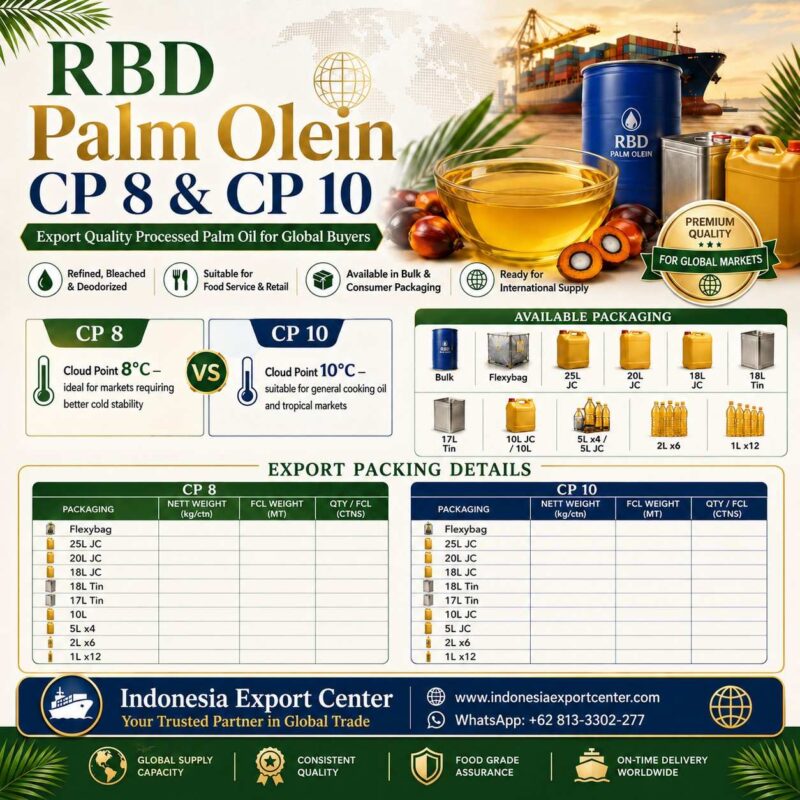
RBD Palm Olein Packaging Guide: Flexitank, Jerrycan, Tin, or Bulk Vessel?
Selecting the right packaging is a critical part of importing RBD palm olein from Indonesia. The packing method does not only influence the product quotation. It also affects shipping efficiency, storage requirements, unloading procedures, branding opportunities, handling costs, and the final landed cost of the cooking oil.
A buyer developing a private-label cooking-oil brand may prefer printed tins or jerrycans that are ready for distribution. A food-processing company may achieve better cost efficiency by receiving palm olein in flexitanks. Meanwhile, large importers, refiners, and national distributors with dedicated port terminals may require bulk-vessel shipments.
There is no single packing method that is suitable for every buyer.
The right choice depends on several factors, including:
-
Total order volume
-
Target customers
-
Destination-country requirements
-
Storage and unloading facilities
-
Local distribution system
-
Destination climate
-
Private-label requirements
-
Whether the product will be sold directly or repacked locally
This guide compares the four main RBD palm olein packing options: flexitank, jerrycan, tin, and bulk vessel.
Understanding RBD Palm Olein Before Choosing the Packing
Palm olein is the liquid fraction produced through the fractionation of palm oil. It is different from palm stearin, which is the solid fraction with a higher melting point.
Because RBD palm olein is an edible product intended for human consumption, every surface that comes into contact with the oil must be suitable for food use. This includes:
-
Storage tanks
-
Shipping tanks
-
Flexitank liners
-
Hoses
-
Pumps
-
Valves
-
Fittings
-
Jerrycans
-
Metal tins
-
Pipelines
Commercial grades such as RBD Palm Olein CP8 and CP10 should not be purchased based only on the grade name.
The purchase contract should clearly state the agreed technical parameters, including:
-
Cloud point
-
Free fatty acid level
-
Moisture and impurities
-
Iodine value
-
Colour
-
Testing method
-
Packing type
-
Net quantity
-
Applicable tolerances
The packaging method does not change CP8 into CP10 or vice versa. However, it can affect how easily the oil is stored, handled, pumped, and discharged, especially when the shipment travels through regions with lower temperatures.
For bulk transportation, palm olein generally needs to remain sufficiently fluid for loading, pumping, and discharge. Codex guidance recommends maintaining palm olein at approximately 25–30°C during bulk transportation and approximately 32–35°C during loading and discharge.
Heating should be gradual. Localized overheating should be avoided because excessive heat can affect product quality.
1. RBD Palm Olein in Flexitank
A flexitank is a large flexible liquid container installed inside a standard dry shipping container. It is commonly placed in a 20-foot ISO container and supported by protective liners, fittings, a valve, and a restraining bulkhead.
Flexitanks are generally designed for the single-use transportation of compatible, non-hazardous liquids.
The maximum loading quantity is commonly around 24,000 kilograms or approximately 24,000 litres. However, the actual payload must be confirmed for every shipment because it may depend on:
-
Product density
-
Flexitank design
-
Container payload limit
-
Shipping-line requirements
-
Road-weight restrictions
-
Port regulations
-
Destination-country rules
When Is Flexitank Packing Suitable?
Flexitank packing is generally suitable for:
-
Food-processing factories
-
Industrial frying operations
-
Cooking-oil repacking companies
-
Importers with heated storage tanks
-
Buyers purchasing approximately one container or more
-
Customers that do not need retail-ready packaging from Indonesia
Instead of handling hundreds or thousands of individual packages, the buyer can pump the palm olein directly from the flexitank into a clean receiving tank.
Advantages of Flexitank Packing
Higher Payload Efficiency
A flexitank allows a large volume of palm olein to be transported inside one 20-foot container.
The shipment does not require individual tins, jerrycans, cartons, or pallets. Therefore, a larger proportion of the container payload can be allocated to the oil itself.
Lower Packaging Cost per Metric Ton
Because the oil is transported as one large liquid unit, the packaging cost per metric ton can be lower than the cost of supplying the same volume in small retail or foodservice packages.
Suitable for Local Repacking
Flexitanks are especially useful for buyers that operate their own filling lines.
After receiving the oil, the importer can repack it locally into:
-
Bottles
-
Pouches
-
Jerrycans
-
Metal tins
-
Other destination-market packaging
This provides greater flexibility in relation to branding, label language, package size, and local market preferences.
Access to Regular Container Services
A flexitank makes it possible to transport bulk liquid through regular container-shipping services.
This can be more practical for container-scale orders than arranging a dedicated edible-oil tanker or bulk vessel.
Limitations and Risks of Flexitank Packing
A flexitank buyer must have adequate unloading facilities.
The receiving operation will normally require:
-
A compatible pump
-
A food-grade hose
-
A trained unloading operator
-
A clean receiving tank
-
Spill-control procedures
-
Sufficient unloading time
-
Safe access around the container
Before confirming the order, the buyer should verify:
-
Flexitank manufacturer
-
Flexitank operator
-
Shipping-line approval
-
Food-contact declaration
-
Container inspection report
-
Flexitank design
-
Nominal capacity
-
Valve specification
-
Loading temperature
-
Product compatibility
-
Leakage-response procedure
-
Emergency procedure
-
Disposal or recycling arrangements
The flexitank system should be supplied and operated by experienced parties that follow recognized quality and safety procedures.
Used flexitank materials may be recyclable, but drainage, collection, cleaning, transport, and recycling should be planned in advance.
Temperature Planning for Flexitank Shipments
Temperature planning becomes particularly important when CP8 or CP10 is shipped to a cooler destination.
The buyer should determine whether the container may require:
-
External warming
-
A heating pad
-
Warm warehouse storage
-
A heated receiving tank
-
Another approved warming arrangement
The oil should not be heated too aggressively.
Gradual heating is recommended, with the temperature increase generally not exceeding approximately 5°C within a 24-hour period.
Flexitank Is Best For
Flexitank is generally one of the strongest options for an industrial buyer that:
-
Can receive palm olein in bulk
-
Wants efficient container utilization
-
Plans to repack the oil locally
-
Does not require immediate retail distribution
-
Has reliable storage and unloading facilities
2. RBD Palm Olein in Jerrycans
Jerrycans are rigid plastic containers commonly used for cooking oil supplied to foodservice businesses, wholesalers, restaurants, hotels, caterers, institutional kitchens, and households.
Depending on the supplier’s packing capabilities, the buyer may be able to customize:
-
Container capacity
-
Container shape
-
Plastic colour
-
Handle design
-
Cap and seal
-
Label
-
Carton
-
Pallet configuration
-
Private-label artwork
When Is Jerrycan Packing Suitable?
Jerrycan packing is appropriate when:
-
The buyer does not have a bulk storage tank
-
The oil needs to be distributed immediately after customs clearance
-
Customers include restaurants, hotels, caterers, and small factories
-
The importer requires private-label packaging
-
The market prefers portable containers
-
Orders will be distributed among multiple smaller customers
Advantages of Jerrycan Packing
Ready for Immediate Distribution
Jerrycans can be transported directly from the port to:
-
Distributor warehouses
-
Wholesalers
-
Restaurants
-
Hotels
-
Catering businesses
-
Institutional customers
The importer does not need to operate a local repacking line.
Easy to Carry and Handle
The integrated handle makes jerrycans convenient for smaller commercial users.
They are easier to carry, pour, store, and distribute than large bulk containers.
Flexible Private-Label Options
Depending on the agreement with the supplier, the buyer may request customized packaging with:
-
Brand name
-
Logo
-
Product information
-
Barcode
-
Nutrition panel
-
Importer information
-
Label language
-
Storage instructions
-
Destination-market declarations
No Bulk Receiving System Required
Unlike flexitank or bulk-vessel shipments, jerrycan packing does not require the importer to operate a receiving tank, pipeline, or liquid-transfer installation.
A standard warehouse is generally sufficient, provided that food-storage and product-stacking requirements are followed.
Limitations of Jerrycan Packing
Jerrycans usually have a higher packaging cost per metric ton than flexitank shipments.
The packaging system also requires more:
-
Warehouse space
-
Loading labour
-
Unloading labour
-
Individual handling
-
Plastic materials
-
Cartons
-
Pallets
The buyer should also evaluate:
-
Cap strength
-
Seal integrity
-
Leakage risk
-
Container deformation
-
Food-contact suitability
-
Carton strength
-
Pallet arrangement
-
Maximum stacking height
-
Heat exposure
-
Label durability
-
Availability of replacement caps or containers
Food-contact containers should be manufactured from suitable, non-toxic materials and designed to protect the product against contamination during their intended use.
Jerrycans Are Best For
Jerrycans are generally preferred by importers serving foodservice and wholesale customers where portability and immediate distribution are more important than obtaining the lowest possible packaging cost per metric ton.
3. RBD Palm Olein in Metal Tins
Metal tins are widely used for branded cooking oil in markets where customers value rigid packaging, traditional presentation, and strong visibility on retail or wholesale shelves.
The buyer may choose between:
-
Custom-printed tins
-
Plain tins with adhesive labels
-
Supplier-branded tins
-
Private-label tins
The available capacity and design must be confirmed with the refinery or packing facility. Tin dimensions, printing quantities, artwork specifications, and production lead times may differ between suppliers.
When Is Tin Packing Suitable?
Tin packing is suitable for:
-
Private-label cooking-oil brands
-
Retail distribution
-
Wholesale distribution
-
Institutional buyers
-
Foodservice customers
-
Markets where metal cooking-oil tins are commonly used
-
Importers seeking a premium or traditional product presentation
-
Buyers requiring stronger puncture resistance than flexible packaging
Advantages of Tin Packing
Large Branding Area
Metal tins offer a substantial surface for branding and product information.
The artwork may include:
-
Brand logo
-
Product name
-
Cooking illustrations
-
Nutrition information
-
Arabic or English text
-
Importer details
-
Distributor information
-
Promotional messages
-
Storage instructions
Rigid Construction
Properly manufactured metal tins maintain their shape and can provide strong physical protection during storage and distribution.
They are generally more resistant to punctures than flexible packaging.
Ready for Retail or Wholesale Distribution
Palm olein packed in tins can be distributed without requiring a local filling facility.
This can be useful for buyers that want to launch or expand a cooking-oil brand without investing in repacking equipment.
Familiarity in Certain Markets
Large metal tins are already well established in some traditional wholesale, institutional, and foodservice markets.
Customers may associate this packing format with reliability, durability, and value.
Limitations of Tin Packing
Tin packing normally costs more than flexitank shipment due to the additional expense of:
-
Metal containers
-
Printing
-
Labels
-
Cartons
-
Pallets
-
Filling
-
Handling
-
Labour
The weight and volume of the tins and secondary packaging also reduce the net quantity of oil that can be loaded into a shipping container.
Potential risks include:
-
Dents during transportation
-
Seam leakage
-
Closure leakage
-
Corrosion caused by moisture
-
Damage to printed artwork
-
Unstable stacking
-
Incorrect private-label artwork
-
Longer packing-production lead times
-
High minimum quantities for customized printing
The buyer should approve the final artwork before printing and production.
The label should comply with the destination country’s requirements, which may include:
-
Product name
-
Net content
-
Country of origin
-
Manufacturer or packer
-
Importer
-
Production code
-
Date marking
-
Storage instructions
-
Required language
-
Nutrition information
National regulations may impose additional requirements for retail and non-retail food packaging.
Metal Tins Are Best For
Tin packing is usually the preferred option for buyers with an established retail, wholesale, or institutional cooking-oil brand whose customers specifically expect oil in rigid metal containers.
4. RBD Palm Olein by Bulk Vessel
Bulk-vessel shipment involves loading palm olein directly into dedicated or segregated tanks inside a vessel.
This shipping method is designed for high-volume contracts. It is generally not suitable for trial orders or ordinary container-scale purchases.
Individual ship tanks used for edible oils may hold approximately 200 to 2,500 metric tons. Larger edible-oil tankers may have total capacities ranging from approximately 15,000 to 40,000 metric tons, while smaller coastal vessels may range from around 750 to 3,000 metric tons.
The actual vessel and tank sizes depend on the shipping route, port facilities, cargo programme, and commercial agreement.
When Is Bulk-Vessel Shipment Suitable?
Bulk-vessel shipment may be considered when the buyer:
-
Purchases several thousand metric tons
-
Has access to a liquid-bulk terminal
-
Operates approved shore tanks
-
Has suitable pipelines and pumping systems
-
Can appoint independent surveyors
-
Has recurring and stable demand
-
Can manage vessel nomination
-
Understands laytime and demurrage
-
Has experienced technical and port-operation teams
Advantages of Bulk-Vessel Shipment
Economies of Scale
When the order is sufficiently large, bulk-vessel shipment may reduce packaging and handling costs per metric ton.
The buyer does not need to pay for individual jerrycans, tins, cartons, or pallets.
Direct Discharge into Shore Tanks
Palm olein can be pumped directly from the vessel into approved storage tanks located at or near the discharge terminal.
This can provide an efficient receiving system for large industrial or national-scale operations.
Suitable for Large Distribution Programmes
Bulk vessels are commonly more relevant for:
-
Large refiners
-
National distributors
-
Government procurement programmes
-
Major food-industry groups
-
Companies with extensive repacking capacity
-
Buyers with continuous edible-oil demand
Limitations and Control Requirements
Bulk-vessel shipping requires strict operational and quality controls.
The process may involve:
-
Vessel nomination
-
Tank nomination
-
Tank-coating approval
-
Previous-cargo verification
-
Tank-cleaning inspection
-
Independent survey
-
Loading samples
-
Discharge samples
-
Heating records
-
Quantity determination
-
Shore-tank confirmation
-
Pipeline segregation
-
Laytime management
-
Demurrage exposure
-
Port compatibility
-
Terminal compatibility
Stainless-steel tanks are generally preferred for fully refined edible oils. Appropriately coated mild-steel tanks may also be used when accepted and suitable.
All tanks, pipelines, pumps, heating coils, hoses, valves, and fittings that come into contact with the oil must be inert, clean, properly maintained, and suitable for food products.
Importance of Previous-Cargo Records
Previous cargoes are particularly important in edible-oil vessel shipments.
The parties should review the applicable acceptable and banned previous-cargo requirements before approving the vessel and tanks.
The three previous cargoes carried in each nominated ship tank should normally be declared and made available to the relevant parties.
This process helps prevent contamination and ensures that the vessel is suitable for carrying edible palm olein.
Bulk-vessel transport is therefore not merely a larger version of container shipping. It requires specialized contracts, terminal coordination, technical supervision, sampling, inspection, and strict handling controls.
Flexitank vs Jerrycan vs Tin vs Bulk Vessel
| Packing option | Most suitable buyer | Receiving requirements | Branding opportunity | Main advantage | Main limitation |
|---|---|---|---|---|---|
| Flexitank | Food factory, repacker, or industrial importer | Pump, food-grade hose, and storage tank | No branding at shipment stage | Efficient container-scale bulk delivery | Requires unloading and bulk-storage facilities |
| Jerrycan | Foodservice distributor or wholesaler | Standard warehouse | High | Portable and ready for distribution | Higher packaging cost per metric ton |
| Tin | Private-label retail or wholesale brand | Standard warehouse | Very high | Strong presentation and rigid packaging | Heavier and more expensive |
| Bulk vessel | Major importer, refiner, or national distributor | Port terminal, pipelines, and shore tanks | No branding at shipment stage | Efficient for very large recurring volumes | Complex operation and high-volume commitment |
This table should be used as a general commercial guide.
The following details must still be confirmed during the quotation process:
-
Actual payload
-
Minimum order quantity
-
Container quantity
-
Freight cost
-
Packing availability
-
Production lead time
-
Shipping-line approval
-
Destination-port requirements
Which Packaging Is Better for CP8 and CP10?
Both RBD Palm Olein CP8 and CP10 may be supplied in flexitanks, jerrycans, tins, or bulk vessels, subject to the supplier’s facilities and destination-market requirements.
The required grade should normally be selected before deciding on the packaging.
RBD Palm Olein CP8
CP8 may be considered when the destination has moderately cooler storage conditions or when the contract requires a lower cloud point.
The packaging can then be selected according to the buyer’s distribution model:
-
Flexitank: Suitable for industrial users and local repackers
-
Jerrycan: Suitable for foodservice and wholesale distribution
-
Tin: Suitable for branded retail and institutional markets
-
Bulk vessel: Suitable for large and established supply programmes
For CP8 supplied in flexitanks or bulk vessels, the loading, storage, warming, and discharge-temperature plan should be agreed before shipment.
RBD Palm Olein CP10
CP10 is commonly selected for general cooking-oil distribution in markets where the agreed product specification and local temperature conditions are suitable.
It may also be supplied in all four packing systems.
The final commercial decision will normally depend on:
-
End-user requirements
-
Storage temperature
-
Required cloud point
-
Target price
-
Distribution format
-
Order volume
-
Local packaging preferences
-
Repacking facilities
Buyers should not assume that every refinery applies identical technical specifications to products marketed as CP8 or CP10.
Always request the complete specification sheet and ensure that the following documents are aligned:
-
Sales contract
-
Product specification
-
Certificate of analysis
-
Final cargo documentation
Information to Include in a Palm Olein Packing Inquiry
A complete inquiry helps the Indonesian supplier calculate the quotation accurately.
The buyer should provide:
-
Product: RBD Palm Olein
-
Required grade: CP8 or CP10
-
Technical specification: Including applicable testing methods
-
Total quantity: In metric tons or containers
-
Packing: Flexitank, jerrycan, tin, or bulk vessel
-
Package capacity: Where applicable
-
Branding: Private label or supplier brand
-
Artwork language: English, Arabic, or another required language
-
Port of discharge
-
Incoterm: FOB, CFR, or CIF
-
Required delivery schedule
-
Destination-country documents
-
Required certifications
-
Unloading facilities
-
Storage facilities
-
Payment terms
-
Inspection or survey requirements
Providing complete information allows the supplier to calculate:
-
Filling cost
-
Packaging-material cost
-
Net payload
-
Number of containers
-
Production schedule
-
Inland transportation
-
Ocean freight
-
Export documentation
-
Private-label preparation
-
Inspection costs
Final Recommendation
Choose flexitank packing when the buyer has suitable bulk receiving facilities and wants an efficient container-scale shipping solution.
Choose jerrycan packing when the oil will be distributed to restaurants, hotels, caterers, wholesalers, and smaller commercial customers that require portable packaging.
Choose tin packing when branding, rigid presentation, and direct retail or wholesale distribution are the main priorities.
Choose bulk-vessel shipment only when the purchasing volume is sufficiently large and the buyer has the terminal infrastructure, storage capacity, technical personnel, survey arrangements, and operational experience required to manage edible oil in bulk.
The lowest FOB quotation does not always produce the lowest landed cost.
Buyers should evaluate the complete supply chain, including:
-
Packaging cost
-
Net payload
-
Ocean freight
-
Import duty
-
Port handling
-
Storage
-
Unloading
-
Repacking
-
Product losses
-
Local transportation
-
Final distribution
For further product information, buyers can continue to the following pages:
-
RBD Palm Olein Supplier from Indonesia
-
RBD Palm Olein CP8 Supplier
-
RBD Palm Olein CP10 Supplier
A reliable RBD palm olein supplier or Indonesian sourcing partner should help the buyer compare the available packing options, confirm supplier capabilities, review the packaging specification, coordinate export documentation, and prepare a quotation based on the actual destination and operational requirements.
Read also
https://indonesiaexportcenter.com/product/rbd-palm-olein-cp-8-cp-10-from-indonesia/
https://indonesiaexportcenter.com/rbd-palm-olein-cp10-supplier-indonesia/
References
This article is based primarily on guidance provided in the Codex Standard for Named Vegetable Oils, the Codex Code of Practice for the Storage and Transport of Edible Fats and Oils in Bulk, Codex food-hygiene principles, and technical guidance issued by the Container Owners Association.
